
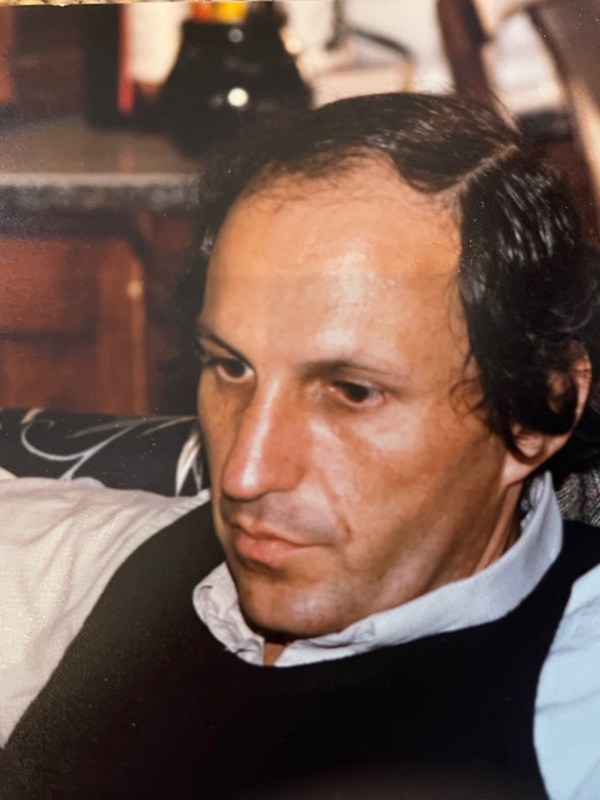
Sheridan Blau
Professor Sheridan Blau died from cancer at his home in New York City on November 8, 2025. He was surrounded by his family who adored him.
Sheridan, who was known as “Shark” or “Sharky” by family and close friends, was born in Trenton, New Jersey, in 1939. His mother, Sylvia Sherman Blau, was a homemaker who was raised in Russia and Poland. His father, Harry Blau, was a first-generation American who worked as an accountant. As a young boy at his first Scouts meeting, when other boys introduced themselves with names like “Avi” or “Label,” Sheridan told his father he’d rather leave than introduce himself as “Sheridan.” “Tell them your name is ‘Shark,’” Harry said, and the name stuck.
Shark was a popular kid, with loads of friends, many of whom followed him to Rutgers University where he studied English Literature. At Rutgers, Shark was a member of the ZBT fraternity. When he became president of ZBT, he enjoyed many liberties, including sending underclassmen to his classes to get the assignments so he could spend one semester in his bathrobe, reading, writing poetry, and hanging out with friends. When his fraternity brother, the former book critic for NPR, Alan Cheuse, brought Bonnie Robitzer to a ZBT party, Sharky fell in love. She was from a five-thousand-acre ranch in Vermont, and he was from a row house in Trenton, yet the match seemed perfect. They were married before their senior years, and, shortly thereafter, their first child, Rebecca, was born.
In spite of his bathrobe semester, Sheridan was an exceptional student and a passionate learner. After graduating, he, his wife, and daughter moved to Boston where he entered the PhD program at Brandeis University. Sheridan adored his professors and became like a son to many. These were relationships he flipped and mirrored as he “fathered” many of his own students for the rest of his career.
While in Boston, his second child, Jessica, was born. Sheridan loved his girls and was a playful father. He claimed that Jessie was such a generic-looking baby that not even her own mother would recognize her if she walked by her on the street. To test this, he once handed Jessie off to a clerk when he saw his wife about to enter the store he was in. As suspected, she was unsure if it was her child and only became certain when she spied Sheridan out the window bent over his knees laughing.
Following Brandeis, Sheridan took his first job as an English Professor at the University of Michigan, Ann Arbor. It was there that Sheridan’s third child, Joshua, was born. Sheridan was a popular and successful professor but yearned for a life out west, so in 1970 the family moved to California where Sheridan joined the English department at the University of California, Santa Barbara.
Sheridan adored his three children, and they adored him equally. He read to them at night, took them to the harbor on the weekends to look at fishing boats and walk along the breakwater, and laughed at the stories they recounted each night at the dinner table. When his grandchildren were born, he was overjoyed. He was a man who got down on the ground doing Legos and puzzles. He went high, too, and climbed a giant tree to make a tire swing for his grandchildren. With the grandchildren, his kids, and anyone else who would join, he hiked all over his property in the mountains of Santa Barbara, where he assigned a cave to each grandchild: a place they could call their own.
He loved taking hikers to the bear cave, which could only be reached by rappelling down a rock wall to the stony creek below. Hikers were encouraged to taste the miner’s lettuce he’d pick; to stroke the glossy, rust-colored bark of the madrone trees; and to use their walking sticks (carved and sanded by him) to examine the animal scat to discern if it was from a bobcat, mountain lion, or bear.
Once, Sheridan fell off a cliff while hiking with his then-7-year-old granddaughter. He caught himself on chaparral jutting out from the cliff side. Sheridan shouted up to the granddaughter to wait for him and then climbed down into the canyon and out again until they were rejoined, both unharmed. Sheridan’s exuberance extended to everything he did; he took in life as if he were an alien discovering new worlds. A trip to the hardware store with Sheridan might take three hours, but you’d walk away with a new appreciation for the beauty of screws and bolts of various sizes and a fascination with the myriad ways to cut wood.
At UCSB, Sheridan taught courses in both the English and Education departments. He was passionate about Milton’s Paradise Lost and spoke of Milton so frequently that his children thought Milton was an uncle who never visited. In 1979, Sheridan founded the South Coast Writing Project (SCWriP), where Sheridan used experiential learning driven by his philosophy that “teaching is the enemy of learning” to train kindergarten through university teachers how to teach writing effectively.
After nearly 40 years directing SCWriP and the dissolution of his marriage, Sheridan and his then partner (later wife), Cheryl Hogue Smith, moved to New York City, where Sheridan took a position at Teachers College Columbia University (TC). There, Sheridan served as Program Chair for English Education and continued to teach Paradise Lost, which he used to help students understand the “dangers of consuming false knowledge.” During his time at TC, Sheridan helped develop Elite Direction, a program that sent TC students to Shanghai, Beijing, and Kuwait where they used Sheridan’s methodology to teach.
Among Sheridan’s many publications are the co-edited environmental reader The House We Live In; the co-authored textbooks The Writer’s Craft, The Language of Literature, and Prentice Hall Literature; three co-edited volumes of What is College-Level Writing?; two co-edited volumes of Deep Reading, Deep Learning; and two volumes on one of his academic heroes (and friends) James Moffett.
Sheridan’s most significant work was the award-winning The Literature Workshop: Teaching Texts and Their Readers, a book whose groundbreaking theories about “performative literacy” gives readers a full understanding of Sheridan’s personal and professional mantra, “confusion often represents an advanced state of understanding.” Sheridan served as President of the National Council for the Teaching of English (NCTE) in 1997 and 1998 and was on the Presidential team from 1995 through 2000. In 2007, NCTE honored Sheridan’s achievements with the Distinguished Service Award.
In 2025, NCTE published Building Literate Communities: In Conversation with Sheridan Blau, a comprehensive collection of essays that honor and extend Sheridan’s contributions to English education. The 2024 NCTE convention included “Heart, Hope, and Humanity: A Tribute to Sheridan Blau.” The book and the session honor Sheridan’s work since the 1960s as he promoted an interactive, collaborative approach to literacy and education.
It wasn’t until he was 85 that Sheridan retired. By his own calculations, he’d taught roughly 10,000 students (some of whom were the children of former students) and 30,000 teachers in workshops across the country and overseas. Add the unknown number of teachers who have studied his many books and articles, and one can see Sheridan’s enormous impact on the teaching of literature and writing.
Outside his career, Sheridan had many passions, the most prominent of which was pottery. He regularly sat at the pottery wheel in his backyard in California and, later, on his patio in Manhattan. With his wife, Cheryl, he was an avid theatregoer and loved to walk their dog on the city streets or in Riverside Park where there is now a bench dedicated to him.
Sheridan was compassionate and generous with all people. He once discovered a naked man sleeping in the bushes near the ocean and brought him home (shocking his daughters) in order to properly clothe the man.
Sheridan will be missed by thousands and thousands of students, teachers, and friends from all around the world. He is an irreplaceable presence and will be a lifelong heartbreak for those who have survived him: his wife, Cheryl Hogue Smith; his daughters, Rebecca Summers and Jessica Anya Blau: his son-in-law, Alejandro Augusto Suárez; his brother, Allan Blau and his wife, Roz Blau; his cousins Spencer Ross, Pat Sellers, and Wendy Levy; and his grandchildren Satchel Summers, Shiloh Summers, Hannah Summers, Maddie Tavis, Ella Grossbach, and Sonia Blau Siegal.
Sheridan’s son, Joshua Blau, died three and a half months before him. And his ex-wife, Bonnie Blau, died three and a half weeks after him.
The world would be a greater place if we all were to live as Sheridan did: with unending enthusiasm, undying passion, bottomless curiosity, an open mind, and a full-to-bursting heart.
Those wishing to attend the memorial for Sheridan should go to https://www.eventcreate.com/e/sheridanblau
In lieu of flowers, donations can be made to the South Coast Writing Project at UCSB in Sheridan’s name.

