
Auctioning the Block:
Battistone Foundation Puts
Seniors’ Homes Up for Bid
As Affordable Homes Head to Auction,
Residents Share Their Stories and Concerns
By Jean Yamamura & Christina McDermott
Photos by Ingrid Bostrom | July 10, 2025
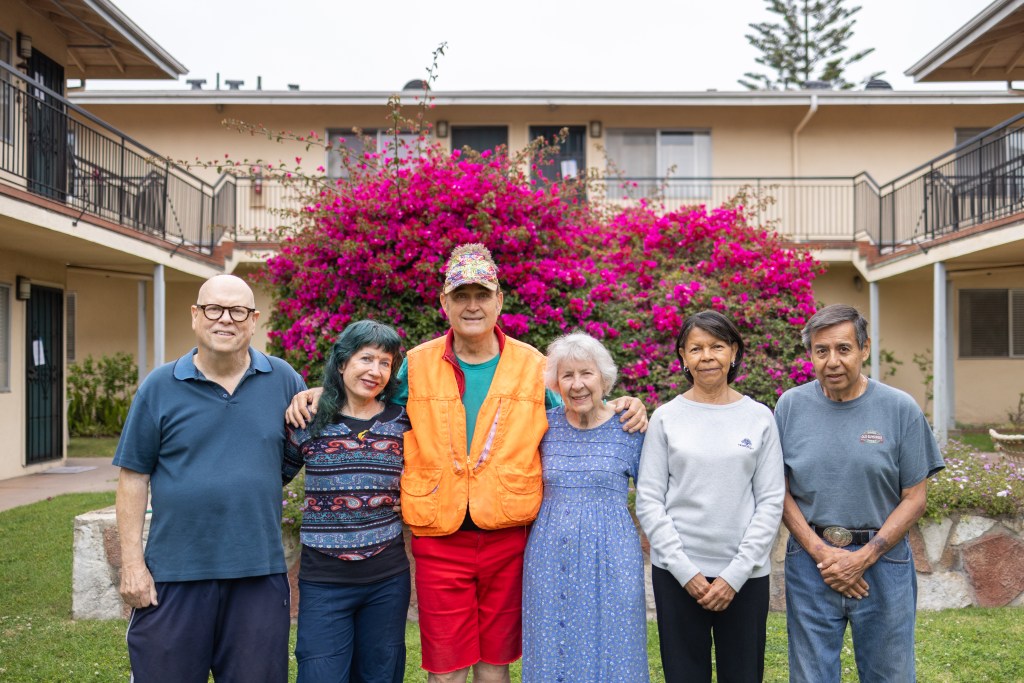
The drone flying overhead this February was an unsettling confirmation of what they had just heard: that their apartments — home to nearly 200 seniors on fixed incomes — were being sold by their longtime landlord, the Battistone Foundation. The foundation had decided to get out of property management and, instead, use the sale proceeds to directly fund housing grants for the elderly.
Property manager Cindy Battistone Hill had repeatedly tried to reassure her tenants that the foundation intended to “take care of them,” but some of them continued to fear the worst: that the buildings would be sold to a developer of luxury apartments and they would be forced out of their homes.
Then, at the beginning of July, the Independent received an email from the Battistone Foundation’s spokesperson that Hill was planning to hold a private auction as part of the second phase in the selling of the properties.
The initial marketing of the apartments — 152 units in downtown Santa Barbara, anchored by the big, pink Edgerly Apartments, built in 1912, and 40 units at the Palm Tree apartments near Cottage Hospital — had been a “phase one” effort to determine the price a buyer might be willing to pay. “Phase two” would be the private auction.
“The Foundation will invite a select group of highly qualified buyers to submit offers for the properties, with an emphasis on buyers who will continue to operate the properties as low-cost housing,” Hill explained in the email. “This private auction will not include an asking price. Instead, each invited buyer will be given a timeline and asked to submit a bid based on their own valuation.”
Although Hill held a Fourth of July lunch with her tenants at the Edgerly the day the Indy ran a story about the auction, no one talked about the auction — the elephant at the garden party. One tenant said he stayed away lest he blurt out an agitated question.
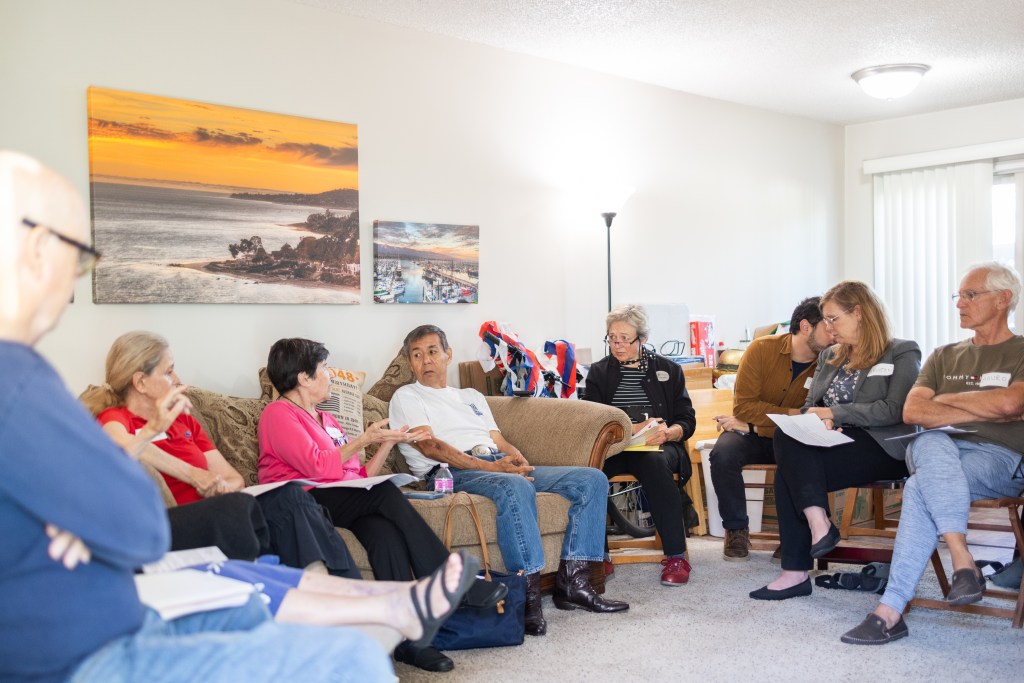
Since learning of the sale, some of the tenants have met regularly to discuss the options they might have. They explained their plight to the media, the Santa Barbara Tenants Union, and city councilmembers. In late June, they held a press conference to announce their quest for an “angel” investor to help fund a purchase and keep them in their homes.
Of the auction, the seven-member board of the Edgerly Tenants Association said, “It is our heartfelt prayer that the Edgerly properties continue to support and house our low-income senior tenants for past and future generations, as it has for 100 years. If they were sold to a developer, our city would lose nearly 200 low-income apartments. We worked hard to help Santa Barbara grow and thrive — we deserve to retire and spend our golden years here.”
The marketing materials for the Battistone Foundation properties describe the Edgerly complex as nine properties that date from 1876 to 1977, with 85 parking spots and an initial offer of $65.6 million. The nine parcels occupy the majority of the block bordered by Chapala and De la Vina, and West Sola and Victoria streets, just one block from the city’s iconic State Street. The Palm Tree apartments on De la Vina Street contain three buildings built in 1971 with 34 parking spots and a listing of $17.9 million.
Hill is the granddaughter of Sam Battistone Sr., who amassed a fortune from his Sambo’s restaurant chain and in 1968 established the foundation in honor of his parents to care for elderly people “in their Golden Years.” At one time, the Sambo’s restaurants numbered more than 1,000 across the country. The name was formed by combining Sam’s name with his partner’s, Newell Bohnett, an innocent-enough decision, but one marred by accusations of having racist overtones. The company declared bankruptcy in 1981.
The one remaining restaurant on Cabrillo Boulevard is run by his great-nephew, who renamed it Chad’s Café. The Battistone Foundation, however, remains as Sam Senior’s enduring legacy.
While the mission of the Battistone Foundation has been, over the last half-century, a godsend for thousands of retired Santa Barbarans, it’s always kept a low profile. In recent years, applicants only learned of vacancies through word-of-mouth. The buildings and grounds are well-maintained, and Hill is widely regarded by her tenants as a sweet and kind woman. But her announcement of the sale threw many of them for a loop.
Many are deeply distressed that they might lose their homes, which are conveniently close to bus stops, markets, and entertainment. Over the years, they had formed a community of friends and neighbors, all living independently, enjoying their “Golden Years,” just as Sam Senior had wanted when he set up the foundation more than 50 years ago.
The Battistones’ apartments accept tenants from the age of 63, and some have lived there for decades — teachers, nurses, sales people, and film fest volunteers among them. A one-bedroom apartment currently rents for $1,600, well below the market rate.
If the foundation succeeds in finding a buyer who will keep the rents affordable, the tenants would be able to keep their homes, and the foundation would be free to use the proceeds to support the rents of more seniors, as its five trustees originally conceived.
But, should the generosity of strangers fail to materialize, tenants are protected to some degree by state and city laws, said City Attorney Sarah Knecht. A new buyer can only raise rents annually by no more than 10 percent. And, should a wholesale makeover occur, or a “renoviction,” Knecht said the city’s new ordinance requires a 12-month “cooling-off” period before any eviction proceedings could begin. Once the renovation is completed, tenants would have the right to return to their apartment, and the rent could go up by no more than 10 percent.
As of this writing, the time of the auction or who might be on the “private” list remains unknown.
— Jean Yamamura
Tenants Share Their Stories
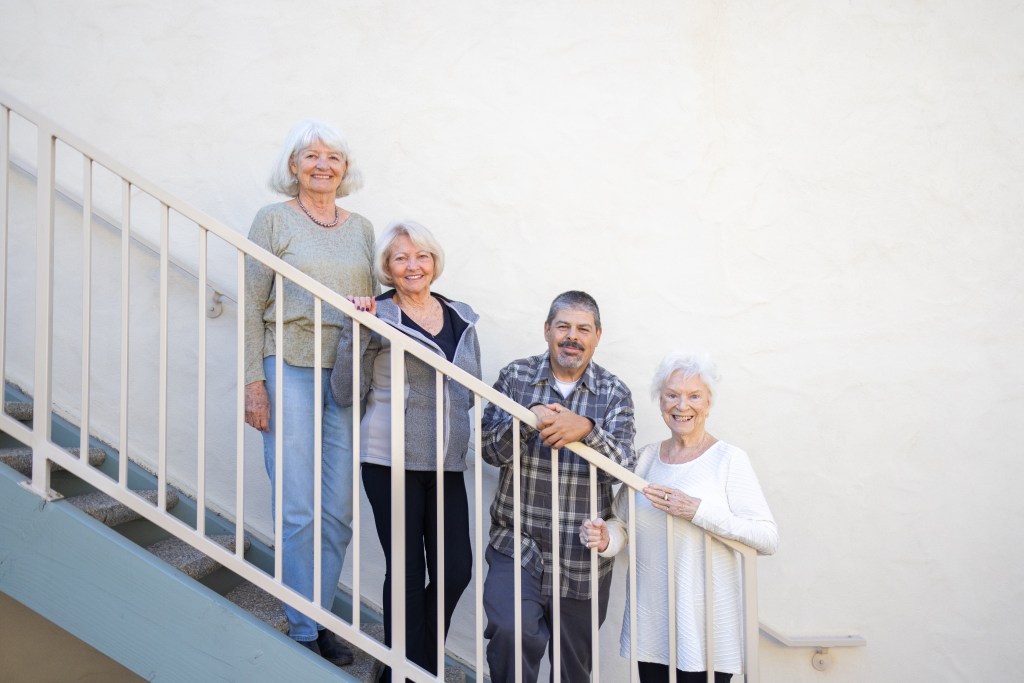
It is easy, in housing stories, to focus on the property — its size or its cost or what can be built on it. That’s important, but it doesn’t show enough of the picture. Information about the people who live there gives a place history, reveals the role it plays in our community, and generally tells a fuller story.
I had the chance to sit down and talk with several of these seniors. Many have lived and worked here for decades. Each one told me they felt lucky to live where they did. Many of them said they were grateful for the Battistone family, as well as the building’s maintenance staff and supervisors, for the care they take in running the buildings.
Here are some of the Battistone residents’ stories.
— Christina McDermott
Nina
Nina welcomed me into her apartment by offering me a glass of wine (which I reluctantly declined) and a comfortable seat in her living room. Art decorated her walls, and a sliding door opened to her patio full of lush plants, a canopy, a mini fountain, and secluded spots to sit. She created and maintains it herself.
Nina is of Italian descent but was born in Cuba. As a child, she and her family came to the United States — first to Connecticut and then west, settling in Santa Monica and then Solvang, arriving in Santa Barbara in 1965. Here, she worked, eventually owning her beauty salon on State Street called New Image for 15 years.
Nina said she and her family had lived in different places around Santa Barbara, moving each time the rent increased past what she could afford. Then, in 2011, she heard about the Battistone apartments from a friend, reached out to management, and, after an interview, was offered a spot. She’s been there ever since.
“It is wonderful to be here,” she said. When she first arrived, she and the longtime manager, Gene Marasco, were able to speak to one another in Italian, and she felt right at home. “It was peaches and roses from there on,” she said. Nina made friends and found it such a “good place … especially being retired — all of my children are grown up.”
At her apartment complex, she has a close group of friends she sees regularly. Her building’s manager is Italian, too — something they bonded over — and an opera singer. She said that she and other tenants took unofficial classes from him.
“We learned all about different operas and listened to them. It was beautiful. He would sing to us,” she said.
The cost of living in Santa Barbara is high. Nina said she feels blessed to be living where she is.
Beryl
Beryl’s ties to Santa Barbara are deep ones: She grew up here, as did her mother. Her grandparents owned a converted apartment building on Cota Street. She remembers attending McKinley Elementary, biking to her friend’s house after school, and, in summers, going off the high dive that used to be at Los Baños del Mar pool. When she grew up, she lived in other places — Ventura, Louisiana — but she came back to Santa Barbara, where she worked different jobs in the area before spending about 25 years employed by the post office.
Beryl’s an avid softball fan. She was a member of one of Santa Barbara’s first girls’ leagues when she was in 7th grade (the Bellwood Belles) and played on local teams for years (not to mention an All-American team when she lived in Louisiana). She’s still friends with some of her Santa Barbara teammates from the ’70s. The sport seems to be a family tradition; her daughter played softball, and now, Beryl attends her granddaughter’s games.
Beryl has lived in the Battistone apartments for years now. She helped raise her grandchildren there. “What do you find at Grandma’s house? Security. You’re going to have a warm meal, security, and you don’t have to worry about the outside world. And that’s what this place was [for my family],” she told me.
Beryl said she’s seen Santa Barbara get less affordable in her lifetime. Living at the Battistone apartments is possible for seniors on fixed incomes, she said. But that’s not true for most of the city.
Joyce Brooks-Kazie
When Joyce Brooks-Kazie was a young woman ready to leave her home state of Michigan, she flipped a coin — heads, New York; tails, Los Angeles. She got tails and journeyed west. In L.A., amid a marriage, divorce, and a second marriage, she ran her own boutique clothing store.
After her second husband passed away, her daughter, who was living in Santa Barbara, convinced her to move in. She made the trip north. For years, she helped with her grandchildren and worked as a preschool teacher in the community. And for years, 22 of them, she has called her apartment home.
Gradually, she said, she started meeting her neighbors.
“It started to really hit me how amazing this place is,” she said, later adding, “It’s the beginning of new life really coming here. And you know, I just had so much gratitude. I was so grateful.”
Brooks-Kazie said she made a tight-knit group of friends that took turns cooking meals for each other. The wider community had moments together too: During the COVID-19 pandemic, folks would stand outside their homes to hear the manager sing opera from his front patio.
Her group of friends continues to evolve as new people move in and older ones pass away. She even held her wedding to her third husband here.
Now, Brook-Kazie and a few others meet on Saturday afternoons to chat.
“Everybody has their apartment, but it’s really a community,” she said. “We help each other. If somebody needs a ride for a doctor’s appointment or market or whatever, we help in those ways.”
Old age, Brooks-Kazie said, can bring loneliness.
“But chat time helps so much,” she said, adding, “It makes such a difference even if you say hi to somebody just once in the day.”
Brooks-Kazie said that news of the sale was a shock, but after taking time to reflect, she’s calmed down. More generally, Seniors on a fixed income, she said, lack options when it comes to being priced out of their local areas: it’s hard to get hired at 80, after all.
David Diaz
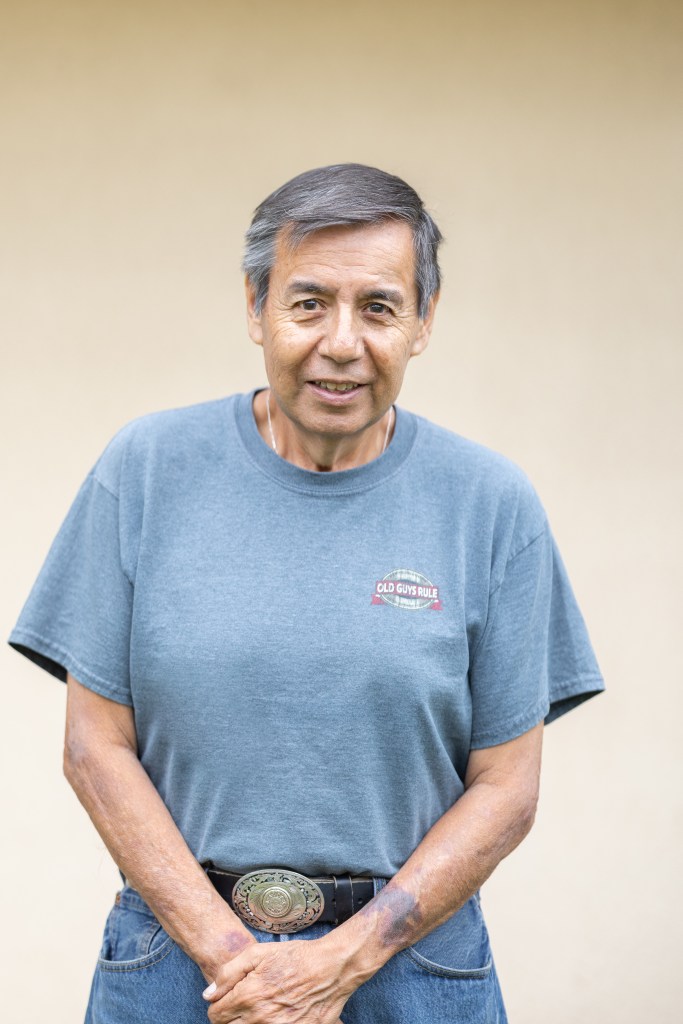
In one of those twists of fate, David Diaz tells me he actually shook Samuel Battistone Senior’s hand about 50 years ago at a church breakfast.
“My best friend was working for him and asked me, ‘You want to meet a millionaire?’ I’d never met one — I was 18 years old — [I said] ‘Yeah, sure!’ ” he said.
Diaz was born at St. Francis Hospital and raised in Santa Barbara. As a young man, he joined the military, completing more than 80 combat jumps in training and served in Germany, starting in 1969, when Soviet troops invaded what is now the Czech Republic. As a veteran, Diaz married and went to work for the power company in Price, Utah, for about two decades before returning back to his hometown. In Santa Barbara, he worked as a gardener and a security guard, including at the Santa Barbara Bowl. He moved to the Battistone apartments about six years ago.
Diaz is a creator. He built a patio garden space just outside of his current apartment for anyone to use, fixes his neighbors broken objects, and repurposes discarded jeans, sewing them into aprons, purses, and beach blankets.
Like many of the Battistone residents, Diaz prizes his apartment’s prime location. “I live here in town. Buses are right here. State Street’s two blocks away. I can walk down State Street all the way to the beach with no problem. Why do I need to drive?” he asked. Diaz gave up driving and now only uses public transportation, including taking buses to visit his kids, one of whom lives in Ventura.
When asked about the sale, he said a lot of people here have nowhere else to go, and the majority didn’t expect to ever move again.
“I’d say about 80 percent to 90 percent of the people here had always thought this was their last home,” he said, himself included.
Craig Griffith
Craig Griffith first arrived in Santa Barbara County as a young man by way of Vandenberg, where he was stationed at the air base in the ’70s. Santa Barbara became his home base — Griffith went on to travel parts of Latin America and for decades worked nine months of the year as a language instructor in China.
In 2019, Griffith moved back to Santa Barbara full-time. For years, he tried to get a Battistone apartment before finally securing a place.
Griffith is a lifelong teacher. He still tutors twice a week and advises young instructors who took over his business in Shenyang, China.
Now, with the possibility of the sale looming, Griffith said he’s seen his community struggle with the uncertainty of what happens next. “You can see our spirits degrading over time. We’re not as active,” he said, adding, “It seems like it’s wearing us down.”
Society as a whole, Griffith said, doesn’t prioritize its low-income seniors, even though many people grow to be them — especially in high-priced Santa Barbara.
“Old people tend to disappear. They tend to be shunted aside,” he said, adding, “I don’t know why. I suppose I was the same way when I was in my thirties, but it mystifies me.”
Maria Carvalho
When Maria Carvalho and her husband moved from Rio de Janeiro to California 14 years ago to help raise their grandchildren, one U.S. dollar was about 1.7 Brazilian reals. Today, one U.S. dollar is about 5.7 reals.
“So, I conclude that we are about five times more poor than when we first arrived,” Carvalho said.
The Carvalhos lived in Pasadena with their daughter and grandchildren for about seven years before the whole family moved to Santa Barbara in 2017. Carvalho and her husband were renting an apartment on De la Vina Street, but as their rent climbed, they began looking for somewhere they could afford to stay put.
One day, she was walking by one of the Battistone properties when she had the chance to speak to a resident, who told her if she and her husband qualified financially, they could apply to live there. So Carvalho started applying, and after about four months, they managed to get a spot.
Their apartment is small but suits two people, she said. And the location, Carvalho said, is more important to them.
“We are near everything. I go to my doctor; I go to my dentist; I go to the park; I go to the bank; I go walking,” she said.
The Carvalhos stay active. Maria Carvalho does yoga and takes language classes — English and French. Her husband is an avid cycler. She is still around to help her family. Although her grandchildren are older now, she’s able to help her neighbors.
Not everyone, she said, is so lucky to have family nearby, or an external support network. For many, she said, the uncertainty of the sale causes deep stress.
“You can see our spirits degrading over time. We’re not as active.
It seems like it’s wearing us down.” — Craig Griffith
Karine Anderson
Karine Anderson taught elementary school in Santa Barbara for about two decades.
“I see [my students] all over town,” she told me, adding, “and they are adults in many different jobs. It’s wonderful.”
As a teacher, she rented a room in a house, a garage conversion, and finally an apartment on Sola. Along the way she got her master’s degree in social justice.
Health challenges forced her to retire from teaching earlier than she anticipated, and healthcare costs ate into her savings. When her Sola apartment building sold, her monthly rent expense jumped. Some of her friends had already moved to the Battistone apartments. For four years, she waited to get a spot that worked for her. She moved into her cottage in 2018.
Today, Anderson remains active in her community: She goes to church, does yoga, takes classes at SBCC, paints, and volunteers at Santa Barbara’s visitor center.
“I’m still active; I’m still learning. I’m still living,” she said.
She said her friends at the Battistone apartments support one another. As we sat chatting for this interview, two friends popped by to say hello to her.
But Anderson said that for many of her community, there isn’t a simple place to go if the building sells and they have to move. Many people can’t afford to pay market-rate rent, and many don’t have extended family on-hand to help.
Anderson said the news of the move also prompted her to think about the bigger picture: where future generations can go as they age.
“I’m thinking about your age group — thirties, forties, fifties — all the things that will transpire in your lives and where you’ll end up,” she said. “Where you’re living, how your health [will be] when you become 65 or older. I want to know that there’s a place for you.”
EL
Sometimes, you know when you’re talking to a good teacher — someone who is patient, listens, and can offer instruction with kindness. That’s my impression of EL. And, well, she was a teacher. For decades. She tells me that when she first started teaching in 1961, her salary was about $4,800 a year. Throughout her career, EL also started three Montessori schools in the Sacramento area, ran her own teacher workshop program, and taught university-level classes for teachers.
EL was driving home from a teachers’ conference in L.A. one night in the ’90s, when she stopped to spend the night. Here, she said, she found home. She went for a bike ride in Alameda Park and saw a “for rent” sign. Initially, the rental was for six months. She lived there for 10 years.
She found her way to the Battistone apartments about 22 years ago. She likes the location and spends time with a few close friends who live nearby.
“You cross the street to the world,” she tells me — the library, nearby parks, the courthouse, the post office, and movie theaters, all within walking distance.
She said she appreciates the support and maintenance staff who care for her building, and the area around it, too.
The prospect of the sale, she said, has caused acute stress in her community. But she knows there isn’t much she can do right now so, she may just have to let things unfold.

Pali X Mano
Back in 1988, when Pali, on a visit from his native Hungary, was hitchhiking across the United States and Canada, someone told him, “If you’re an artist, you need to go to Santa Barbara.” So, to Santa Barbara he went. He spent a week here, and in that time created a clock using a U.S. dollar. As it turned out, President Reagan was in town, and he wanted to give it to the president.
“I took this United States dollar clock to the Biltmore Hotel, and they examined it, and then they accepted it,” and said they would pass it on to the White House crew.
Several months later, back in his native Hungary, Pali received a highly decorated thank-you note from Ronald and Nancy Reagan.
About two years later, Pali returned to Santa Barbara, this time as a permanent resident. When he learned the Summer Solstice celebration was looking for artists in residence, he submitted his portfolio. “And right away,” he said, “they chose me to do the first ensemble and the last ensemble.”
That year, he created a giant jellyfish, complete with inflatable tentacles, as the first float. For the parade’s final float, Pali said he made 60-foot deep-sea fish with children moving waves and dressed as other fish.
Pali has done the final float in the Solstice Parade ever since (this year, he created a 35-foot inflatable elephant). Over time, he’s worked as an artist, a tutor at Santa Barbara City College, and a caregiver for other artists. He met his partner, Raven, in 2018 when teaching a yoga class at the Jewish Community Center.
Pali said he had the opportunity to move into the Battistone apartments with Raven about five years ago, and that he loves the location, both for his work and his health.
“It’s very close to cultural programs,” he said, as well as to the downtown farmers’ market. “[The] farmers’ market is a favorite for fresh produce. It’s important for us, healthy eating, because it extends life,” he said.
If rent increases past what they can afford. Pali says he and Raven will have to consider leaving Santa Barbara. For now, he will keep making art.
Shyama Osborne
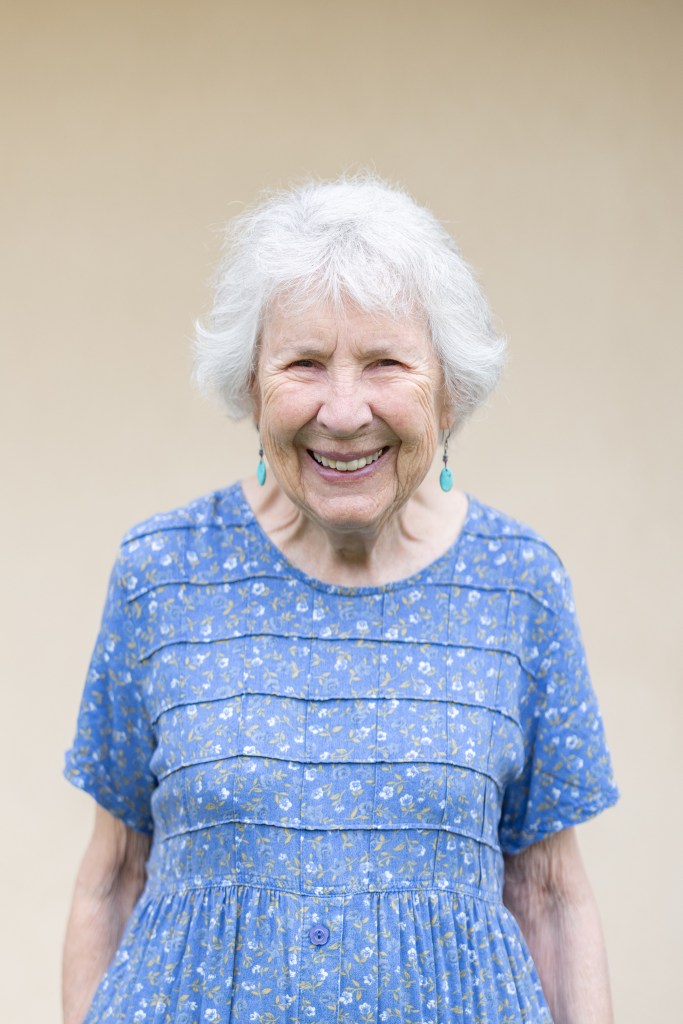
When I sat down with Shyama Osborne on her patio, she said that her friend reminded her to tell me about her experiences at the 1941 Pearl Harbor bombing. She was a little girl — not quite 6 years old — and her father was stationed at the base in Honolulu.
“It was Sunday morning, and, we were in my parents’ bedroom. My father was reading the funnies to us. The house started shaking, and we heard booms.” Her father held her up to the small bathroom window to see the smoke and flames before reporting for duty.
In 1950, Osborne and her family moved to Santa Barbara, when the area around Las Positas was still pastureland. Her first job was at the Irene Davis Bakery near the courthouse. And her’s was the first class to attend UC Santa Barbara at the Goleta campus in 1954.
For years, Osborne worked within the Santa Barbara Public Library system. After her divorce, she finished her bachelor’s at UCSB and then went to USC earning a master’s in library sciences. When she returned to Santa Barbara, she worked as a librarian, eventually running the bookmobile, and finally became the head children’s librarian.
Osborne traveled in Europe and Asia, as well as across the United States, and she lived in other cities before returning to Santa Barbara permanently in 1996. She’s lived in the Battistone apartments since 2017. “It was such a relief to be here,” she said.
Osborne knits and crochets clothing for the Unity Shoppe, which is in walking distance. As is the grocery store and the library. “This is such a nurturing place, supportive place for older people, and it’s so handy if you can’t drive anymore, like me,” Osborne said, adding. “I can catch a bus all the way out to Foothill, where I can have my eye exam, where I can have my ear problems looked at, or I can get off at Cottage Hospital.”
Osborne uses Section 8 vouchers — which she said have been a godsend to her while living in Santa Barbara. The wait list for Section-8 housing, she said, is currently closed. That means that if she has to move, it will be more difficult finding somewhere she can afford.
Raven Wylde
Raven Wylde is a poet and an artist. She and her family moved to Santa Barbara when she was in middle school; she attended Goleta Valley Junior High, Dos Pueblos High School, and Santa Barbara City College, where she earned an associate’s degree in nursing and graphic arts. She later went on to earn her bachelor’s in nursing at Stanislaus State.
Although Wylde has called other places home, she’s returned to Santa Barbara throughout her life. For years, she worked at Cottage Hospital as a neonatal nurse, as well as at St. John’s Hospital in Oxnard and Sansum Pediatric Clinic. She spent time as a maternal child public health case manager for Santa Barbara County. Here in Santa Barbara, she raised her kids and was a foster mom along with her own mother. She even started her own cat-sitting business, which she ran for 10 years.
Her most recent move back to Santa Barbara was in 2018 to help her mother. Here is where she met her current partner, Pali.
Wylde paints and writes poetry — mostly inspired by her memories, with bits of philosophy interspersed, she said. Her apartment is full of the art she and Pali have created. They have lived there for about five years.
“It’s just the best thing to be able to live in this beautiful apartment downtown where I can get to everything,” she said. That includes the Solstice workshop, where Raven helps put together floats and costumes.
She said she feels secure here, surrounded by good people and with responsive management.
“I keep hoping someone’s going to buy it that will keep low-income seniors here, and that’s the uncertainty, I think,” she said. “Because we can’t control when they sell it, or what [new owners] will do with it.”
Mary Harris
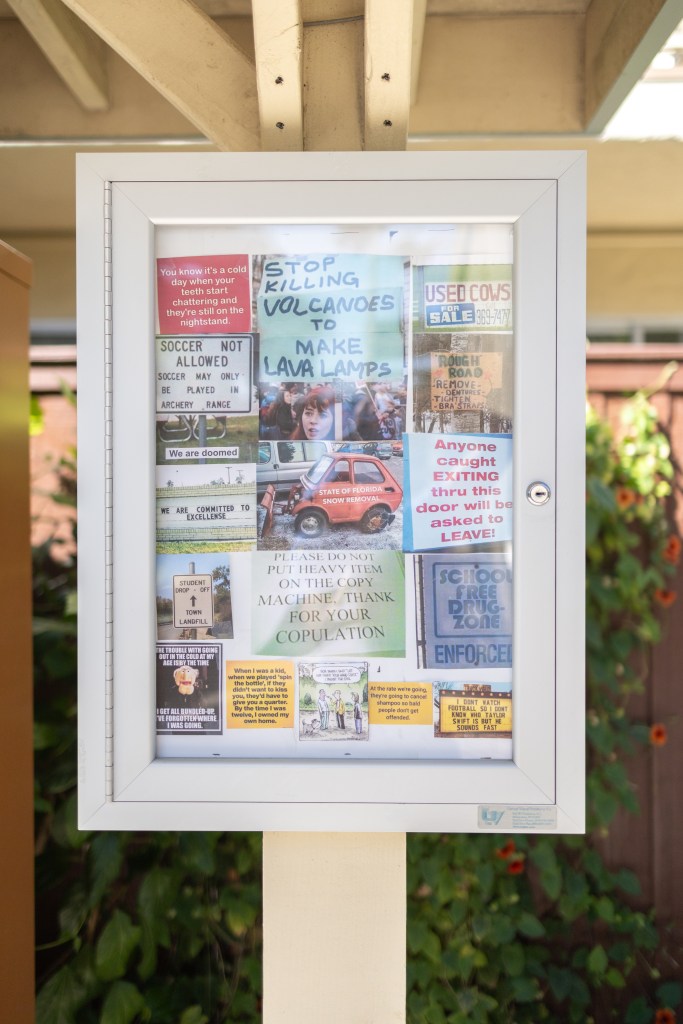
“For me, the location [of my apartment] is intimately tied to what I do,” Mary Harris told me. Harris knows her community’s cultural scene well, from film to music to food.
She came to Santa Barbara County from New England 17 years ago, settling in the Santa Ynez Valley near her sister. For seven years, she called Santa Ynez home, as the executive director for Visit Santa Ynez Valley, a tourism group. She said the group started small with modest means, but eventually received a TBID (Tourism Business Improvement District) approved for the area, which helped the organization take off.
Harris also developed strong ties to Santa Barbara; she worked as a fundraiser for the State Street Ballet, coordinated with folks in the Santa Barbara travel industry and, of course, enjoyed the art and performance Santa Barbara has to offer, regularly attending events in town. The 40-minute commute could be tough, though. After seven years, she decided to make the move to the city.
Harris said she scoped out the Battistone apartments, putting her name on the wait list and introducing herself to management each time she was in town. When an opening came up, she jumped at the chance. She’s been in her apartment ever since. This area is her home.
“There is no question that one of the perks of the Battistone [apartments] is location. I mean, it’s phenomenal,” she said. “This is my neighborhood. This is where I live. This is where I buy things. This is where I know everybody in all the restaurants.”
Harris stays active in the art world. After moving to Santa Barbara, she spent six years as a county arts commissioner, helping distribute funds to artists and performance groups across the county. Now, she works for the Music Academy of the West as a house manager and is on the VIP team for the Santa Barbara International Film Festival.
Downtown living, she said, is walkable. It’s kind of like living in Paris, she said, in the sense that necessities and art and entertainment are all within reach.
“Everything you could ever want is within 15 minutes if you live downtown,” she said.





You must be logged in to post a comment.