
Dancing with Color and Light
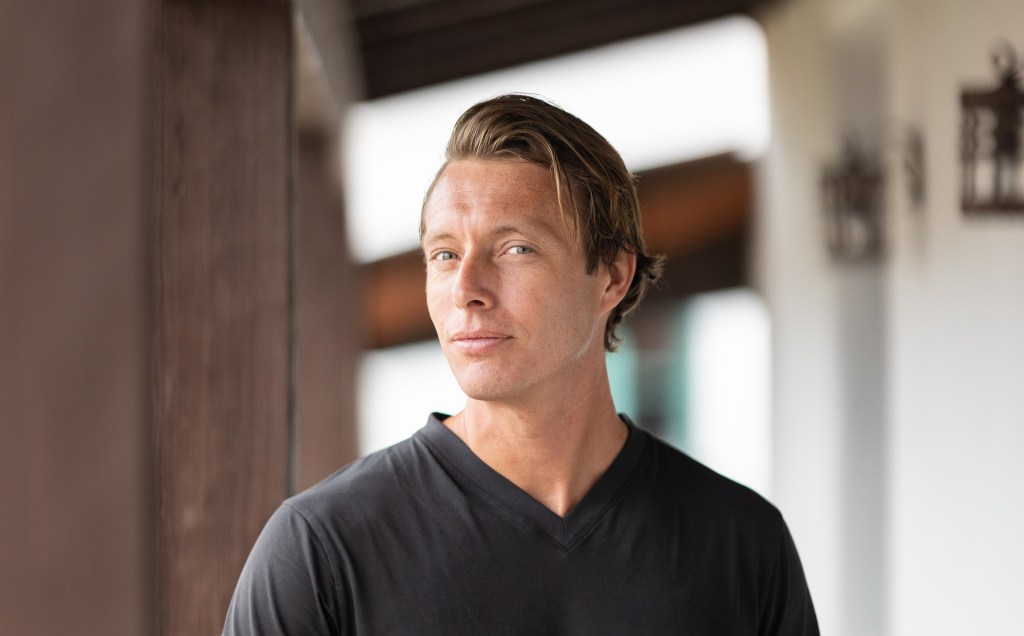
Artist Derek Harrison Paints
The Spirit of Fiesta
By Roger Durling | Photos by Ingrid Bostrom
July 24, 2025
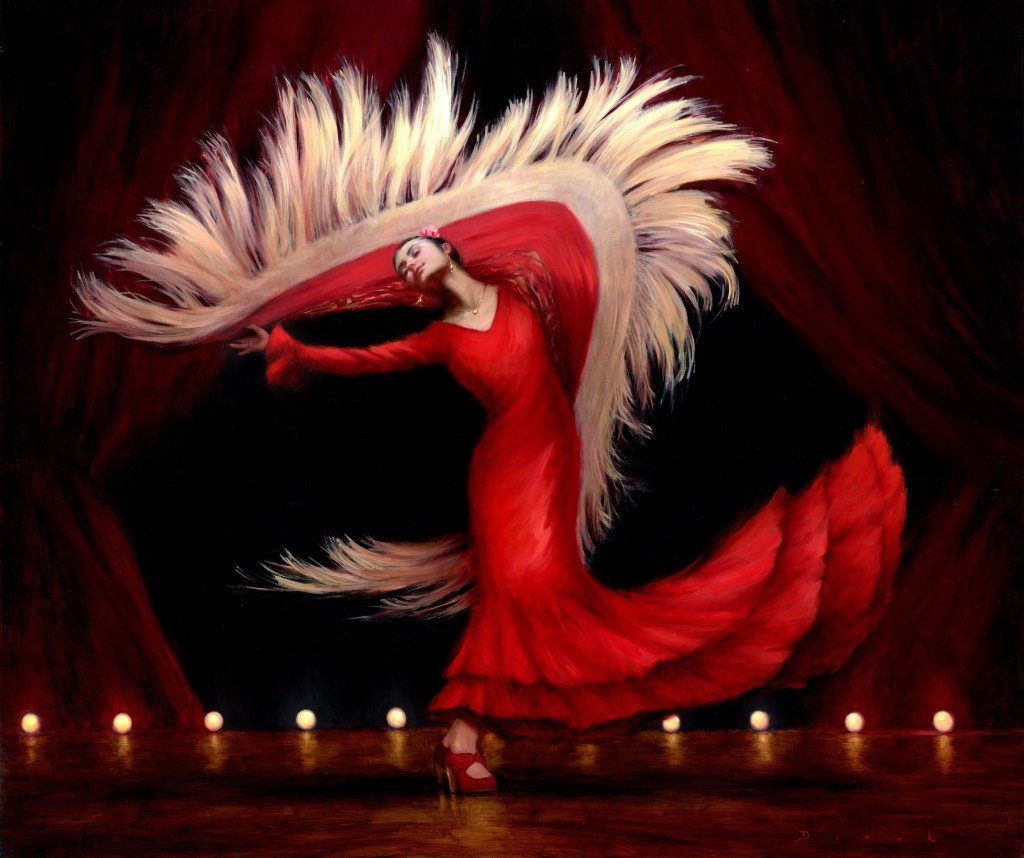
“The Spirit of Fiesta” painting, which adorns this year’s official poster for Old Spanish Days, features a dancer suffused in a light that seems to emanate from inside of her. She is in a pulsating pose, with her dress spinning while her right arm extends to hold a mantilla that swirls all around her. Her body and shawl form a dynamic letter “S” in the middle of the frame — and it is this shape that builds a sense of propulsion in the composition. The painter’s brushwork enhances the movement and urgency, with austere contrasts between light and darkness that highlight the dancer’s form and the power of the performance. The supple paint strokes subsidize the painting’s vivacious, almost improvisational feel. The artwork is practically monochromatic — her dress is red; the curtains behind her are a deeper crimson — and the background is almost pure black. The lack of a barrier between the viewer and dancer helps create the illusion that we are present at the actual event.
The creator, artist Derek Harrison, was inspired by the flamenco dancing he’d witnessed and studied in the past during Fiesta. But he was particularly influenced by John Singer Sargent’s masterpiece “El Jaleo” (1882) — on display at Isabella Stewart Gardner Museum in Boston — which similarly depicts a Spanish dancer performing to the accompaniment of musicians. Sargent’s inducement on Harrison goes deeper. The dramatic usage of the several contrasting red tones in Harrison’s work recalls another Sargent masterpiece, “Dr. Pozzi at Home” (1881), which illustrates a doctor in a sensuous scarlet robe standing in front of a burgundy curtain. Red is a color that evokes strong emotions, and its use in the Fiesta painting contributes to the overall sense of vivacity and intensity.
This year’s Fiesta poster, in my humble opinion, is the best ever, and the painting used in it is a notable example of Harrison’s skilled ability to capture the heart of the subject through classical technique and a sharp eye for specificity. As you observe the work, you can almost imagine hearing the sound of the zapateado (footwork), pitos (finger snaps in flamenco), palmas (hand clapping), and possibly the echoes of the cante (singing), and toque (guitars). There’s drama in this canvas: mood, energy, and strong, visceral arrangement.
“I always try to do that with my paintings,” Harrison tells me. “I always try to get as much drama into my paintings as I can.”
One of the special privileges of serving as El Presidente of Old Spanish Days is the opportunity to create the official Fiesta pin and poster. This tradition was started by the 1976 El Presidente Rudy Castillo Sr., who was the Grand Marshal in the 2024 Historical Parade and who passed away in January. The design typically reflects a personal touch from the leader — whether that’s a favorite color, a hobby, or even a beloved sports team.
This year’s El Presidente, Fritz Olenberger, wanted to incorporate his photography, as he is well-respected for it. “I actually began planning this year’s design around March of 2024,” said Olenberger. “Out of all my photographs, I wanted to choose one that projected energy, movement, and joy. I considered using the photograph itself for the poster, but opted for a painting of it because I thought a painting would be more appropriate for a poster.”
Olenberger wanted the artist doing the honors to be of museum quality, and particularly good with portraiture. He called his friend Diane Waterhouse at Waterhouse Gallery for help. She recommended Derek Harrison without hesitation. Then she arranged for the three of them to meet at her Montecito gallery.
“I looked at his work on the web and also at her gallery when we met,” Olenberger recalls. “The quality of his paintings and the realism is outstanding. I was convinced he was who I wanted before I even met him, and at our meeting, he was quite friendly and enthusiastic about the project.”
Painters in the 1800s longed to present their work at the Paris Salon, for it was a major cultural event, attracting tens of thousands of visitors each year. Exhibiting there provided an artist with unparalleled visibility and an opportunity to have their work seen and discussed by a wide audience, including critics and potential patrons. John Singer Sargent’s prestige was established in 1877 when he first presented his work at the Paris Salon. Today in Santa Barbara, for a young up-and-coming artist, there’s no close equivalent break to make a big splash. Yet Fritz Olenberger may have created a similar chance by bestowing young and gifted Derek Harrison with this showcase in this year’s Fiesta — Santa Barbara’s most prominent cultural event.
“Fritz wanted it to be a classical oil painting, not a graphic design,” Harrison said, understanding the importance of the assignment. “I tend to hold myself to a high standard. I wanted it to be something special.”
La Vie Boheme in Santa Barbara
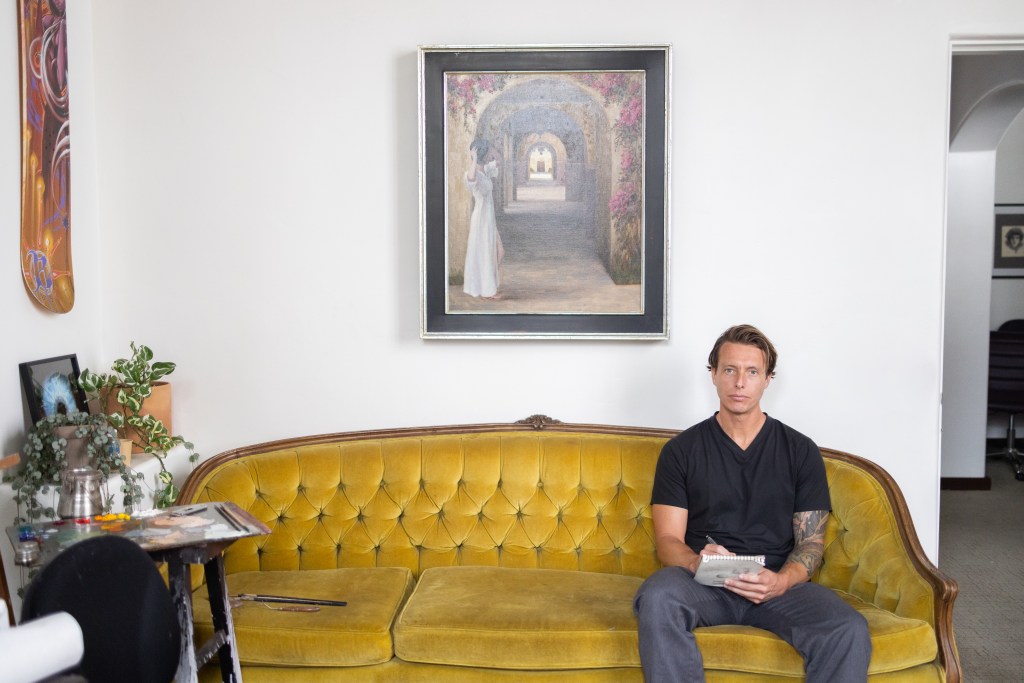
I came across Harrison’s work about a decade ago. Most of my lunch hours are spent walking through downtown Santa Barbara and checking out art in our galleries. I kept noticing his remarkable figurative paintings (a type of art that depicts recognizable objects and scenes from the real world, particularly the human figure) at the Waterhouse Gallery. When I asked Diane Waterhouse about Derek Harrison, she urged me to go visit him at his studio. That same day, as I walked back to my office, I decided to stop by, as his studio was close to the Arlington Theatre and on my way.
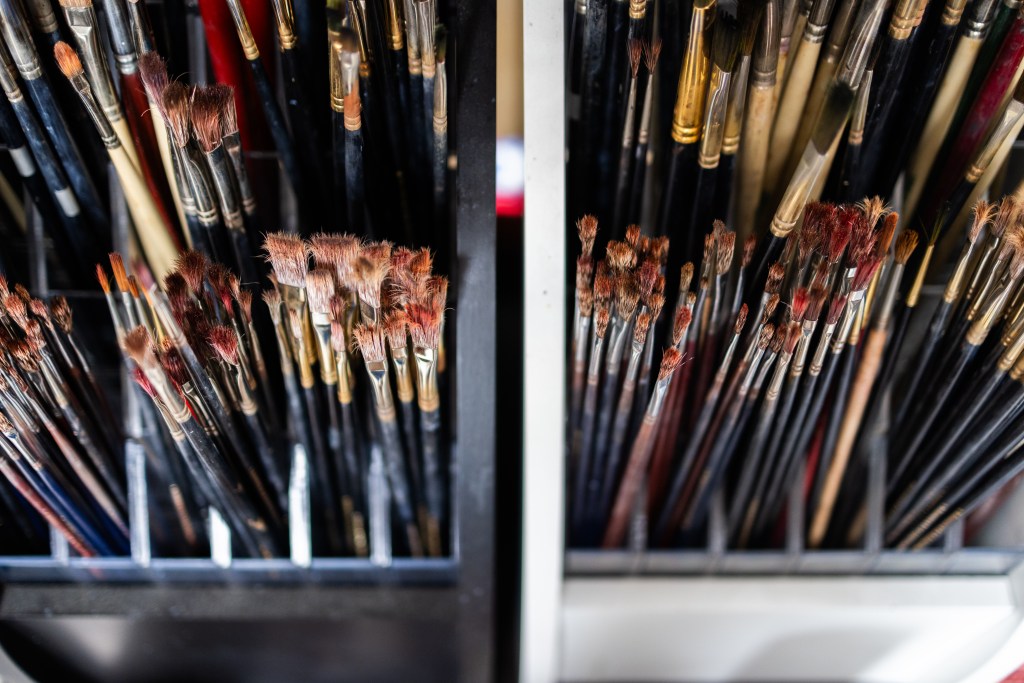
The young artist worked in a walk-up, and — to my surprise — his art studio was also his apartment. The setup was something you’ve seen in movies about the Parisian Belle Époque. There was a corner that was dedicated for his models to sit and pose, with spotlights and a backdrop. There were several easels scattered about and next to this arrangement, there was a bedroom and a small kitchenette.
“I like to be immersed in the art environment,” said Harrison. “I don’t like to separate myself from it. I never feel like I’m at home. I just need a place to sleep in. I try to put it all into my work.”
When conversing with him, he unhesitatingly discusses John Singer Sargent and how much his portraits have shaped him. Harrison shares how Rembrandt has motivated him to do a self-portrait of himself once a year since he started painting, and we chat about Caravaggio’s usage of chiaroscuro (strong contrasts between light and dark). He venerates all of these classical painters and has studied at length.
“Derek admires the Old Masters because of their immense talent, craftsmanship and skill,” said Diane Waterhouse. “Their artistry was astounding.”
Harrison divulges his motivation for painting in the classical style that he does: “I want to expose people to the way I felt when I saw the works done by the masters.”
Tattoo Artistry Meets the Masters
Harrison’s roommate for a while was Danny Meza, the renowned tattoo artist and muralist who passed away last April. “We were coming up together in Santa Barbara,” said Harrison. “We shared that space the majority of the time. All we talked about was art, history, technique. We barely had a social life. All we did was paint. He helped me see things differently. He brought things out in me I was lacking and vice versa.”
Harrison himself began as a tattoo artist. “That’s how it all started,” he said. “In 2005, I was 22 years old and working at a fitness center in Steamboat Springs, Colorado. I was sketching on a pad, and a tattoo artist who owned a studio called Truth Tattoo offered me an apprenticeship.”
It’s very hard to be hired as a tattoo artist. You start by going to art school. Harrison was untrained and unschooled — yet he was tapped to become one. He was supposed to be in a year of training, but it took him just four months to get ready to be on the floor working. (He has a tattoo of Quentin Tarantino above his knee that he did himself as he was learning.) “When I began tattooing, I started to take art more seriously,” he said. “Art became a complete obsession.” He’d taken basic drawing class in high school but had had no formal training in art — yet tattooing taught him a lot. “I learned about composition, balance, and color,” he explains. “I did it the backwards way. Tattoo artists study art and then become tattoo artists. I didn’t know it yet, but painting was what I ultimately wanted to do.”
I urged him to elaborate on the ways that tattooing prepared him to be a figurative painter. “You learn about the rhythms of the body — the flow of the biomechanics of the body,” he says. “It translates very well to figurative painting. Posing the model is 75 percent of what makes the painting good.”
After a few years in Steamboat Springs, he decided to move to California because he knew there were better artists here. He got a job at Energy Tattoo, and they offered him an apartment above the shop to live in. In the meantime, he started taking art classes and paint workshops in L.A. — specifically at the Los Angeles Academy of Figurative Art. A highly regarded tattoo artist named Shawn Barber had a painting by American realist painter Jeremy Lipking. His work so impressed Derek that he reached out to him about taking classes from him, and he ended working for him about a year as an assistant. “He taught me most of what I know,” said Harrison. “He brought me into the fine art world.”
Coincidentally, Jeremy Lipking was represented by Diane and Ralph Waterhouse in our city.
Figuratively Speaking
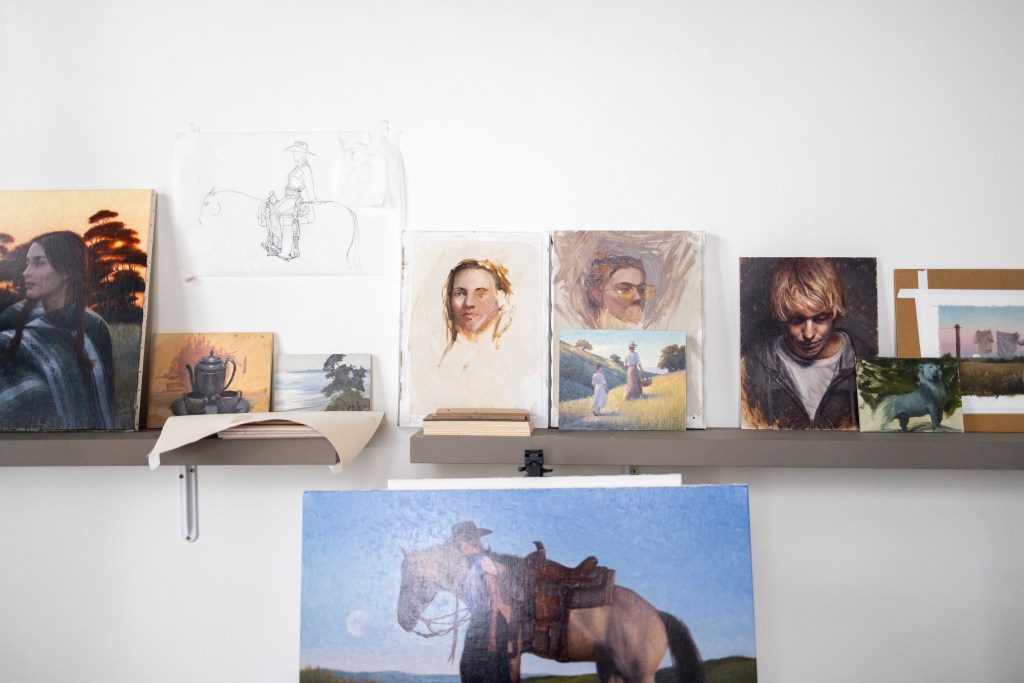
Why figurative painting? “There’s something instinctual about it,” says Harrison. “It’s the most challenging thing to do. If you can paint the human figure, if you can do a portrait, you can do anything.”
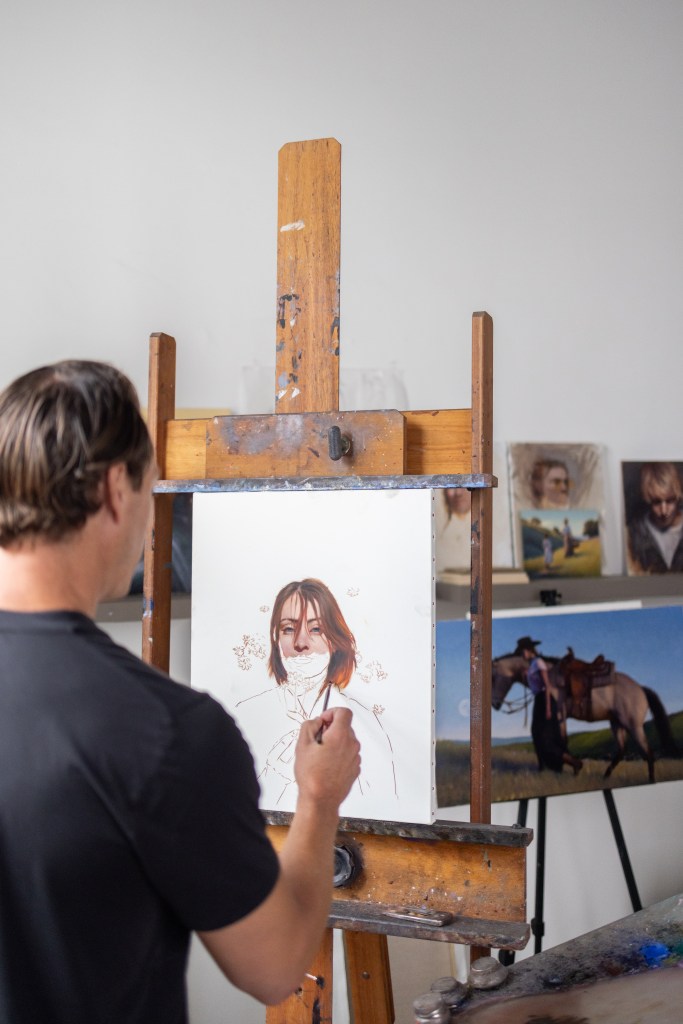
He also particularizes that whenever he paints a portrait of someone, he is also painting a self-portrait. “I tend to idealize when I try to capture the person,” he says.
Harrison has a model come into his studio to pose once a week. “There’s something that is lost when you work from a photograph,” he says. “There’s no filter with a live model. No technology. No middle man. There’s a unique energy. An urgency. Models cannot sit for a long time.”
He does paint landscapes often. “But I like them to be populated,” he says. “By bringing people into a landscape, it tells a story. Plain landscapes seem static to me.”
Before his 31st birthday, he began winning awards for his paintings and establishing a strong collector base. He is an instructor at the Los Angeles Academy of Figurative Art as well as an adjunct faculty member at Westmont College. “The aim of my work is to inspire,” he states.
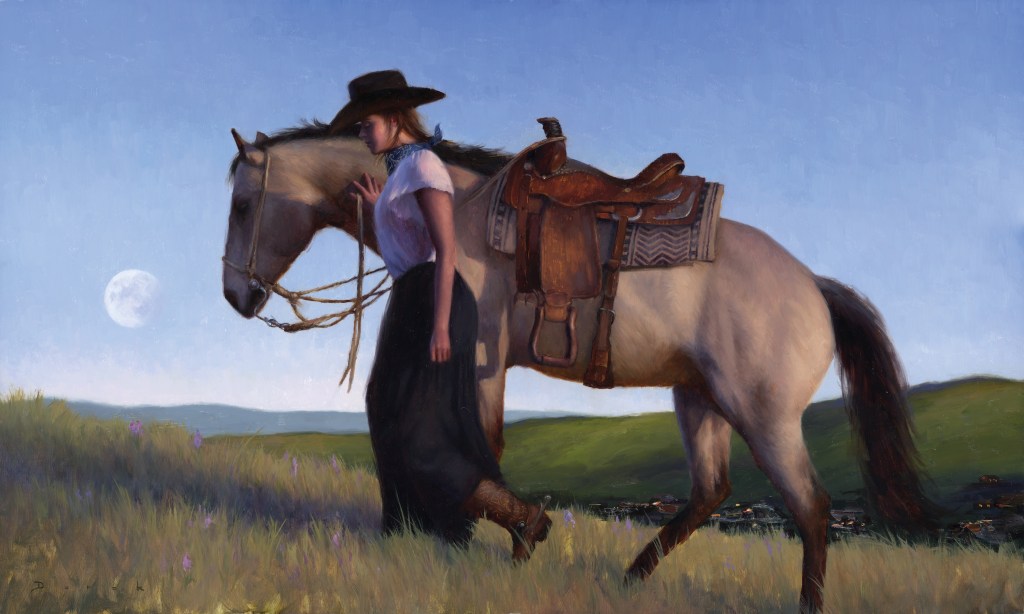
Lately, he has been enthralled with doing American West painting, capturing scenes of people with horses and those who work in ranches. “There’s something nostalgic about it,” he says. About three years ago, he spent a month traveling through the southwestern states: Colorado, Utah, Nevada, and New Mexico. He visited western heritage painter Bill Anton, who lives in Prescott, Arizona. “I love the scenery, the clothing, and the drama,” he says. “There’s great nostalgia about it. It is an idealized world that is fleeting.”
The American West Inspires
At the first American Western painting show where Harrison submitted one of his works, the Tehachapi Art Commission Exhibition, his art sold in minutes. On the surface, his paintings in this genre seem pretty straightforward, but at a closer look, you start noticing that there’s a cycle of life being portrayed in each frame. There might be a bone on the ground, and there’s always a sunset depicted conveying the end of things and mortality.
About a year ago, Harrison met Kate Maddaloni when he was looking for a model who was good with horses and had experience at a ranch. She has competed in rodeos and has brought him further into this world. She has also become his muse, and the person whom he trusts the most to give him feedback on his work.
“He originally reached out to me hoping to shoot some reference photo content with cowgirls and horses,” Kate said. “But I think he ended up with more than he bargained for. With my knowledge of horses and ranch life combined with his incredible skill with a paintbrush (and charcoal), I think we have created something pretty special.” It is her who is depicted on the Old Spanish Days poster.
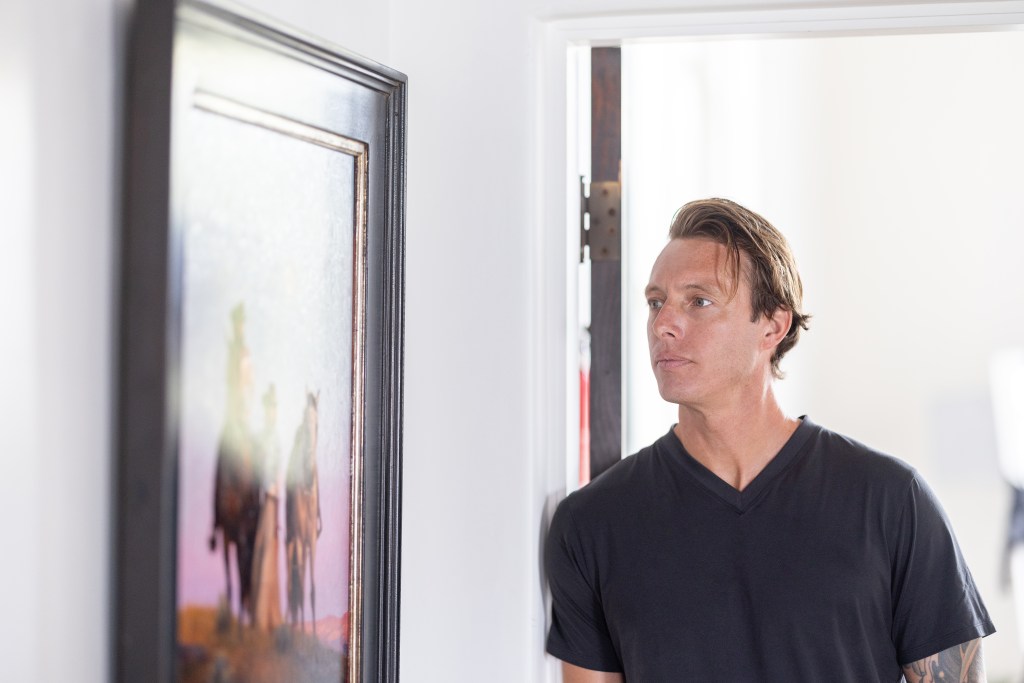
Harrison is thrilled to have been tapped by El Presidente for the poster. “I’ve always enjoyed the history of Fiesta and going to the Historical Museum and seeing all of the posters from previous years,” he says. “It has such a rich legacy. I always thought it would be amazing to paint something for the poster. This opportunity came out of the blue this year, and it is such an amazing honor to be added to the roster of artists who have created works for Fiesta. It’s truly a dream come true. I love how Fiesta brings everyone together!”


You must be logged in to post a comment.