

SAGAS OF SABLE: Trust me, I know from stupid. Everything dumb, I’ve already done. Hell, I even bit when some two-bit hustler accosted me on the streets of New Orleans with, “Hey, I bet I know where you got your shoes.”
They see me coming a mile away.
But even I was dubious when the charm squad unleashed by the Sable oil company told us they could put 120 Band-Aids on Exxon’s 120-mile stretch of badly corroded pipeline that infamously sprang the 142,800-gallon leak along the Gaviota Coast back on May 19, 2015. And make it safer than ever.
Even Exxon knew better than to propose something so outlandish. But when Exxon’s efforts to install a brand-new pipeline hit the brick wall of environmental delay, the biggest, baddest oil company on the planet declared, “No más.” It sold its three offshore platforms, its whole Santa Ynez Unit, and, yes, the leaky, squeaky pipeline that sprang the 142,800-gallongusher in 2015 to Sable, then a brand-new company.
By any reckoning, Sable’s two-year sprint toward the regulatory finish line has been a marvel of speed, muscle, chutzpah, desperation, determination, and true improvisational ingenuity. But there are signs that Sable might find itself hoisted by its own petard.
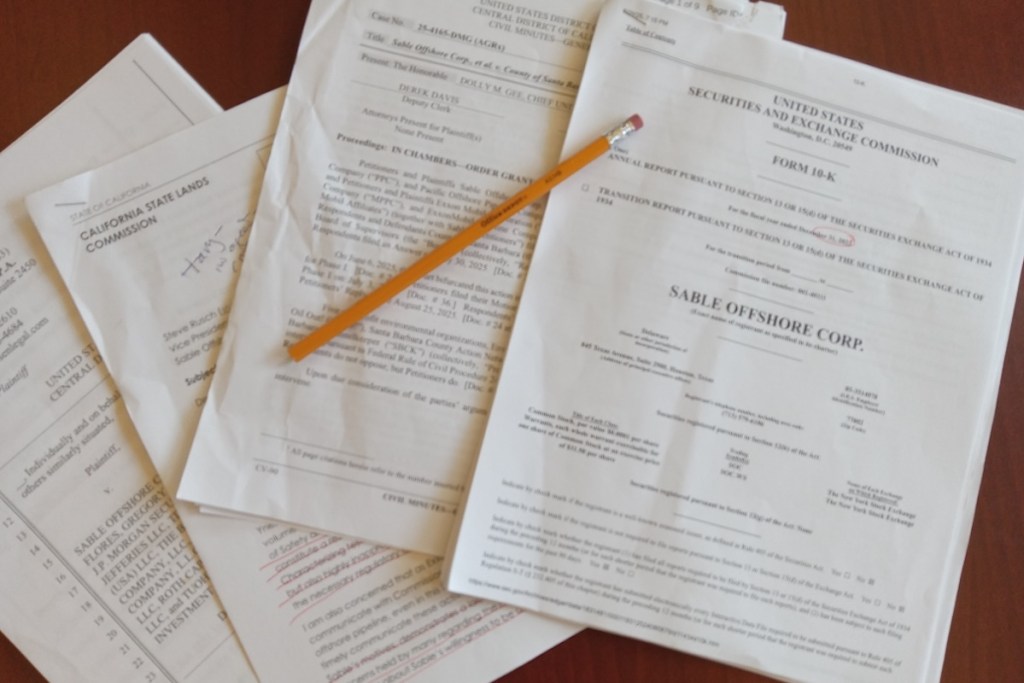
Just this week, two law firms that specialize in suing big operators for what’s called “securities fraud” on behalf of fleeced or otherwise bamboozled investors filed class-action lawsuits against Sable. They are accusing it of pulling the wool over its investors’ eyes by claiming that Sable had brought Exxon’s old oil plant back to production.
For the past several weeks, seven such firms — call them white-collar ambulance chasers if you must — had been churning the waters for possible clients. That two law firms have now pulled the trigger — whatever the merits of their case — qualifies as a significant development in Santa Barbara’s ongoing Saga of Sable.
We all tend to believe what we want to believe. It’s much worse when we believe what they want us to. Perhaps some of the regulatory agencies that have yet to sign off on the project might ponder that.
According to the legal papers I read, the Rosen Law Firm of Los Angeles is looking for people who invested in Sable between May 19 and June 3 of this year. On May 19 — coincidentally or not, the 10th anniversary of the 2015 pipeline spill that shut down every oil operation off the Gaviota Coast — Sable issued a press release announcing the processing plant had resumed production and it anticipated selling that oil as of June 2025.
The release stated, “Sable Offshore announced today that as of May 15, 2025, it has restarted production of the Santa Ynez Unit and has begun flowing oil production to the Las Flores Canyon.”
It also announced Sable had finished all the onshore pipeline repair work in accordance with the consent decree, which Sable described as “the governing document for the restart and operations of the pipeline.” Sable propagandist described all this as a “milestone achievement.”
Anyone reading this might be forgiven for thinking it meant that Sable had gotten all the permits it needed and was now back in the business of pumping oil. But, in fact, Sable had not, and has not yet, gotten all the permits needed to restart. And at the time, Sable was not even close to free-flowing production.

Sable had, in fact, pumped oil, but it was only to test the safety and functionality of Platform Harmony — 10 years dormant — located more than five miles off the Central Coast to assure the Department of the Interior’s Bureau of Safety and Environmental Enforcement inspectors that it was
good to go.
When I get my car smog-tested, the engine is running. But no one would confuse that with driving.
Except for people who invested in Sable between May 19 and June 3. If they were confused, it was because they were meant to be. In that time, Sable sold $688 million worth of new stock, revenue it needed to keep its deal alive.
Laurence Rosen of the Rosen Law Firm charged that the May 19 announcement was designed to act as a financial aphrodisiac to stimulate greater interest in Sable and generate higher stock prices. Sable’s statements, he argued, were “materially false,” “misleading,” “lacked a reasonable basis at all times,” and “failed to disclose adverse facts” about the company’s business operations “which were known to the defendant or recklessly disregarded by them.”
If true, provable, and winnable in court, “Ouch.”
The smoking gun in this case comes courtesy of California Lt. Governor — and chair of the state’s State Lands Commission — Eleni Kounalakis. On May 23, she issued a scorcher of a letter accusing Sable of lying. “Characterizing testing activities as a restart of operations is not only misleading but also highly inappropriate,” she objected, “particularly given that Sable has not obtained the necessary regulatory approvals to fully resume operations at the Santa Ynez Unit.” Rosen cites this letter extensively.
To be fair, anyone can file a lawsuit and claim anything. That don’t necessarily make it so. “The company denies the allegations,” said Sable spokesperson Alice Walton, “and intends to defend the case vigorously.” The company warned investors not to take “forward-looking statements” — like “expectations, hopes, beliefs, intentions, and estimates” included in the fine print of its stock prospectus too seriously.
A homeless guy tried to warn me, “You got your shoes on your feet and your feet on the ground. Don’t bet.” It was already too late. But maybe not for us.






You must be logged in to post a comment.