
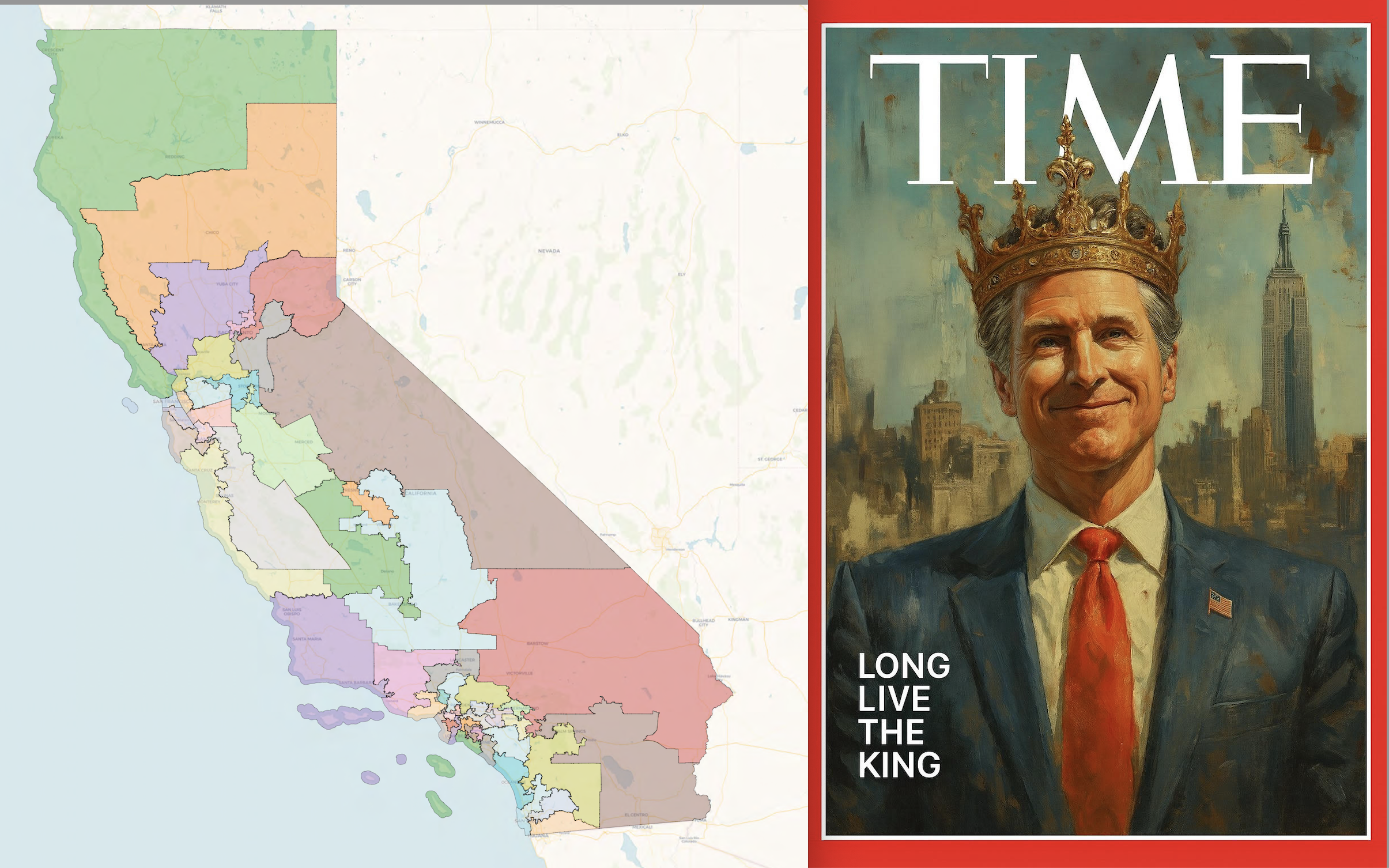
As California prepared to release new Democrat-dominant electoral maps, the governor’s office continued to troll the president, posting images of Newsom on the cover of Time magazine and nominations for the Nobel Peace Prize. The satire edged into international waters on Trump’s visit to Alaska: “TRUMP JUST FLED THE PODIUM WITH PUTIN — NO QUESTIONS, NOTHING! TOTAL LOW ENERGY. THE MAN LOOKED LIKE HE’D JUST EATEN 3 BUCKETS OF KFC WITH VLAD.”
About an hour later the California Legislature released the newly redrawn map of the state’s 52 districts that define its congressional representatives. They show coastal areas largely untouched with the exception of Northern California, where districts 1 and 2 have merged from Nevada to the coast. Other districts both split and merged, all in an effort to produce five more Democrat-leaning electoral districts. The public should have a chance to vote on this map November 4.

The map and the trolling are to goad Trump and Texas Governor Abbott into canceling the state’s announced redistricting. If they cancel, Newsom says California will do the same. Texas intends to add at least five additional Republican congressional seats to pack the U.S. House of Representatives for the remainder of Trump’s tenure. Texas Democrats have signaled that they intend to return after having fled the state to avoid a quorum and a vote. In D.C., Republicans currently hold the majority in the House by a narrow margin of seven votes.
California Republicans and the League of Women Voters disagree with the tactic. State GOP Chair Corrin Rankin called it a “calculated power grab” and a betrayal of the state’s independent Citizens Redistricting Commission. The commission took “politicians out of the process so no one could rig the maps for their own gain. Now, Newsom wants to take that power back, rush through secret maps, and spend hundreds of millions so he and his friends can choose their voters instead of voters choosing their representatives.”
“In Texas, the League of Women Voters is actively fighting extreme partisan gerrymanders,” said Dora Rose, executive director of the California League of Women Voters. She argued for consistency and warned that once a standard is broken, future politicians will do the same. “We understand the urgency,” Rose continued. “Authoritarianism is not abstract; it is here, and it is dangerous. President Trump has created a constitutional crisis on multiple fronts – assaults to democracy that the League is at the vanguard of fighting. But the way to fight is not to abandon one of California’s greatest democratic reforms.”
According to Assemblymember Gregg Hart, the new map was drawn using information the Citizens Redistricting Commission had when its bipartisan members put together the state’s 2021 map following the 2020 Census. California created an independent map-drawing group 15 years ago to avoid the overt partisanship involved in drawing electoral maps, which are made anew every 10 years. The same contractor who assisted the commission, Paul Mitchell, also developed the new map, along with the Congressional Democratic Caucus, Hart said.
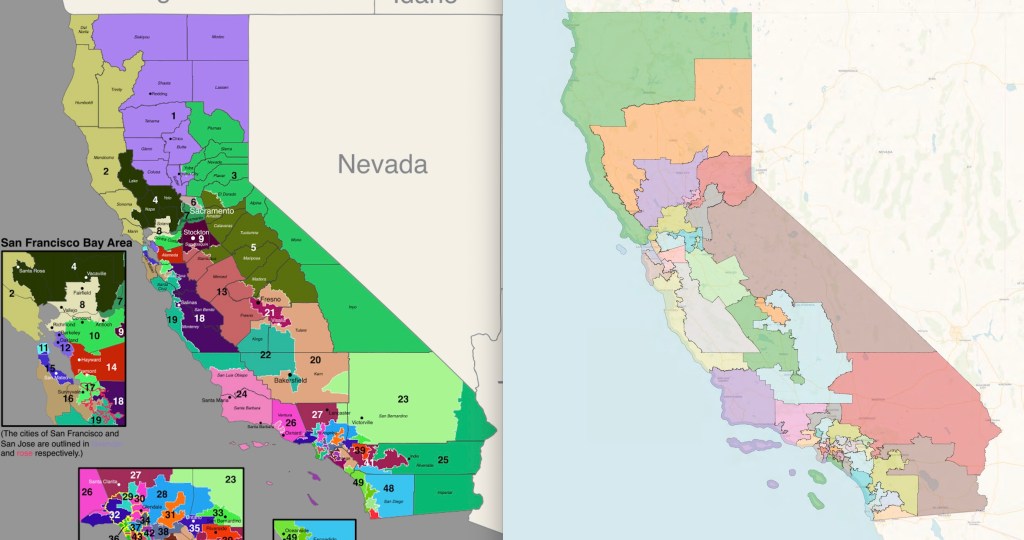
The effect on Rep. Salud Carbajal’s seat in Santa Barbara/Ventura/San Luis Obispo seems to be negligible. However, the number of Republicans in Santa Barbara County declined by 5 percent after Trump took office in 2017, a quantity taken up in the Democrat column of state registration data. Deep reporting by the Los Angeles Times indicates that seats held by Republicans Kevin Kiley, Doug LaMalfa, David Valadao, Ken Calvert, and Darrell Issa are at risk, while the maps bolster the seats of Democrats Adam Gray, Josh Harder, George Whitewides, Derek Tran, and Dave Min.
The California redistricting process — The Election Rigging Response Act is set to undergo Senate and Assembly votes next week in order to be signed by the governor in time for a November election — took into account “communities of interest,” as the mapmakers call it. “The Voting Right Act is very specific in how it protects minority communities,” Hart said. “The California map-drawing process tells that value at the top, and the next map does not compromise that.” Hart said it was highly unlikely that an appeal to the courts following a Texas vote — or the California vote — would make it to the Supreme Court before the balloting for congressional seats takes place in 2026.
Though California supports legislation in Congress that has tried and failed to implement independent redistricting nationwide, California is now responding to a crisis. “Texas started redistricting, and California is trying to respond,” said Hart. “If we don’t, the consequences are dire for the United States.”
In an email, State Senator Monique Limón expanded on that point: “These last seven months have been defined by constant attacks on our constitutional rights, including the violation of due process, and the unilateral rollback of federal agencies and programs that deliver critical services like health care, education, and disaster aid to taxpaying Americans,” Limón wrote.
In an interview with YouTuber Brian Tyler Cohen, Newsom explained, “Every issue you care about — addressing them with real, tangible solutions — depends on having a functioning democracy. That is what we are fighting for here in California. California will not sit idle as Trump and Texas shred our democracy — we’re moving forward right now to stop them!”
The California Legislature, which has a Democrat majority, has three bills to consider: A constitutional amendment that allows the current map to be redrawn; a statute to implement the new map; and a call for a special election, its funding, and the changing of election calendars. But, “California only acts if Republicans try to rig the vote,” said Senate leader Mike McGuire.
Limón, who is slated to be the next California Senate leader in 2026, has clearly been hearing from her constituents: “Right now our communities are hurting and demanding that we take action in ways that we can.” And, voters will still be heard, she added: “Time and time again the Legislature has gone to the voters to make decisions that impact the 40 million Americans that call the Golden State home — and this time is no different. This narrowly crafted proposal maintains the intent of Californians and allows them to ultimately decide on whether California redraws its congressional maps and neutralizes the attempts to set us back. The commission is not being dissolved, it will redistrict as scheduled in 2030.
“It is critical to remember that this policy proposal is a trigger — meaning the President still has the ability to reverse course and call off a midterm redistricting,” Limón reminded. “We have never in our history experienced this level of an attack on our democratic principles and it is imperative that we do what we can to protect the future of our nation.”


You must be logged in to post a comment.