

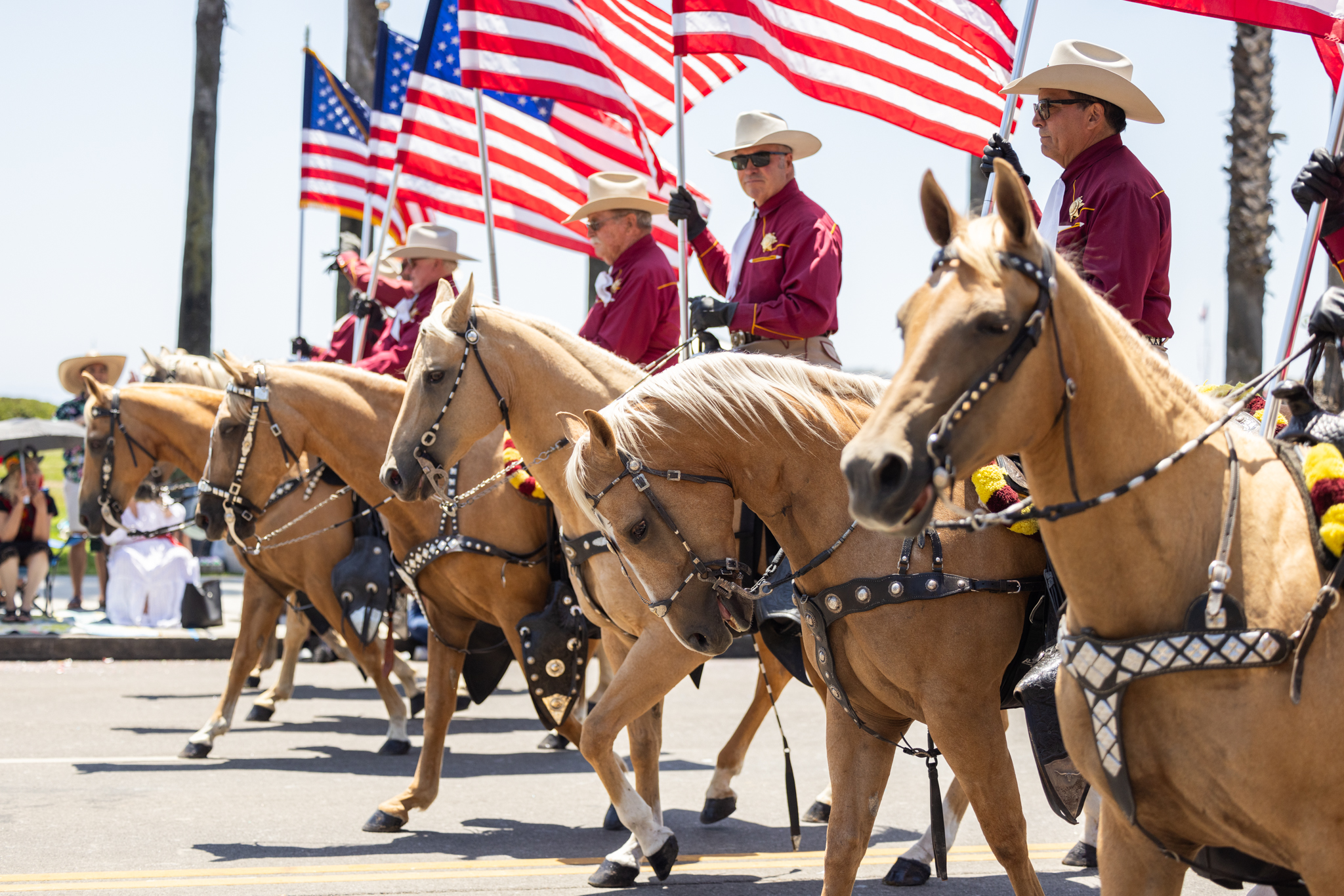
Each August, my city erupts in a swirl of color, rhythm, and nostalgia. From my downtown apartment just a few blocks away, I hear the hoofbeats of palomino horses echoing down the street, the laughter of children tossing confetti-filled cascarones, and the booming voice of an emcee introducing the next baile flamencotroupe. Fiesta — formally known as Old Spanish Days — has arrived.
Officially, Fiesta is a celebration of Santa Barbara’s “Spanish heritage.” Unofficially, it is a week of civic performance, tourism promotion, cultural appropriation, and selective memory. Hundreds of thousands of visitors descend upon our streets to indulge in tacos, tequila, and a carefully curated version of the past. Dancers in extravagant costumes swirl across makeshift stages. Vendors at mercados sell overpriced burritos and aguas frescas. Lines at our beloved Mexican restaurants stretch down the block. Tourists snap selfies under papel picado and buy straw sombreros they’ll abandon before Labor Day.
I get the appeal. I do. I’ve danced to the mariachi music, cracked eggs full of glitter on friends heads, waited in line for mole at Our Lady of Guadalupe’s booth. These are beautiful rituals, infused with joy and family tradition. For many local Latinx communities, Fiesta is a time to showcase culture and celebrate resilience. But the deeper I’ve reflected — especially as a sociologist — the more uneasy I’ve become.
Because Fiesta is not just celebration. It’s story. And the story it tells is dangerously incomplete.
The official Fiesta narrative centers on the Californios — Spanish-speaking settlers and ranchers of the Mexican era — depicted as elegant, romantic figures who lived in harmony with the land and their Indigenous “helpers.” This arcadian vision whitewashes the colonial brutality upon which it was built. In this retelling, the Chumash people — the original inhabitants of this region — are mostly invisible. When they do appear, it’s as background, or as grateful recipients of Spanish “civilization.”
But here are some facts:
• The Chumash were forced to build many of Santa Barbara’s earliest structures, including those celebrated during Fiesta.
• They were compelled to labor in fields and missions for the profit of the Franciscan order.
• They were often fed far less than Spanish clergy and soldiers and punished with whippings and solitary confinement for resisting religious conversion or breaking colonial rules.
• Their spiritual traditions were denounced as witchcraft and systematically eradicated.

In 1824, the Chumash revolted. Their uprising — one of the largest Indigenous rebellions in California history — was a direct response to systemic abuse, including the beating of a young Chumash boy by a Mexican soldier. Armed with whatever tools they could gather, the Chumash took over three missions and held them for weeks before being brutally suppressed. Yet this courageous act of resistance finds no place in Fiesta parades.
Fiesta’s glorification of the mission and rancho periods often echoes the logic of manifest destiny: a benevolent empire civilizing “savages” and cultivating wild land. Even the architectural backdrop of our downtown — a pastiche of whitewashed stucco, red tile roofs, and wrought iron balconies — performs a fantasy version of Spanish colonialism. It’s less Santa Barbara, more Disney’s Andalusia.
We don’t just celebrate history; we stage it to please tourists. And in doing so, we risk deepening a collective amnesia.
This selective memory is especially painful for local Chicanos and Chicanas, many of whom feel the contradiction of being essential to the party but peripheral to the power. One day each year, white residents enthusiastically don pseudo-Mexican garb, drink margaritas in the street, and snap photos of brown-skinned dancers in huipiles. The next day, those same dancers might be followed in stores, pulled over for “looking suspicious,” or denied housing because of their last name.
This dissonance is not accidental. It is the product of a city that has long commodified Mexican culture while excluding Mexican people. It’s the story of Santa Barbara’s dual identity: postcard perfect on the surface, structurally unequal beneath.
And yet — and this is important — I don’t believe we should cancel Fiesta. Rituals matter. Community events can hold meaning even when they are flawed. For many families, Fiesta is about reunion, pride, and survival. Latinx youth train all year for those dances. Grandparents tell stories over plates of tamales. There’s beauty and power in that.
But we can — and must — hold complexity. We can love the dancing and critique the narrative. We can cherish community joy while rejecting historical erasure. We can say yes to celebration and no to colonial cosplay.
We can also do better.
Imagine a Fiesta that begins not with the ringing of bells from a Catholic mission, but with a land acknowledgment and blessing from Chumash elders. Imagine educational booths explaining the 1824 revolt alongside booths selling elote. Imagine programming that honors not just the Californio elite, but the Indigenous, Black, Chinese, and Mestizo workers who made early Santa Barbara run.
Imagine a Fiesta that’s not afraid of truth.
As it stands, Fiesta reminds me of something James Baldwin once wrote: “People are trapped in history and history is trapped in them.” Our city is trapped in a fantasy of its past, and we play it out year after year with confetti and tequila. But we are also capable of change — of telling fuller stories, of remembering what was buried.
That week, as I walked through the mercado and saw a child dance barefoot in the plaza, I felt joy and grief, both. I remembered the hands that built these buildings and the ancestors whose names we’ve forgotten. I celebrated and I critiqued.
And I’ll keep hoping for a Fiesta that finally includes all of us.


You must be logged in to post a comment.