
Step Into the Unknown
at Brave New Work
World Leaders in Art and Technology
Gather in Santa Barbara to Discuss Our Future
By Leslie Dinaberg | October 2, 2025
Read more of the 2025 Fall Visual Arts preview.
Whether you love it or hate it, embrace it or fear it, AI is everywhere. The intersection of art and technology takes center stage next week for a three-day, citywide symposium, “Brave New Work: AI and Tech in the Hands of Artists,” arriving in Santa Barbara October 7-9.
A multi-venue gathering of leading artists and scientists and interested members of the public, this program is the brainchild of executive producer Michael Delgado, who has worked in partnership with the Santa Barbara Museum of Art; the Museum of Contemporary Art, Santa Barbara; Santa Barbara Community Arts Workshop; Santa Barbara Center for Art and Technology; Santa Barbara High’s Visual Arts and Design Academy (VADA); and multiple departments at UCSB, including Media Arts and Technology and the Art, Design & Architecture Museum (AD&A), to bring thought leaders and cutting-edge artistry to our town.
“The most exciting thing about the event is that you can interact with the artists and their technologist counterparts as they discuss how, through collaboration, they are moving art and technology on a path that serves humanity and makes us better,” says Delgado. “Technology is neutral. How we apply it is up to us. Science and art can usher in a true renaissance period for our time, but we need to be a part of that conversation.”
Brave New Work features internationally renowned contemporary artists Nancy Baker Cahill, JoAnn Kuchera-Morin, Victoria Vesna, and Beatie Wolfe, as well as technology leaders Kevin Davis, Ken Kosik, and Alan Macy, among others.
“Working outside the white cube of galleries and museums, our artists use the social fabric of a community as a canvas, orchestrating local input to make culturally colorful installations, experiences, and performances to deliver universal messages of hope, resistance, inclusion, environmental stewardship, and personal identity.
“The term ‘AI’ solicits a strong response, mostly negative from the general art community. And, for good reason,” admits Delgado. “It is powerful, invasive, and moving incredibly fast — all the attributes that raise our ‘fight or flight’ instincts. But making art is what separates us from other beings or robots. It defines our humanity. The pursuit of art and science collaborations puts us on a path to a more hopeful future.”
The tension between human expression and expeditious technologies is the heart of the symposium, he explained. Santa Barbara is a leading center for AI and other technologies that are transforming how we interact with both the natural and digital environments.
Among the ideas on the table are:
Where do these worlds intersect and why? And what does that mean for art and for science?
How are these fast-changing technologies impacting the traditional gallery and museum ecosystems?
What does it mean to be an artist today? What does it mean to be a scientist?
“Interestingly, the artwork, which may seem so new, is rooted in several well-known modern art movements. You can draw a through line from Cézanne and the Impressionists to Surrealist filmmakers, abstract expressionism — especially the ‘gesture’ in a Jackson Pollock painting, the cynicism of pop art and the grandeur of environmental works by Smithson or Heizer and especially the light and space artists like James Turrell; all the way to the time-based, ethereal immersive installations of the artists in the show,” says Delgado. “You can even argue that our own plein air artists like Michael Drury and Andy Vogel, with their expert depictions of Southern California’s unique light and preoccupation with our place in an earthly landscape, are kinfolk to someone like Victoria Vesna or Beatie Wolfe.”
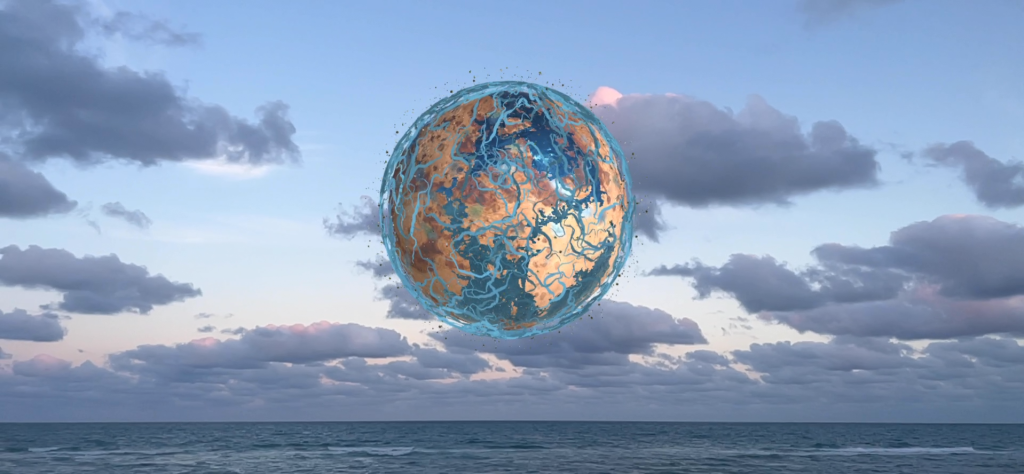
Wolfe’s project, titled “Smoke and Mirrors,” uses art to communicate six decades of climate data, specifically rising methane levels (“smoke”), set alongside the verbatim advertising slogans deployed by the Big Oil industry to deny, doubt, and delay (“mirrors”) climate awareness through the decades, starting from 1970 until present day.
This evocative visualization is based on NASA’s “Blue Marble” photograph and produced in collaboration with the creative studio House of Parliament. It will be set to the music titled “Oh My Heart,” a recording that was released as the world’s first bioplastic record by Wolfe (who will be part of a panel on October 8 called Signals & Systems: Artists Rewiring Perception in the Age of Intelligent Media), Michael Stipe (REM), and Brian Eno’s EarthPercent.
“Smoke and Mirrors” is part of a free program of projected public art works at the Santa Barbara Public Library Plaza on October 8. In addition to Wolfe’s piece, the screening (from sunset to 9 p.m.) will also include art works by Nancy Baker Cahill, Richelle Ellis/SuperCollider.la, Victoria Vesna, and Yuge Zhou.
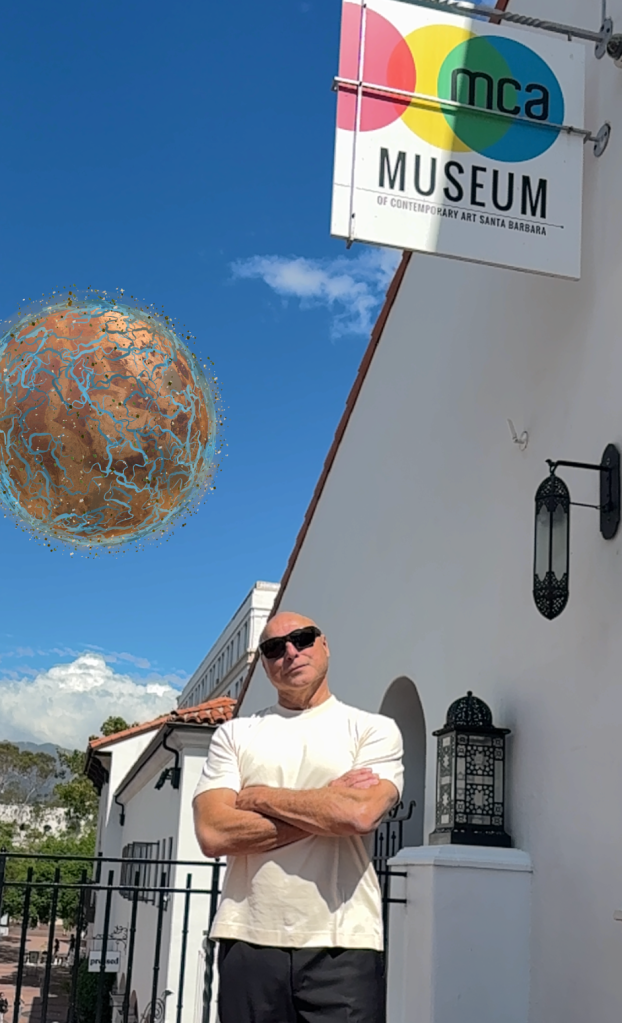
“Stone Speaks,” a special AR (Augmented Reality) installation by Baker Cahill, will be on view at the Welcoming Reception at MCASB’s Paseo Nuevo Arts Terrace on October 7. Inspired by conversations between Baker Cahill and Sophia the Robot about the accelerating climate crisis, and the adaptive potential of human-machine collaboration, “Stone Speaks” was originally geolocated simultaneously over Madinat Jumeirah in Dubai and Miami Beach in Florida, to underscore the borderless nature of the climate crisis.
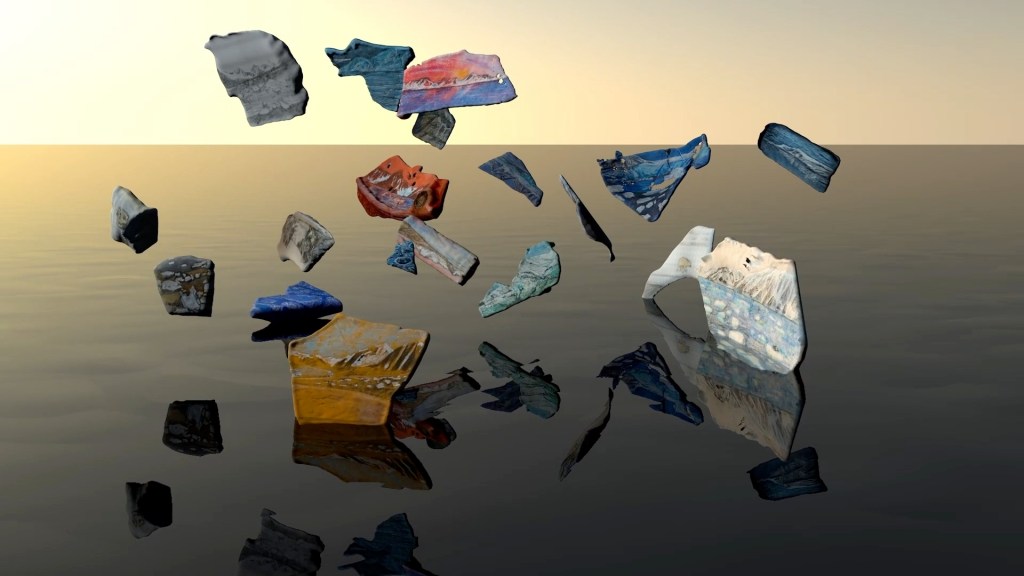
Ellis’s work is also environmentally themed. Titled “Left Behind,” with collaborative animation and sound design by Isabel Beavers, it features landscape drawings on discarded plastics collected near the North Pole. As the plastics float to the water’s surface like glaciers in the ocean, it asks the question, “What is left behind when the ice melts?” As Ellis wrote in her artist statement: “Human impact is reshaping our planet, affecting the farthest reaches of our planet. This work reflects on such impacts, gathering artifacts from the places we alter without noticing.”
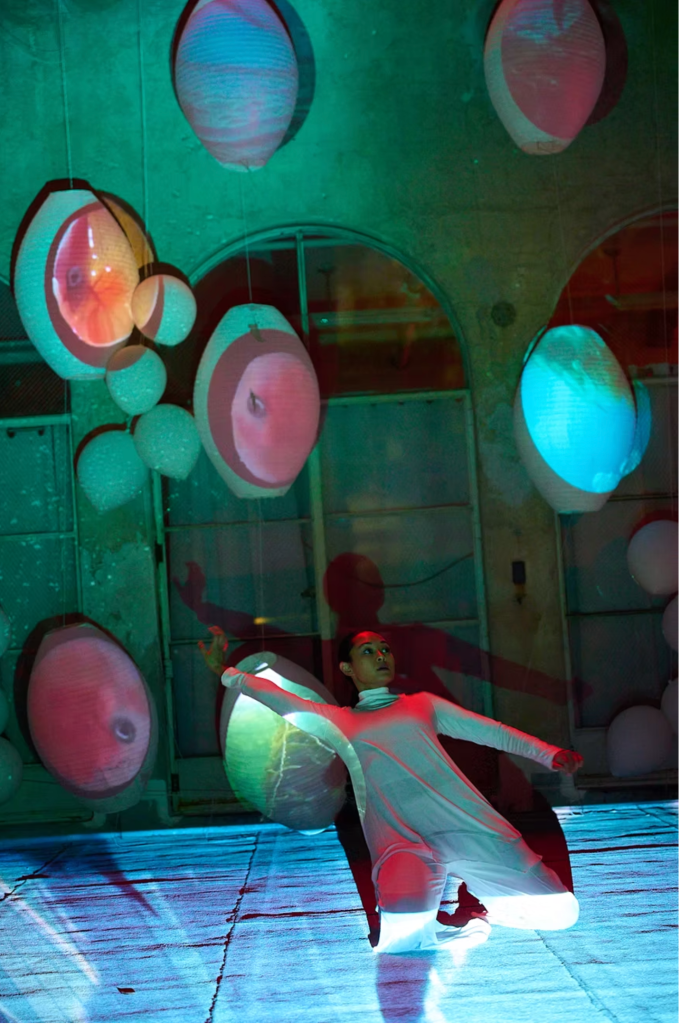
Vesna’s work, “[Alien] Star Dust,” which premiered at the Natural History Museum in Vienna as a site-specific immersive art experience, is a research-based art project that invites viewers to gain an intimate understanding of the importance and complexity of dust. In addition to being an internationally renowned artist, Vesna is also a professor whose work bridges both art and science at the UCLA Department of Design Media Arts and Director of the Art|Sci Center at the School of the Arts and California NanoSystems Institute.
Zhou’s piece, “Trampoline Color Exercise,” goes in a completely different direction, as a moving-image collage of leaping gymnasts whose uniforms and identities shapeshift as they flip and tumble on pink gridded trampolines. “Growing up in China, watching the Olympic Games, it’s such a ritualistic family event every four years,” says Zhou, who left China for the U.S. in 2008.
Using aerial vantage points from archival broadcasts of Olympic Games footage, this art piece, which was shown in New York’s Times Square, is a bird’s-eye meditation on the human form and the athletic pursuit of perfection. It’s also a timely yet subtle nod to global national flags and fluctuating affiliations in our ever-changing geopolitical climate. “But also the powerful symbolism, what it represents, the kind of the rivalry between the superpowers,” says Zhou. “The idea is that even if people don’t understand this piece from a deeper level, it’s kind of like a really playful kind of a reference to just the fun of the play of the primary colors and the athletes pursuit of perfection, … but if you kind of look at it in a deeper sense, it also is kind of about the ever-changing kind of geopolitics that we have, the superpowers kind of shifting from one nation to another; there’s this shifting allegiance.”
Composer JoAnn Kuchera-Morin — whose name may be familiar as the Director and Chief Scientist of the AlloSphere Research Facility and Professor of Media Arts and Technology and Music in the California NanoSystems Institute at UCSB — will perform excerpts of her groundbreaking concerto in which she uses quantum mechanics in the way that a composer writes a classic work for a traditional orchestra. Taking place on campus on October 8 between 2:30 and 4:30 p.m., guests will have the opportunity to see the AlloSphere — a 30-foot-diameter, three-story-high metal cylinder inside an echo-free cube, designed for immersive/interactive scientific/artistic investigation of multidimensional data sets. In addition to creating this research program, Kuchera-Morin is renowned as a pioneer in musically and visually immersive experiences, now most recognized in the technologies employed at the Sphere in Las Vegas.
Additional program highlights include a panel on The Human Element: Designing Empathy into the Machine Age, featuring Kevin Davis, Director of Amazon Alexa AI, and Forest Stearns, Artist in Residence at Google Quantum Lab (Oct. 7). There is also a discussion of Encoded Gazes: Women of Color on Bias, Power, and Possibility in AI, with Ana Briz, curator of the UCSB Art, Design & Architecture Museum; Haewon Jeong, assistant professor, Electric and Computer Engineering, UCSB; and artist Kira Xonorika (Guarani) (Oct. 8).
A Brief History of the Impossible is the title of a talk by James Glisson, chief curator of the Santa Barbara Museum of Art, who will explore how historical artists anticipated AI in an insightful look at art history through the lens of contemporary technologies (Oct. 8).
In addition, Sivia Perea, curator of UCSB’s AD&A Museum, will moderate a discussion of Architectures of Perception: Immersion, Intelligence & the Shape of Conscious Futures, a multidisciplinary panel that explores how architectures — digital, biological, cultural, and material — shape consciousness and perception. Participants include Markus Novak, director, UCSB Media Arts & Technology Program; Dr. Ken Kosik, Harriman Professor of Neuroscience & Co-Director, UCSB Neuroscience Research Institute; and artist and environmental material researcher Minga Opazo (Oct. 9).
In addition to a number of networking opportunities, casual receptions, and public art components, there are also companion programming events going on in parallel with Brave New Work, including an October 7 VADATalks presentation on Art x AI: Who Makes, Who Owns, Who Decides? On October 9, there is a workshop called AI Foundation: Tools for Image & Video Creation, which is a hands-on creative lab where participants dive into the experimental creative landscape of generative AI visuals. In addition, from October 2-12, there is a special exhibition at SBCAW called Symbiosis or Schism, the AI-Human Odyssey, curated and organized by the Brill Foundation.
Ultimately, says Delgado, “Brave New Work is an intimate forum. Lectures are capped at only 150-200 attendees. The value of this conference is precisely in its scale. It is a rare opportunity to see world leaders talk about their explorations at the intersection of art and science and to interact with passionate regional leaders focused on building a like-minded community.”
For more information, the complete schedule, and tickets for these events, see bravenewworksb.org.


You must be logged in to post a comment.