

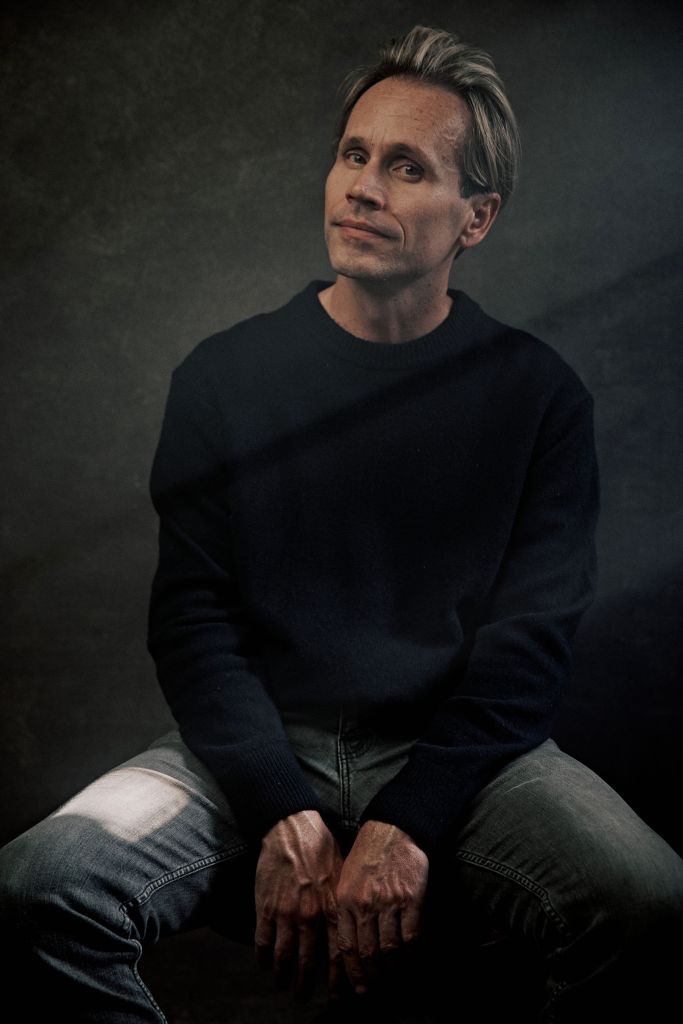
At 15 years old, Santa Barbara–raised actor Tobias Jelinek had his breakout role as Jay, the glam-rock mean kid from Halloween classic Hocus Pocus. Now, 30 years later, he finds himself involved in another spooky-season phenomenon (albeit a darker, less family-friendly story) playing convicted killer Richard Speck in Ian Brennan’s Monster: The Ed Gein Story on Netflix.
When the show premiered earlier this month, Jelinek devoted a day to watching all eight episodes (though he admitted to taking a break halfway through the intense subject matter, after Gein’s descent into necrophilia). He wasn’t the only one binging Monster — the show became an overnight sensation, the top-streamed show in 70 countries. “I couldn’t believe how fast people blew through it,” says Jelinek, who immediately began receiving messages about the show from around the world. “People love horror,” he says, “the macabre nature of humanity.”
Jelinek filmed Monster in Chicago, where he followed the path of Speck’s mass murder, his attempted disappearance into skid row, his suicide attempt, and his arrest at the hospital after a doctor recognized his tattoo from news broadcasts. His scenes were shot in the Stateville Penitentiary, where the real Speck was incarcerated until his death in 1991.
“I knew very little about Speck going into it, but the language [of the script] was so complete, so inspired. It was very easy to go into the role he fulfills in the Ed Gein story. He is the extreme,” says Jelinek. He says that Monster attempts to humanize Gein and explore the impression he made on culture, his violent bouts of psychosis having inspired such films as Psycho, Texas Chainsaw Massacre, and The Silence of the Lambs.
Speck, meanwhile, has a sordid story of his own. He was interviewed in the ’70s by the Chicago Tribune’s Bob Greene, who described him as having a kind of celebrity swagger. After Speck’s death, his notorious prison video, which Jelinek calls “half confession, half pornography,” was leaked, shocking the public. “He knew how to traumatize and manipulate the American public through media,” says Jelinek. “It’s the confession, the drugs, the sex. He’s like, ‘You think I’m in here doing my time, but I’m running the joint.’”
Jelinek still celebrates his Hocus Pocus legacy, appearing at various fan conventions and Halloween-inspired events, including those in haunted hotspot (and the setting of Hocus Pocus) Salem, Massachusetts. Jelinek calls these experiences a “pop-culture campfire,” where fans have access to their favorite performers. “When we meet people, they say we bring back the ’90s for them,” he says. “And the fact that we’re willing to go out and talk to them and hear whatever questions they have or share, whatever memories pop into our head about the experience, it counts for something.”
Jelinek will be back in Salem next October for the town’s 400th anniversary. “The Salem witch hunt and trials, Ed Gein,” he says, “they’re both these moments in the American psyche where we really saw a shift. And I do think Speck is one of those, as well.”


You must be logged in to post a comment.