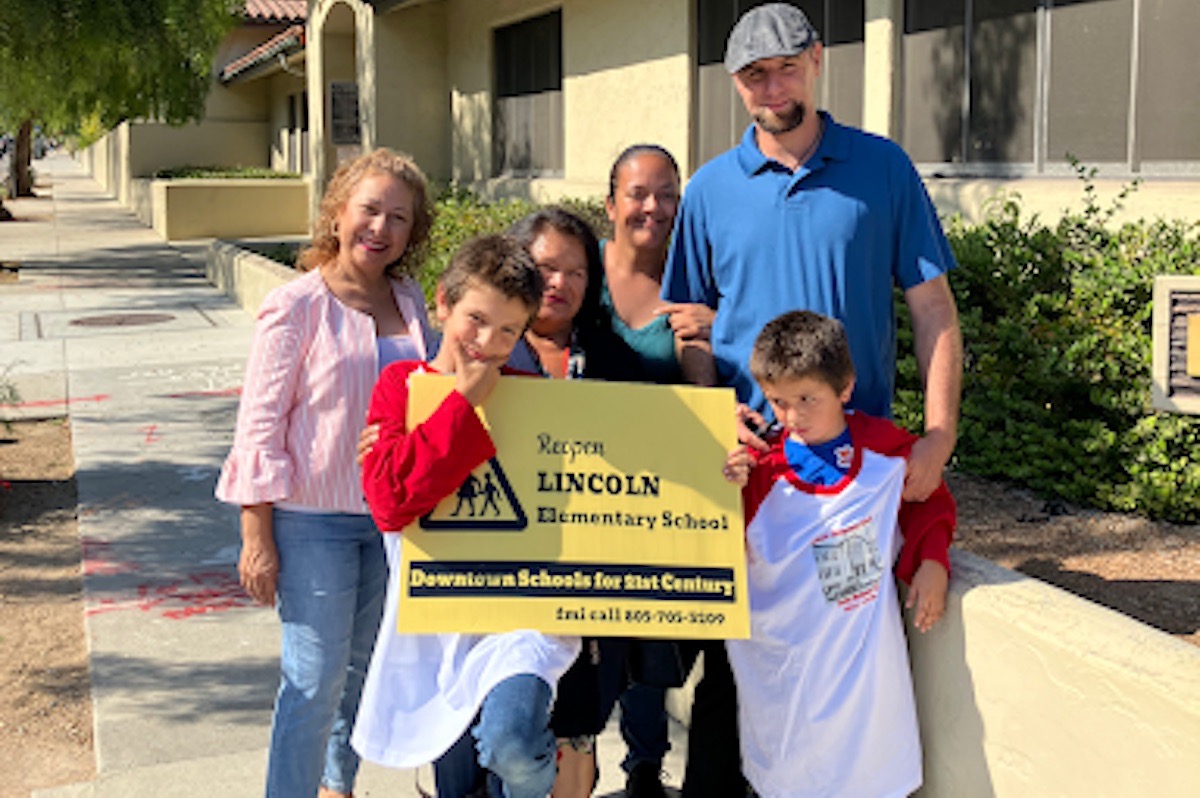
At Tuesday night’s Santa Barbara Unified School District board meeting, alumni of Lincoln Elementary School made an emotional and detailed appeal to reopen the long-shuttered downtown campus by fall 2026. Led by Marvin Gibson and Alberto Leon, with support from longtime Eastside advocate Alice Post, the presentation included a five-minute video montage and a formal request for the board to consider the school’s legacy, community impact, and potential future.
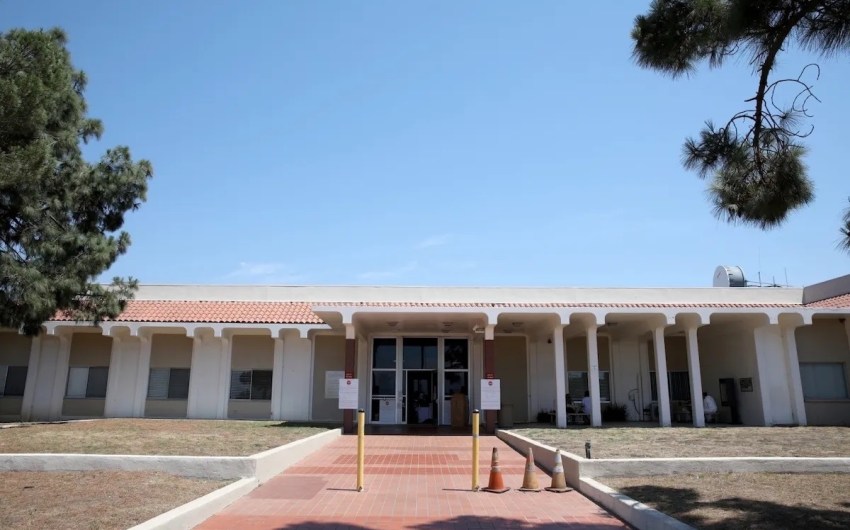
Centrally located at 710 Santa Barbara Street, adjacent to where the board meeting was held, Lincoln Elementary was closed in 1979 due to declining enrollment. But Gibson and Leon argued the closure created a “desert” of neighborhood schools in the downtown and lower Eastside areas, particularly affecting Latino and Black students. “It brought everyone from different walks all together in one place,” Leon told the board. “We were a community that was brought together by working-class families.”
Gibson recalled the school’s cultural diversity, strong academics, and life-shaping structure. “Mrs. Shirley Wright was very significant and played a very big role in my life. She was really strict. It really gave me a sense of studying and doing the best we could,” he said. “Why not preserve the legacy of a school like Lincoln?”
Presenters outlined four formal requests to the board:
- Allow the alumni presentation and video — which the board did.
- Pass a resolution acknowledging Lincoln’s cultural value to the Black and Latino families of the Eastside and Laguna neighborhoods.
- Formally acknowledge a vacancy of public elementary campuses in downtown Santa Barbara.
- Consider reopening Lincoln by 2026 and conduct a cost-benefit analysis as part of the district’s broader facilities master plan.
Post, who is an executive member of the advocacy group Coalition for Neighborhood Schools, said the goal was to begin the conversation as part of long-range planning. “This is preliminary advocacy of a specific outcome that the specific constituency — lower Eastside, Laguna alums, and current neighbors — would like to have considered as part of the long-range planning,” she said.
She also emphasized that property tax revenue remains stable despite declining enrollment, meaning resources exist for neighborhood-based education. “Declining enrollment can be a blessing in disguise — an opportunity to better serve students, not fewer of them.”
While the board took no action at this time, their comments made clear that reopening a school — even one as beloved as Lincoln — may not be a viable option. Board President Gabe Escobedo said he was “philosophically” in support of neighborhood schools but added: “The reality is, adding another school is not on the table for the school district in the future. In fact, when you look at declining enrollment and the expenses that it would take to open up a school, we’re actually looking at probably fewer schools.”
Boardmember Celeste Kafri called for a districtwide enrollment study to inform future facilities planning. “We need a better understanding of the landscape,” she said. “How far are kids traveling? Are some of our schools underused? Are some schools over capacity?”
Boardmember Sunita Beall agreed, calling the issue “a really complex discussion” and suggested holding a broader community forum to address declining enrollment, open enrollment, and school boundaries. “We do have to have this conversation … probably within the next year or two,” she said.
Clerk Rose Muñoz was more blunt. “Opening Lincoln School is not one that I think this school district can provide,” she said, citing logistical burdens and potential displacement of at-risk students who currently attend programs at the site.
Post said the community is hopeful the district will include the Lincoln site in any forthcoming planning process. “I think it was successful in laying that on the table to be considered in the facilities master plan in the next one to two years.”
Since 2015, Santa Barbara Unified has lost more than 2,000 students, shrinking from 15,593 to a projected 13,336 in 2025. But Post and other Lincoln alumni argue that the question isn’t total student count, but where those students live. “The majority of the children within walking distance of 710 Santa Barbara Street are currently bused to the Mesa.”