
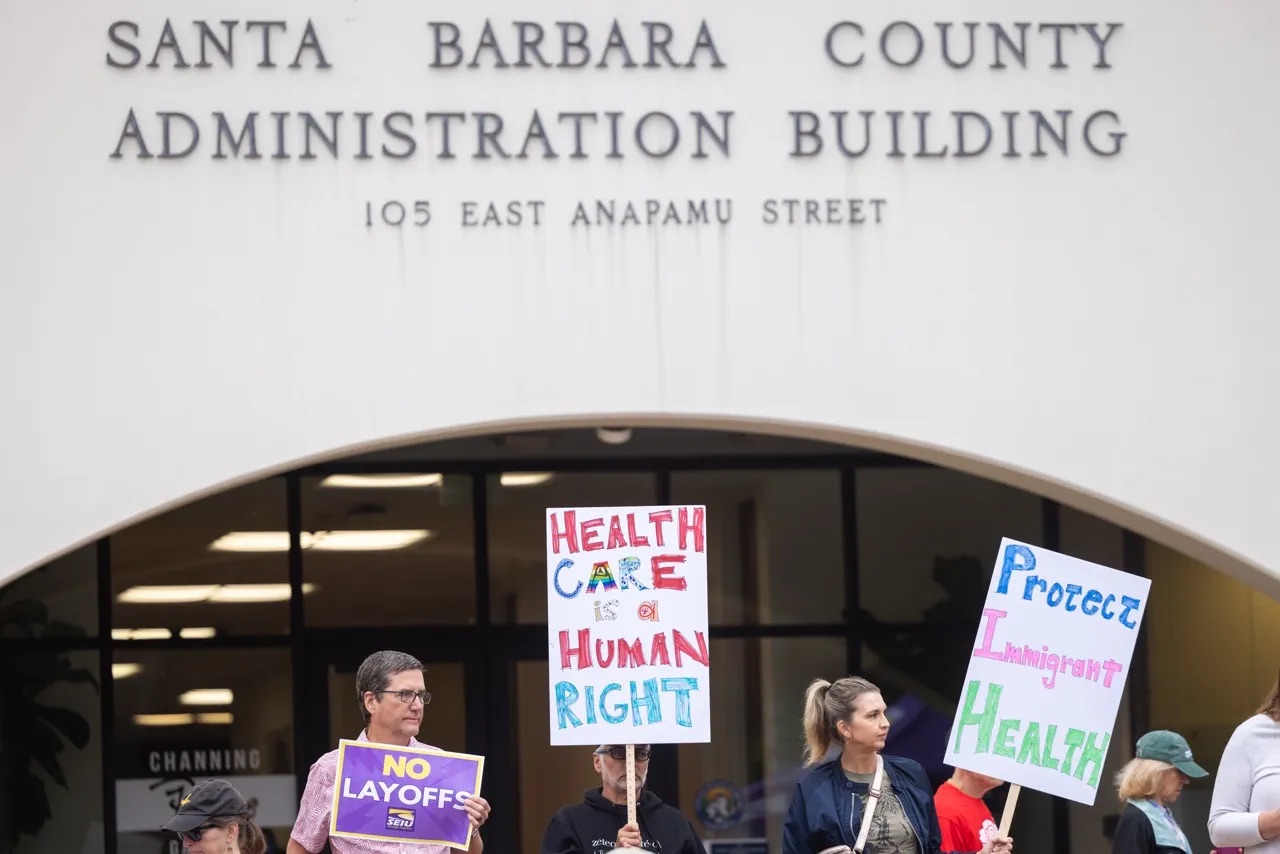
Sometimes, taking no action qualifies as a really big action. That was the case this Tuesday when the Santa Barbara County supervisors voted unanimously to take an indefinite pause on plans — first officially unveiled October 7 — to transfer up to 7,000 undocumented patients now signed up for health care at one of the county’s five public health clinics to other health care providers.
That plan had been vigorously and strenuously opposed by a coalition of immigration rights advocates and labor unions concerned about the 55 public health workers who would have been laid off in response to the significant drop in revenues such a transfer would have triggered. Initially, the supervisors had been poised to vote the other way — to approve the transfer of the undocumented patients — in response to a directive issued by the Trump administration this July to deny federally funded health care to anyone unable to proof of citizenship.
That edict has since been effectively challenged by 21 states in a federal court ruling issued this September, but Public Health Director Dr. Mouhanad Hammami worried that this injunction could and would soon be overturned. Should that scenario come to pass, Hammami expressed serious concern that 7,000 patients would soon find themselves without medical care; he also worried that his department could find itself severely penalized for noncompliance with a federal order and that all federal funding could be lost.

The supervisors seemed initially inclined to follow Hammami’s suggestion but backtracked in the face of serious opposition from immigration rights organizations, labor unions, and Attorney General Bonta Rob Bonta, who all argued against the county supes complying with a Trump order until it absolutely had to. Bonta, after all, represented one of the 21 states that had successfully sued to win the injunction; it would not do to have Santa Barbara County jumping ship.
This Tuesday, the supervisors heard from immigration rights lawyers who sought to reassure them that the injunction was on very sturdy legal grounds. Even if it were to be overturned, these attorneys argued, the supervisors should hold off authorizing the transfer of patients and the layoff of employees. Enforcement could not ensue until the federal government promulgated all the detailed policies and procedures required by federal administrative law. None of that detailed spadework had even been started, these legal beagles stressed, let alone been completed. Not so subliminally, they strongly hinted, the county could be on shaky legal ground and open to lawsuits from the other side if they cast the net too wide in transferring patients to primary care providers not subject to federal rules, funding, or sanctions. Hammami, working closely with CenCal, which delivers Medi-Cal insurance to one out of every third county resident, has identified 31 primary providers that together are able to the provide insured care to 7,000 undocumented patients.
That, at least was the good news. The bad news, according to Hammami, is that his department is looking at a $17 million deficit next year. Services will have to be cut, he warned, for reasons that have nothing to do with immigration status. County Executive Officer Mona Miyasato then added that Hammami’s numbers understated the depth of the financial hole Hammami’s department was in. His numbers didn’t account for how much the county would be obligated to spend providing health care to the indigent. “And that’s going to be a big number,” she stated.
Many of the 16 people who signed up to speak demanded that the county not succumb to federal pressure and hold the line; no immigrants should be transferred and no Public Health employees laid off. They wanted a task force created that would better enable them to communicate their concerns and insights to Hammami’s office.
This triggered Supervisor Steve Lavagnino to blow up, blasting the speakers for not recognizing the enormity of the fiscal cliff Hammami and his department were about to be pushed over. He would later apologize, but not before a psychiatric outpatient care nurse applauded Lavagnino for being willing to share his emotions that lay underneath his frustration.











You must be logged in to post a comment.