

I was exposed to the oil business at an early age. When I was in the fourth grade, my sister and I walked from our house in the Whittier Hills down through an abandoned oil field to our elementary school. In high school I drove down to Huntington Beach to surf on a beach where hundreds of idle wooden derricks lined the coast highway.
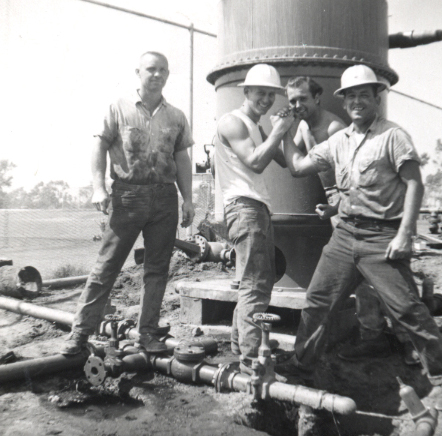
For two summers while in college, I worked for General Petroleum — later known as Mobil Oil company, as part of a gang of roustabouts who took care of oilfield maintenance around Southern California. There I learned the oil business at the end of a shovel. We dug trenches, laid piping, cleaned oil storage tanks. Then, there was no protective breathing equipment, we just crawled in through a small hatch with a fire hose and washed out the accumulated sand and wax, breathing the fumes as we worked.
In the Santa Fe Springs oilfield, our most exciting job was pulling down old wooden derricks by attaching a steel cable halfway up and pulling them over with a truck. Coming back once from a hot day digging trenches in Placerita Canyon, we stopped at a dingy bar in Santa Fe Springs. I was seated to the left of our lead man, a guy named Ollie.
All was peaceful until there was a sudden movement next to me and I was amazed to see that Ollie had pivoted to his right with a left hook, knocking the guy next to him completely off the bar stool, putting him flat on his back on the floor. Apparently, he’d made some comment to Ollie that wasn’t appreciated. He wasn’t part of our crew. After a few minutes, the guy staggered to his feet and walked out. Meanwhile, Ollie ignored him, just kept drinking his beer as if nothing had happened. Another oil field lesson learned.
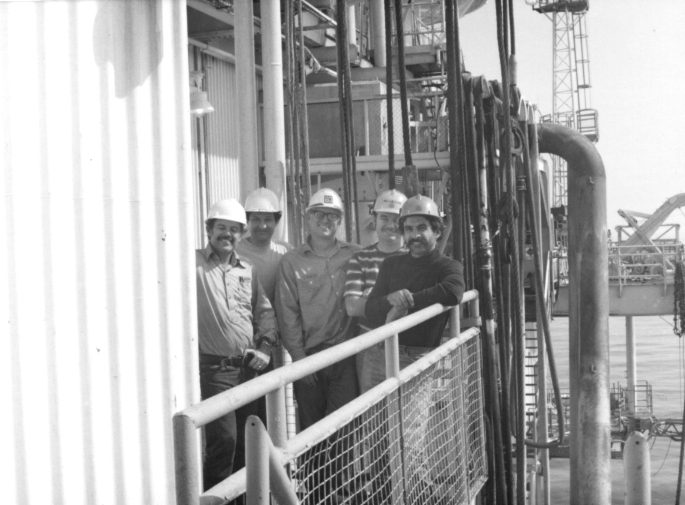
Early in my engineering career I went to Norway on a project for Phillips Petroleum. We flew out on a helicopter to offshore platform 2/4 Delta in the North Sea Ekofist field. We spent 10 days there performing structural tests. The purpose was to identify possible wave damage.
Later, I supervised construction of two control buildings in the Chevron oil refinery El Segundo California. Oil was delivered to the refinery by tankers tied up to an offshore mooring.
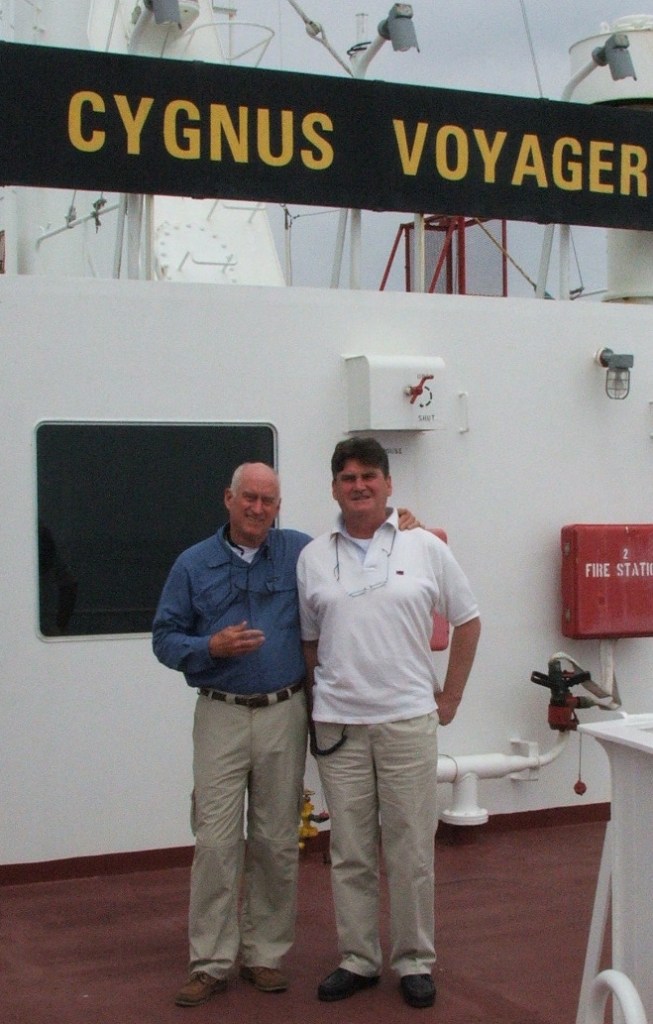
A memorable experience was to ride the Cygnus Voyager, a million-barrel tanker, south to Oceanside, California, to meet up with the TI Europe, carrying 3 million barrels of oil. It was too large for El Segundo’s moorings, so she transferred oil to the Cygnus Voyager. The two vessels met at sea and carefully came side-to-side with each other to transfer three loads, after which she made the month-long trip back to the Gulf for another load.
At this time, I lived in West Los Angeles not far from Beverly Hills. When we bought the house, the Realtor told me we would receive a royalty check from Gulf Oil for $8 or $10 per year. Nearby Beverly Hills High School even had oil wells on the campus.
Later I retired and moved to Santa Barbara. I loved the area with its harbor, views of the Channel Islands, and beaches. That’s where I first saw the offshore wells — source of the disastrous oil spill in 1969 that led to the creation of Earth Day, and later, the Refugio Beach spill in 2015 that dumped 140,000 gallons of crude oil on a pristine beach with cleanup and legal costs over $250 million. On my first visit in 2023, all the mess had been cleaned up, the wells shut down, and sea and beaches serene and clean.
Then, in September 2024, there was news that a company from Texas had arrived and started repairing the 50-year-old pipeline that leaked in 2015. A small problem was they had no permits to do so. In short order they received cease and desist orders from local authorities, a $18 million fine from the Coastal Commission in April 2025, and were charged with five felonies and lesser crimes by the Santa Barbara County District Attorney and next sued by the State Attorney General. The oil company then sued the Coastal Commission for $377 million for trying to stop its activities.
That’s oil business for you.
Craig B. Smith, PhD, is a former faculty member in the UCLA School of Engineering. During his career as a professional engineer, he worked on many energy and power projects.


You must be logged in to post a comment.