

The Santa Barbara Independent’s
40th Annual Celebration of Community Heroes
By Indy Staff | Photos by Ingrid Bostrom
November 26, 2025
Every Thanksgiving holiday, the Santa Barbara Independent publishes a special Local Heroes section honoring some of the great people who make our county an exceptional place to live. It is a tradition that began 40 years ago, when the Independent first began publishing. Since then, we have honored close to 800 people and organizations.
These Local Heroes have been our neighbors, our colleagues, our friends. Some have been in positions of prestige and power, but most have not. They share qualities of kindness, generosity, and courage, all going about the normal course of their daily lives, doing what they can to bring help and comfort to those they meet. Their actions remind us that we all are in this place together. We all belong here. We are all neighbors.
It is with heartfelt appreciation and our great pleasure to honor the Local Heroes of 2025.

Dalia Garcia
Bringing Indigenous Art
to MCASB
Art and activism go hand in hand for Dalia Garcia, who works tirelessly to promote and further accessibility and visibility for the Indigenous immigrant and undocumented communities in Santa Barbara County. An Indigenous Mixteca woman, Garcia immigrated to Santa Maria from San Quintín, Baja California, in 2004, when she was just 16 years old. Learning English, going to school and working in the fields alongside her parents, she also discovered her passion for art during those high school years, inspired by the colorful textile techniques of Oaxaca and her desire to learn more and more about the art and practices of her own family.
After graduating from San Jose State, she worked as the Youth Program Manager for MICOP (Mixteco/Indigena Community Organizing Project), and got involved with Museum of Contemporary Art Santa Barbara (MCASB) by collaborating on the Sangre de Nopal exhibit, which explored the mighty cochineal, found in the nopal cactus in Oaxaca and long cultivated by the Zapotec people as a source of a mythic red dye coveted for fabric and textile work.
When she was asked to come on staff at MCASB, where she now serves as executive director, Garcia took the leap.
Among that work has been the production of the Día de los Muertos Calenda — an innovative cross-institutional collaboration in the heart of Downtown Santa Barbara that saw rapid growth in the first two years from 1,500 to 10,000 participants sharing and celebrating contemporary culture bearers and their cultural heritage and creative expression.
Art met activism with that particular project this fall, when unfortunately, with today’s realities of ICE raids, detentions, and disappearances, the event was called off through Garcia’s leadership and her clearly articulated desire to keep these communities safe.
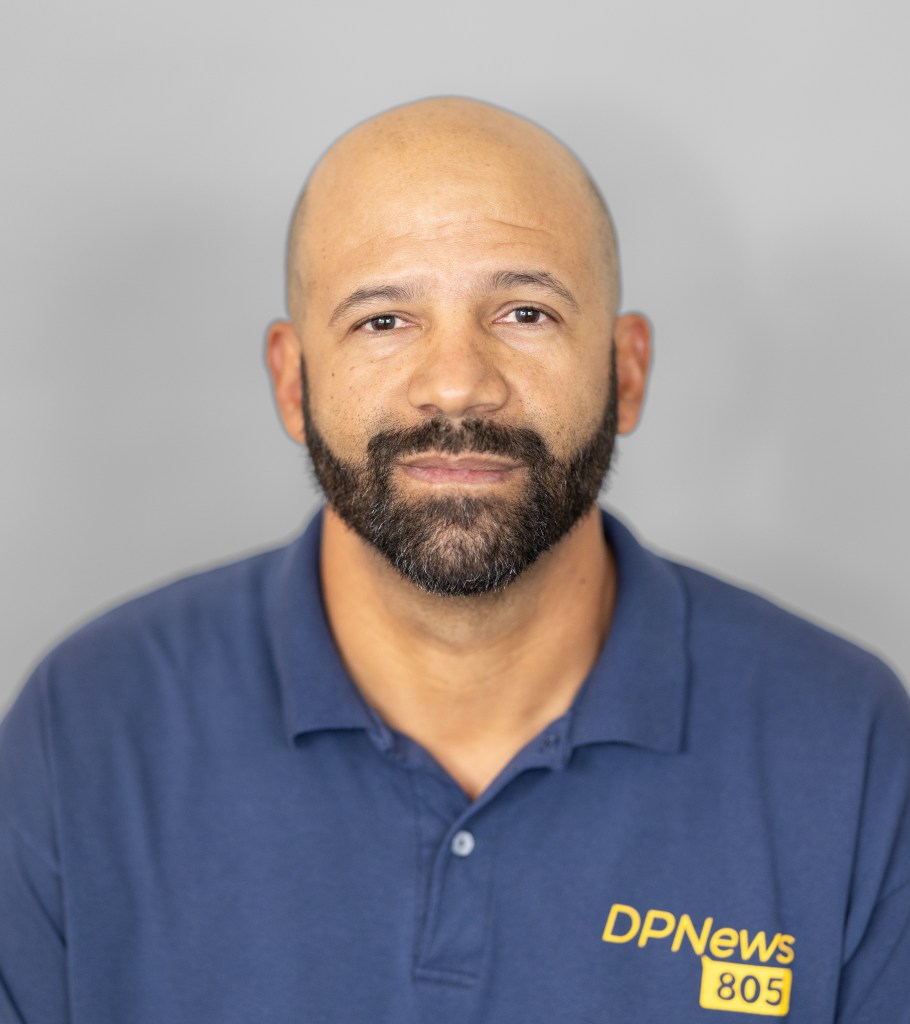
Doug Caines
Coaching and Teaching Excellence
“I feel blessed that I have found two passions that I can meld into one career at Dos Pueblos,” Doug Caines said. Those passions, teaching and coaching, have brought Caines and the high school widespread recognition. DP’s Flag Football team is the Channel League’s champion, and the student-led DPNews network has won many national awards, making it one of the best programs in the country.
Caines rallies his DPNews team in much the same manner he inspires his flag football team, with an unrelenting commitment to excellence. “I lead our news class like a sports team,” Caines said. “We have a deadline to meet, and it’s game day.”
Though the leadership of Caines and his fellow advisor John Dent cannot be ignored, Caines is adamant that it is the students who produce the exemplary coverage, not the instructors. “I have never produced a story for DPNews,” he said. Caines’s pride in the students’ work is evident as he points to the sheer volume of awards received at the National Student Television Network Convention in recent years. “We have a lot of plaques on the wall, and each one is a story told to a national audience,” Caines said.
On the gridiron, Caines has made the transition from tackle football head coach with stints at Santa Barbara High and Dos Pueblos to becoming a flag football innovator. The Chargers finished their 2025 campaign with a 24-3 overall record. In the final MaxPreps rankings, they finished No. 7 in the State of California and No. 14 in the nation.
Caines, raised by a single mother, attributes the successful trajectory of his life to a small group of influential teachers and coaches at Santa Barbara High. It’s that experience that inspired him to have a similar impact on young people.
With all of the extra hours mentoring students in two award winning programs, Caines credits his wife, Nicole, for making his service possible by picking up the slack at home.
“I would be remiss if I did not mention Nicole Caines,” he said. “The only reason I can lead these two teams is because she has my back.”
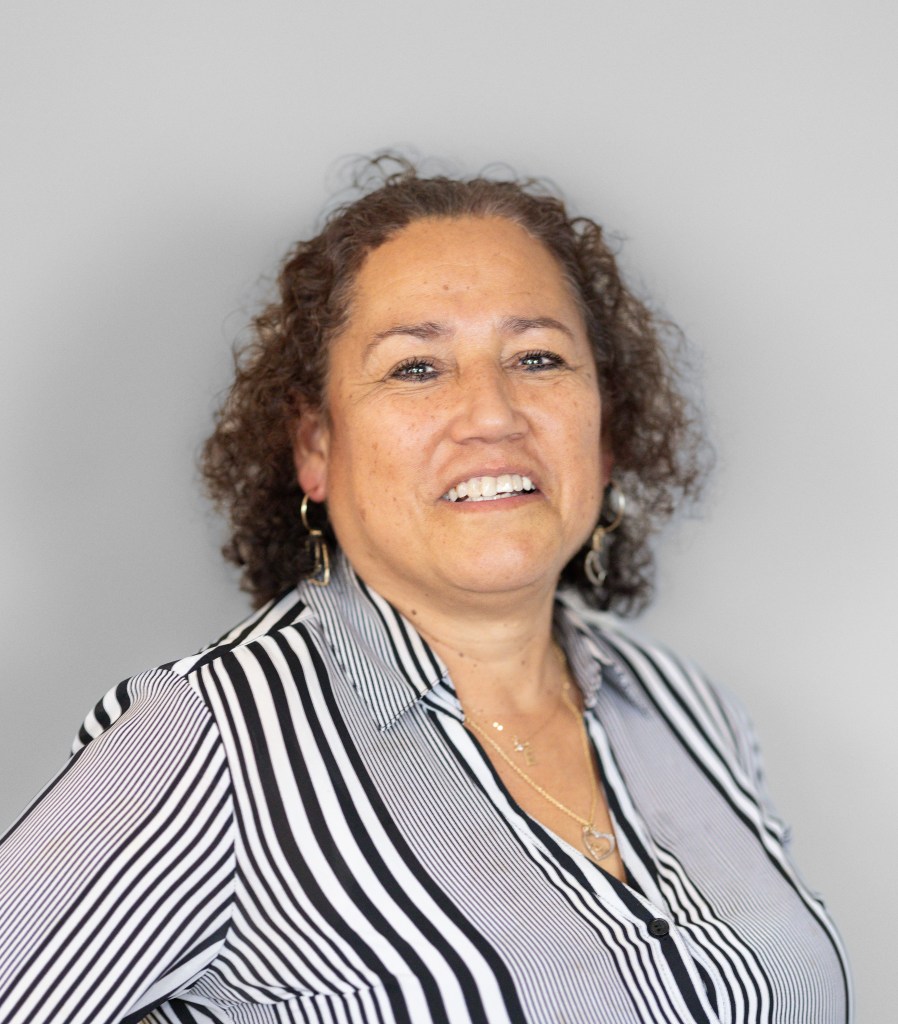
Elena Cruz
Championing for Childcare
Finding good childcare in Santa Barbara, any parent will tell you, is a brutally difficult undertaking. First, you need to search high and low for a place that even has room. Right now, there is a massive deficit of 9,500 licensed spaces for kids aged 0-5 across the county. Then, you have to figure out how to pay for it. Many families spend up to a third of their income on tuition. Finally, if you’ve managed to clear those first two hurdles, you are then required to place an incredible amount of trust in near-strangers to safely look after your little pride and joy.
For 35 years, Elena Cruz, owner of Elena’s House Daycare, has helped fill this essential and growing need for Santa Barbara families, providing a clean, affordable oasis of supervision and learning out of a charming corner building on Olive and Ortega streets. Just as importantly, she is the bilingual co-president and longtime matriarch of the Santa Barbara Family Childcare Association, a support system for licensed providers who need all the championing they can get.
When Cruz came to Santa Barbara from Peru in the 1980s, she needed to earn a living but also wanted to be with her kids, so she took SBCC adult education and WEV (Women’s Economic Ventures) courses on how to open a daycare and obtained her diploma in early childhood education. Her specialty is babies up to 3- or 4-year-olds, and while the work is undeniably exhausting, she loves it. “The kids keep you on your toes,” she said, “but they make you smile every day.”
An enthusiastic advocate for childcare, she speaks with elected officials and nonprofits about how to bring more providers into the fold. “We have to try to convince young people to get into the childhood field.” Because what is more important, she asked, than properly supporting the people who help raise our kids? “It’s better for the community to raise good children,” she said, “because then you get good adults.”

Fran Galt and Paulina Conn
Saving History and Pedestrians
A meandering asphalt path along Mission Canyon Road joins a sand and dirt walkway headed toward Rocky Nook Park. Cars and trucks rush along the road’s curves, but they stop to let a young mother pushing a stroller go across, “winky blinky” pedestrian lights flashing at the broadly striped crosswalk.
Paulina Conn and Fran Galt watch the mother and child cross the road safely with some satisfaction. They’ve worked for years to make the road safer and more attractive. The two friends are quick to name the neighbors who’ve helped them rehash the slower speed considerations and planting and pathway designs with the county, but it really got started when Galt learned the caretaker’s cottage at Rocky Nook Park was going to be torn down.
“That was a total surprise, because nobody knew anything, except for a sign on the door about a demolition,” Galt recalled. That was in 2014. It took a decade, but through Galt’s research for the historic landmark application, which earned the favor of not only the Historic Landmarks Commission but also the Barbareño Chumash, in June, a bronze plaque on a boulder declared the park to be County Landmark Number 54.
The perseverance continues as they care for the drought-tolerant native plants they’ve planted along the road. Conn carries cans of water to the coyote bush and monkey flower plants during the summer, but it’s not just for the greenery. The plantings and sandstone rocks help guard the shoulder against illegally parked cars.
The cottage may have a better chance at survival than the monkey flowers, which tend to get stepped on, said Conn. Built in 1932, the cottage has a stone foundation that likely dates to a mission-era adobe, a centuries-long story of survival against time and bureaucracy, with a little help from its friends.

Grace Fisher
An Inclusive Artist and Composer
Who Gives to Many
When the Kennedy Center honors one of our local heroes before we do — as they did in 2024 — you know this is a recognition that’s long overdue. Grace Fisher received the Kennedy Center’s Emerging Innovative Artist Award in recognition of her inspirational art. At just 26 years old, Grace Fisher has an amazing track record of accomplishments.
After being diagnosed at 17 with a rare illness that left her paralyzed from the neck down, Fisher found a new passion working to enrich the lives of people with disabilities through the arts. An accomplished composer and painter (she holds the paintbrush with her teeth), Fisher has used her talents to bring awareness and raise enough money to create a home for her free arts programs at the Inclusive Arts Clubhouse in La Cumbre Plaza.
One fundraiser is the annual Winter Music Showcase, which takes place on December 14 at The Granada Theatre. She’s currently working on an original piece for the performance, as well as other orchestral arrangements. “I love the collaborative aspect…. That’s been really fun to help coordinate, and also having our kids and our participants perform. That’s just such a joy to see them,” said Fisher.
In addition to getting a new Sensory Retreat Room, the Hidden Haven, up and running at her Clubhouse this year, Fisher also worked with the Eastside Library to develop a similar smaller space for kids and families that have sensory processing difficulties.
Reflecting on her journey, Fisher said, “I feel like I’ve done way more than I could have imagined. I think initially when everything happened to me, it kind of seemed like the world was over for me, all my hopes and dreams were not realistic anymore, and it took a while for me to realize that there was a life beyond everything that I was initially envisioning for myself. … But once I did accept it, I had to keep going. I think the foundation has been a way for me to give back. It also fills my well.”

Jennifer Wasem
Taking the Books to the Child
Back in the early stages of COVID-19, when school campuses closed down, Hope Elementary School Librarian Jennifer Wasem still showed up to work. Wasem, a certified bookworm, set up a mobile, drive-thru library — composed of bookshelves on wheels — in front of the school.
Wasem was a reliable companion and source of calm for the young students, whose social lives and education were so suddenly upended by the pandemic. When panic was pervasive, she promoted peace through her library’s pages. She’d spend hours helping kids find their perfect book, and because she didn’t have access to a computer, she’d keep track of the library’s inventory using pen and paper. She offered families a friendly and familiar face, as she has done for 20 years and continues to do among the school’s shelves.
Wasem said she gets to know her students so she can locate their ideal book. They light up when she reads them the synopsis on the back, she explained, so she grabs a few she thinks they’ll like, reads off the backs one by one, and lays them out for the kids to choose.
“All I ever really wanted to do was work with kids, and I love books,” she said. “One of my very favorite things to do when a student comes in is going on the hunt for a book they’re going to enjoy.”

John Johnson
Connecting Past to Present
Anyone interested in what life was like along the Santa Barbara Channel centuries ago knows John Johnson, who served as Museum of Natural History’s curator of anthropology from 1986 until 2023. But his biggest fans are Chumash descendants whose ancestors thrived here prior to Spanish contact, as Johnson’s research connects them to their families’ long legacies.
“Looking back at my career, I’ve gone from the impersonal to the personal,” said Johnson, who was drawn to anthropology through material remains and dusty archives, but then started reconstructing genealogies. “You learn the names of the people. You learn their lives.”
He first worked with Ernestine Ygnacio-de Soto more than 40 years ago, and he’s still at it, fielding more than a dozen requests in just the last few months for genealogical research. He cofounded the S.B. County Archaeological Society and volunteers for the S.B. Mission Archive Library and San Marcos Foothills Preserve.
Johnson grew up in Corona del Mar, and his dad was an accomplished lepidopterist, with many species of moths now bearing his name. His early archaeology interest led to digs on Santa Catalina Island and summers at a camp in New Mexico. After studying anthropology at UCSB, he worked as a firefighter for the Los Padres National Forest, which hired him to wander the backcountry and look for any disturbed ancient sites. That led him back to UCSB for graduate degrees.
In his so-called retirement, Johnson is helping elderly colleagues publish what will likely be their final works and consulting for PG&E on the ancient Chumash villages located near the Diablo Canyon nuclear plant. “I love this kind of research, just burrowing into the record and seeing what you can find,” said Johnson, who still has plenty of work to do. “I hope to get back to my own stuff this coming year.”

John Palminteri
Bringing News from Everywhere
If a tree were to fall anywhere in Santa Barbara and TV news reporter John Palminteri were not on hand, philosophers would ponder whether it really happened. And with good reason.
Ever since Palminteri first moved to Santa Barbara in the early 1980s at age 23, he has been a perpetual motion machine when it comes to breaking news. He’s everywhere. You can hear his news reports on radio stations KCLU and KJEE; you can watch him on KEYT.
But in some ways, these traditional media outlets are mere appendages of John Palminteri. Palminteri estimates he has about 60,000 followers on his multiple social media platforms. People who do not read newspapers or watch TV news — younger people, for example — get their fix of local news on their cell phones courtesy of Palminteri.
If there’s a fire, a flood, or an inebriated UCSB student falling off an Isla Vista cliff trying to throw a keg over the edge, Palminteri will be there. “I am self-deployed,” he said. Unless he’s wearing his yellow raincoat — his signature fire gear — Palminteri shows up on camera dressed crisply in a trademark dark suit. If there’s a flood, Palminteri won’t be content with a shot of rushing water. He wants people. “I want spectacle, and I want emotion,” he explained.
When Salud Carbajal confronted federal agents during a summer ICE raid in Carpinteria, Palminteri was on hand. “Salud managed to get past the line of scrimmage, but then they pushed him back — twice,” he said. Palminteri was right behind Carbajal the whole time. Viewers not only saw what happened; they felt it. “I call that intuition; I call it a gut feeling; I call it experience.”
Palminteri says he’s in the eighth inning of life. He doesn’t have much time for sleep. In his free time, however, he does stand-up comedy and emcees charity events. In his next incarnation he’d like to be a cross between Jimmy Kimmel and Ed Sullivan. In the meantime, he said, “I enjoy being the first to find something out and the first to tell the story.”
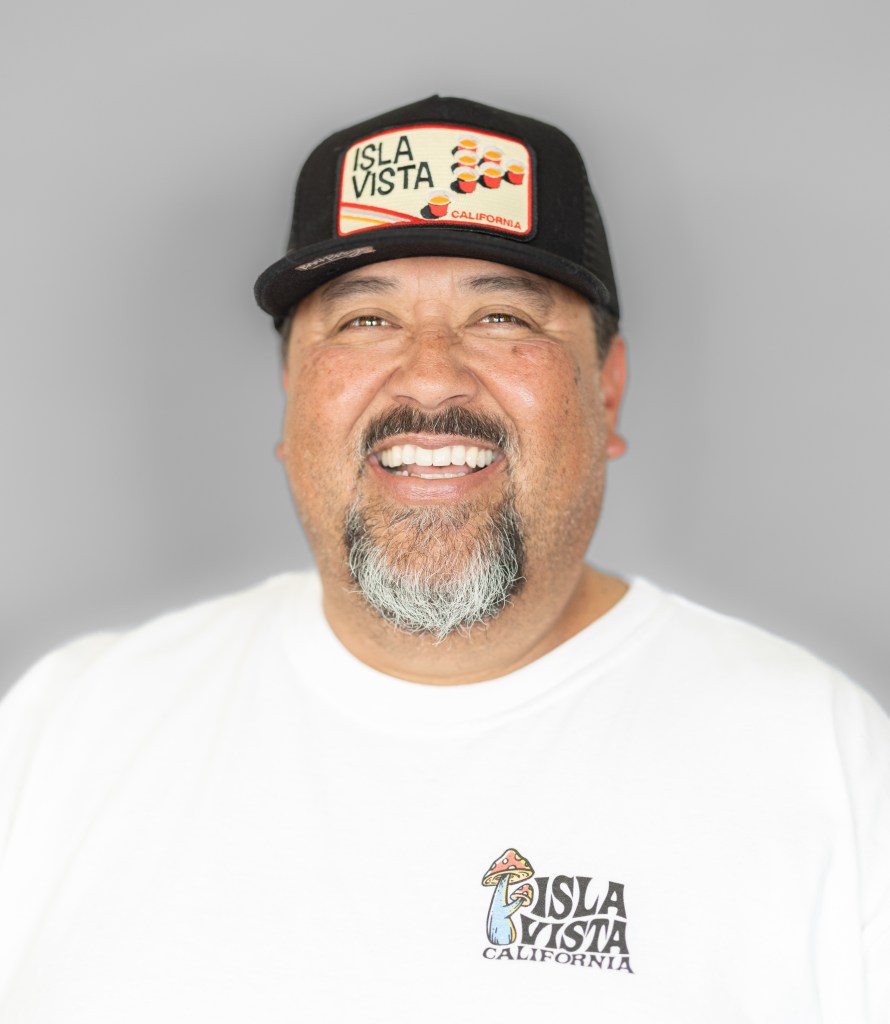
Jorge Lopez
Spreading Love in a USPS Van
In a town where most of the inhabitants have just left the nest and are finding their way through adulthood, a wise yet jubilant mailman has your back. For 30 years, Jorge Lopez has delivered mail through the packed streets of Isla Vista, dodging college students on bikes while music spills out of balconies, and shouts of “Jorge!” follow his white U.S. Postal Service truck down Trigo. He always calls back: “Hey, hey!”
Lopez, who turns 55 this year, never expected to spend his life working a route most mail carriers avoid. “I started way back in the day,” he said, at a family barbecue in 1996 where an uncle encouraged him to try the job. “They threw me out here, and I thought, ‘Oh, heck yeah!’ ” Though some carriers found Isla Vista chaotic, he immediately felt at home. “I just fell in love with it… . I was 25 years old.”
Three decades later, Isla Vista has become part of his identity. “It really is my home,” Lopez said. “It’s a part of me … everybody, I just feel, is my family.” He defends the town fiercely. “You can say it has some bad things … but all the good, a million percent, outweighs the bad things here.”
That “family” sees him the same way. Students flag him down for help — a bike chain off its track, a dead car battery — and Lopez, on his break, once recruited half a block to help locate jumper cables. “It was funny … three of us going knocking from house to house,” he said. “It just goes back to the kindness thing.”
His wife, Mischa Lopez, said he brings “warmth and positivity” that comforts students far from home. Lopez says he’s proud of them, too. “They are going to school, graduating, maturing…. I get to see that.”
As for being named a Local Hero, Lopez paused. “I have no words … it’s just super awesome!”

Laura Wyatt
Leading the Trash Mob
It all started out simple enough. Five years ago, Laura Wyatt, a lover of the great outdoors, was taking a walk. When she stumbled onto a plastic bag stuck in a bush, she plucked it out. When she came across more trash, she put that in the plastic bag. “I’m neat,” she explained. “I love nature. It disturbs me when I see trash.” That would be the genesis for what’s evolved into a five-year ad hoc volunteer initiative that goes by the catchy name Trash Mob.
Once every four Sunday mornings, Wyatt and a crew of about 10 like-minded women hit the road in search of errant trash. Wyatt will have already done the recon. “We follow the trash,” she explained. “It has to be accessible. And we have to be able to park nearby.” Wyatt supplies the gloves, the trash bags, and the pickers. She and her crew — the roster shifts over time, but four of the original 10 are still involved — provide the muscle, energy, and camaraderie. Everyone gets along so well that they now have to show up 15 minutes earlier than usual to get the socializing out of the way.
After about 90 minutes of bending, pulling, plucking, and lifting, Wyatt and the Trash Mob will have collected about 25 garbage bags of trash, including cash dollars, a duffle bag full of cannabis, ammo casings — you name it. Once, Wyatt found a blank check owned by someone she knew. They also find bike parts, old microwave ovens, and other stuff too big to fit in a plastic bag. Often, they clean up the edges of homeless encampments. And yes, there are needles and human feces.
Over the years, a few men have shown up, but, Wyatt noted, they don’t typically last. “It’s the ladies who stick it out,” she says, sounding like a modern-day Abigail Adams. Getting face to face with so much detritus can get dispiriting, but afterward, everyone feels great. “I definitely feel beat-up and dirty, but I like to see results, and we get results,” she said. “I feel proud.”
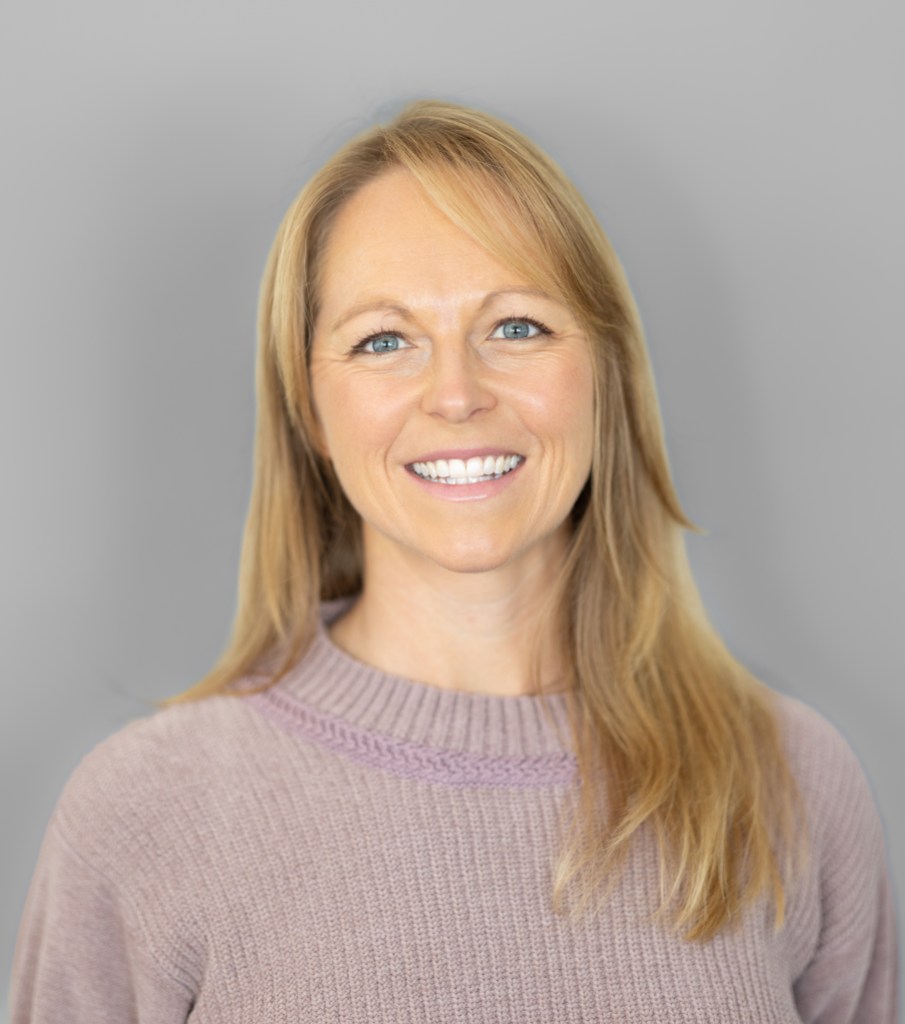
Megan Birney Rudert
Sending Light into the World
It’s something that many of us take for granted: light. All over the world, people live in darkness.
But there are glimmers of hope. Megan Birney Rudert leads the Santa Barbara–based nonprofit Unite to Light, which works to deliver solar lights and battery banks to those living without power, whether that’s due to poverty or disaster.
These super-powerful lights and chargers make a drastic difference in the lives of everyone from schoolchildren, allowing them to study at night; to basket weavers, allowing them to work a few more hours; to shepherds, allowing them to keep closer watch over their herd — saving both shepherd and flock.
“We can send a solar light almost anywhere in the world for about $10,” Birney Rudert noted.
A longtime environmental advocate, Birney Rudert became the chief executive officer of Unite to Light in 2016. She had been working in the solar industry, and she saw this as the opportunity to use her experience to make a difference.
“When I started, there were about 1.5 billion people without electricity,” she said. “We’re down to about 750 million. So, that’s still one in 10 humans, but we’ve halved it.”
Last year, while working with the World Food Program in Sierra Leone, Unite to Light learned that that program had designed an app for teachers to order food from local farmers. “That’s super cool,” she said, “… unless you don’t have power for your phone.” In response, Unite to Light launched a pilot project to equip 200 teachers in the more remote villages with solar chargers, adding extra lights for a students’ “light library.”
“The teachers had literally been hiring a bike messenger to bike their phones to a neighboring town and power it on a diesel generator,” she recounted.
The nonprofit follows a “buy one, donate one” system, so it’s these stories that you hear when you donate or buy a product. It’s possible, Birney Rudert said, to send a donated light or charger to a specific region or even a single person.

Mehrdad Homayouni
The Man Behind the Sam
A fixture of Isla Vista, the sandwich shop Sam’s To Go is run by a man known to many as simply that: “Sam.” Hardworking, ever-present, and with four decades in, the man behind the “Sam,” Mehrdad Homayouni, is adept at serving sandwiches and supporting a neighborhood built on change.
Homayouni opened the I.V. location in 1987 and has watched as generations have come and gone. “It’s a joy to work here for the kids,” he said. “By now we have so many alumni, and they bring their kids to go to school here…. I always get excited when they all come in to see me.”
Originally from Iran, Homayouni came to California to study industrial technology at Chico State. He worked in restaurants through college, managing three or four locations before eventually taking over Sam’s from a friend. He could have pursued a more traditional career path, “but I couldn’t see myself going to an office,” he said. “So, I started doing this.”
During these years, Homayouni built more than a sandwich shop — he’s created a place where students feel at home, whether they’re celebrating or stressed, in a large group or solo. “We made Sam’s a very comfortable place,” he said. “Students get really stressed … so they get to come in here, and we let them have fun.”
Giving students a safe place to scarf down a sandwich is not the only thing Homayouni provides. “We do a lot of fundraising, especially with the fraternities and sororities,” he said. “Two weeks ago, I wrote a check for $500 for Alpha Tau Omega (ATO).”
Though times continue to change, the turnover of new waves of students entering each year, the heart of Sam’s remains. “It’s always been fun,” Homayouni said. “I wouldn’t do it anywhere else.”

Mike Lazaro
Making the Good Times Roll
Founder of Carp Events Mike Lazaro, known to everyone as “Laz,” knows how to throw a party. For as long as he can remember, Lazaro has loved bringing people together for a good time, and it makes sense, given when he came into the world. “I was born on New Year’s Eve, so I came in at a party,” he said.
Lazaro grew up as a self-described “crazy kid” from New Jersey, whose journey to planning major events — such as Carpinteria’s Avocado Festival, Santa Barbara’s Earth Day, and the Rods and Roses car show — began with following the Grateful Dead to Vermont and working as a grill cook. Even back then, he loved bringing people together with food, music, and a good time. After he got his culinary degree on the East Coast, he began running his own culinary events.
“People put their guards down, and they’re joyous when they’re in that celebratory mood,” he says. “So, I always think, ‘How do we do that conscientiously and bring the community together?’ ”
When he landed in Carpinteria, the Avocado Festival was a much smaller event, but a source of pride for the community. He began by cooking taquitos for the VFW Booth more than 37 years ago, and eventually was asked to help plan the annual celebration. At the time, he remembers doing anything he could to get the party started — including bringing his own music gear to set up a second stage.
Lazaro worked the same magic in Santa Barbara with Earth Day and Solstice celebrations. That magic touch happened 16 years ago when he revived Carpinteria’s Alcazar Theatre.
With all of these events, Lazaro puts the community at the center of everything. His mantra is, “Everyone’s invited,” and that flows through every one of his major events, whether that be at the Super Bowl, Notre Dame Stadium, or the local park. “I’m so blessed with the opportunities that I’ve had,” he said. “It’s not even work.”

Peter Claydon and Susan Miller
Riding Toward a Better Life
Horses help heal the hurt. That belief is what motivated Peter Claydon and Susan Miller to found the nonprofit Santa Barbara Youth Project in 1998. For the past 27 years, this duo of professionals has guided thousands of at-risk children through transformational experiences with their summer horse camps and newly added after-school programs.
Clayton, a practicing psychologist in Santa Barbara for more than 33 years, and Miller, a retired clinical care and hospice nurse, are both highly accomplished equestrians who have combined their love of horses with a great compassion for children in need. Peter, a global leader in equine-assisted psychotherapy, is a skilled horseman who has completed the rigorous 100-mile Tevis Cup ride across the Sierras four times. No small feat. Susan has 45 years of equestrian experience in dressage and jumping and for years was a trainer of both horses and their human partners. Both are certified equine specialists.
As they have often stated, “The children we serve are part of our community. but their hurt is often not seen.” But through the Youth Project experience, powerful healing can come when child and horse develop a quiet understanding and communication. Why horses and people can have such positive effects on one another is something we may never know, but the Youth Project has more than proved the concept. Through their work, Peter and Susan have helped make better for so many.
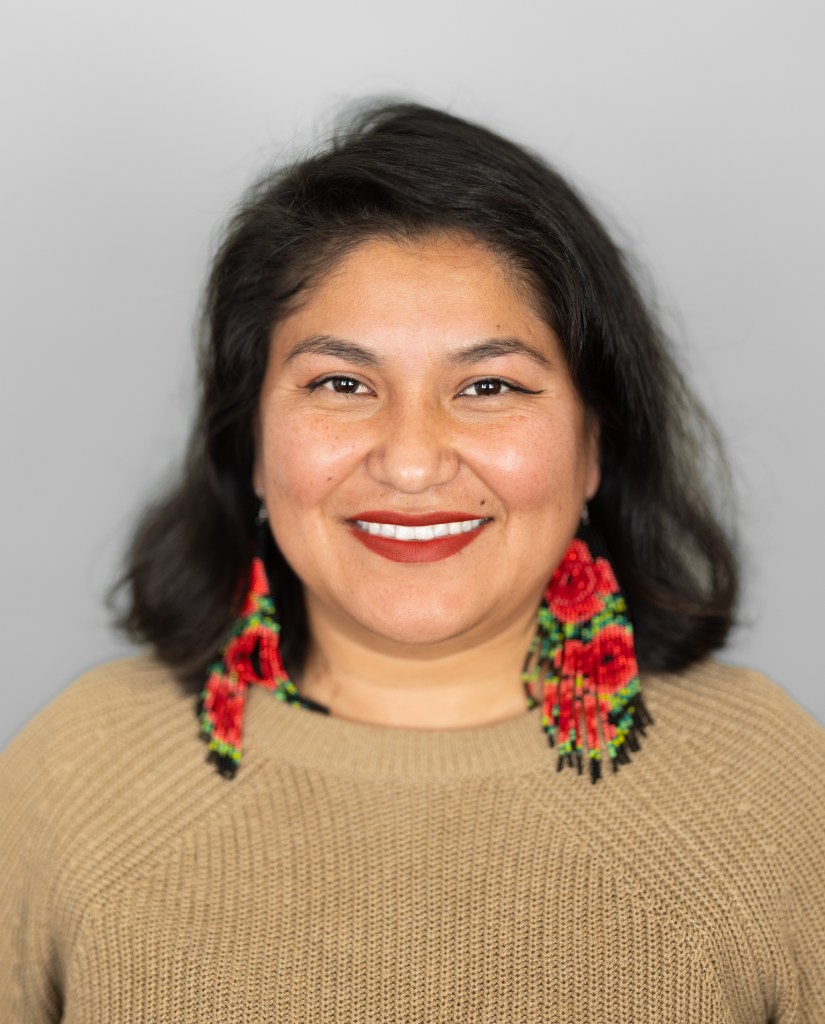
Primitiva Hernandez
Helping the Undocumented
This year has been a whirlwind for Primitiva Hernandez, executive director of 805 UndocuFund. When President Donald Trump began his second term in January, his administration unleashed the full force of its federal immigration enforcement on the undocumented communities of the Central Coast, with more than 1,000 arrests recorded by 805 UndocuFund’s Rapid Response Hotline.
“We knew the second Trump administration was going to be so much worse than his first term,” she said, “but I don’t think we were expecting this outright lawlessness, disregard for the Constitution, and for the rights the Constitution has afforded everybody.”
Hernandez has led the Rapid Response Hotline with a small staff and a team of hundreds of volunteers, to provide resources for the hundreds that have been detained or deported in 2025. It’s been no easy task keeping track of arrests, with ICE, DHS, and HSI launching coordinated raids and roving sweeps of masked agents in unmarked cars. But despite the uphill battle, Hernandez and her team have emerged as a ray of hope for the Latino people in the community.
Over the past several months, she has advocated for immigrant rights and successfully challenged local governments to stand with immigrants, not only with statements, but with financial support for legal aid, food, or healthcare supplies for the families impacted by deportations.
Hernandez said that despite the increased fear in the community, there has also been a revived sense of people helping their neighbors, or as the Spanish saying goes, “Solo el pueblo salva al pueblo (only the people can help the people).” Just this year, 805 UndocuFund’s Emergency Relief Fund has raised more than $170,000 in direct community donations, and there have been more people willing to attend community defense trainings and patrol their own neighborhoods.
“There are a lot of galvanizing moments that keep all of us going,” she said. “Despite the horror, we are seeing an awakening of the community — of people seeing the hidden racism discrimination that people of color have been experiencing for a long time.”

Raúl Aguilera
Guiding Students into Adulthood
For the past four years, Raúl Aguilera has spent his career lifting up students and families across the Central Coast. As Director of the REACH Fellowship, a program that helps guide students from low-income backgrounds by offering academic and career readiness to outdoor exploration and leadership skills, Aguilera’s mission is making sure students feel guided not just in school, but also throughout their transition into adulthood.
Having been part of the REACH program himself in 2009, Aguilera has come full circle, now mentoring hundreds of first-generation students as they navigate life after high school. With his support, more than 95 percent of the students in the Reach Fellowship went to college this past year.
His passion lies in helping young people discover their strengths. Aguilera believes that giving students the knowledge and tools they need can spark real, lasting change. At REACH, his day can be filled with either recruiting future REACH students who could use the support or by providing workshops to current REACH students that include cooking, financial literacy, college tours, essay writing, and financial aid applications.
Even when schools are out of session, he leads tech-free learning adventures to places such as Bolivia, Ecuador, and Guatemala, encouraging students to step outside their comfort zones, build mindfulness and self-confidence, and connect with the environment.
As a first-generation college student who faced limited access to resources, Aguilera worked to reach his goals, earning associate degrees from SBCC, a bachelor’s in Spanish from CSUN, and a master’s in Educational Leadership and Administration from Cal Poly. “At first, I thought I wanted to be a teacher to help out similar students like me, trying to help provide guidance to those who don’t get it from their school or household.”
Born in Jalisco, Mexico, and raised in Santa Barbara, Aguilera continues to champion opportunities for underserved communities within Santa Barbara County, helping open the door to shape the future for the next generation.

Raul Cano-Rogers
Sending Out the Live Music News
It all started when Raul Cano-Rogers saw Rent Party Blues Band at the old Seven Bar in 2015. He had recently moved to Santa Barbara. “I’m like, ‘Wow, I want to hear that band again. Where are they going to play?’ And it was hard to find something, right?” Cano-Rogers began using social media and word-of-mouth to find out about gigs.
According to Cano-Rogers, he just wanted to share the feeling that live music gives him. “I wanted to share that with my friends, and then my friends wanted to share that with their friends, and those friends wanted to share with their friends. So, it just kind of grew.”
And grow it did. What began as a way to recommend upcoming shows to close friends evolved into a concert-dedicated platform to keep the community-at-large informed about the many musical happenings around town: Live Notes S.B.
Cano-Rogers started posting daily lists of concerts on Instagram in 2018, all in an effort to promote local artists and venues that he felt didn’t often have the time or energy for self-promotion. His mission was simple: “Hey, there’s live music here. And hey, it’s really good.”
Not even COVID, which brought the live entertainment industry as we knew it to a screeching halt, could stop him from spreading the positivity and hope of music. “Every single day, I posted something,” said Cano-Rogers.
Now, with more than 7,000 Instagram followers as well as a website and accompanying app, Live Notes S.B. provides music lovers a one-stop shop for shows big and small in Santa Barbara County. So far, it has been an unmonetized, solo venture for Cano-Rogers, who browses at least 250 pages online every week, often reaching out to friends, bands, and venues via text or Instagram DM for information. And each week, he attends about six shows himself while continuing to work his nine-to-five in commercial insurance.
Cano-Rogers’s dream show? A “rock guitarist at heart” with a love for the music of the ’80s, he figures that Guns N’ Roses at the Santa Barbara Bowl would fit the bill.

Sarah Aguilar
Sheltering Homeless Pets
with Kindness
A two-week-old gray kitten mews as Sarah Aguilar feeds him from a thumb-sized syringe at her desk in Santa Barbara County’s South County shelter. She gives him a scratch before placing him carefully back into his carrier and getting back to work.
As director of the county’s animal services department, Aguilar not only guides the shelter’s day-to-day operations, from adoptions to foster programs to providing resources that help people stay with their pets, but she has also transformed the department itself into an open, community-driven place that welcomes volunteers and values kindness. For the more than 6,500 animals that end up in the department’s care (just last year alone), and the thousands of humans who care about them, Aguilar’s work changes lives.
“We’ve got more adoptions, more volunteer hours, more foster placements than we’ve ever had in our history,” she said. “And it’s because we’re engaging the community. We’re asking the community to come in and help us, and we’re very transparent about what’s going on.”
Aguilar didn’t always plan to work in animal welfare; less than 15 years ago, she was on track to work as an accountant in corporate America. But a serious car crash changed her life. When she was stuck at home recovering, unable to work but able to move around, she decided to start fostering pets.
From there, Aguilar leveraged her business background to start a career in helping pets. Aguilar has worked at rescues and shelters and for nonprofits all over the country before returning home to California with her partner to take her current job in 2022. Under her leadership, the department’s foster program has flourished and now includes day fostering where folks can “check out” a pup for a few hours. The shelter has also launched a safety net program to help people stay with their pets when times get tough, and expanded its volunteer base. Aguilar continues to coordinate with the complex array of animal support organizations, including ASAP Cats and BUNS (who house South County shelters’ cats and rabbits and guinea pigs, respectively) to help animals find a home.



You must be logged in to post a comment.