
This interview is an edited version of several conversations with Goleta Councilmember Luz Reyes-Martín.
The grief and anger caused by the crackdown on immigration sparked an outcry heard at county and city meetings this summer, when residents vented their outrage or begged their local government to please, please act to protect their neighbors, friends, or families.
“It’s been gut-wrenching to see videos and images of people being chased through farm fields, through car washes, through city streets,” Luz Reyes-Martín said to the crowd that spoke to Goleta’s City Council in July. The councilmember steadied her voice as she spoke of the fear that infected people who looked like her, of the children who looked like her children and had to worry that they’d come home from school and not find their parents or grandparents there.
Her eloquence matched the emotion in the room because she felt it, too. One thing her family loves to do is go to Dodger games, Reyes-Martín told the Independent recently. But when ICE was seen gathering outside Dodger stadium, she had to ask herself, “Do we go to another game? What if ICE shows up?”
Reyes-Martín is both an immigrant and also a third-generation Californian; her grandmother and mother are naturalized citizens, as is Reyes-Martín. Following the path laid out by her mother and father, who graduated from UCLA and the University of Guadalajara, she has a bachelor’s from Stanford and master’s degrees from the University of Southern California. Her clear voice calls for thoughtful action at Santa Barbara’s political rallies where she represents the Central Coast’s Planned Parenthood, which California is supporting after Trump defunded the nonprofit healthcare provider. For Reyes-Martín, the struggle exists on two fronts at once.
Trump 2.0 has changed so much, even the Supreme Court has condoned racial profiling. It’s awful. If you ask anyone who is a person of color, they’ve probably experienced some sort of racial profiling in their life. I think it’s really tragic. It’s also not new. But for it to be so blatant, that part is very distressing and horrifying.
You know, I was in the third grade when Prop. 187 was on the ballot and passed in California. [The proposition eliminated non-emergency healthcare, education, and social services for undocumented persons in 1994 but was struck down by the courts.] I have very vivid memories of the commercials, the anti-immigrant rhetoric around at that time. My classmates talked about it on the playground, about being fearful that it was clear it was about brown people, and it didn’t matter if you were undocumented or not. Will we still be able to go to school, go to the doctor, will our parents be home when we get home? I remember that topic of conversation, and this feels familiar now. We’ve been here.
Your statements during the Goleta meeting about immigration were so moving. What do you hear from your residents? Not long after the raids and big protests in L.A., I was invited to go speak to the residents at Maravilla [senior living]. And I was prepared to answer questions about pavement, public safety, parks, trees. The first question I got was, “I can’t believe what’s happening in Los Angeles. That’s never going to happen here, right?”
They all had family in different parts of L.A., and they were worried. I think the raid in Carpinteria [at Glass House Farms this summer] made it much more real for very broad parts of the community.
Because I’m a naturalized citizen, I’m very proud to be an American citizen. It’s deeply meaningful to me. I’ve had many members of my family that have served in the military, and they are very proud of that service. The administration right now, or folks on a more conservative side than I am, they are not going to take my patriotism from me.
You were a school boardmember before becoming a councilmember. Do you hear from families about their concerns? At Hollister School, I was invited to talk to PTA parents, and they were worried about ICE coming to the school and the people in the community going about their daily lives. Across the board, parents and teachers, everyone was worried for their students. What has been lovely, what I’ve heard from parents and the school district, is they do not see a rise in absenteeism or a noticeable lack of parent engagement. I think this has a lot to do with the trust the Goleta district has built with their families.
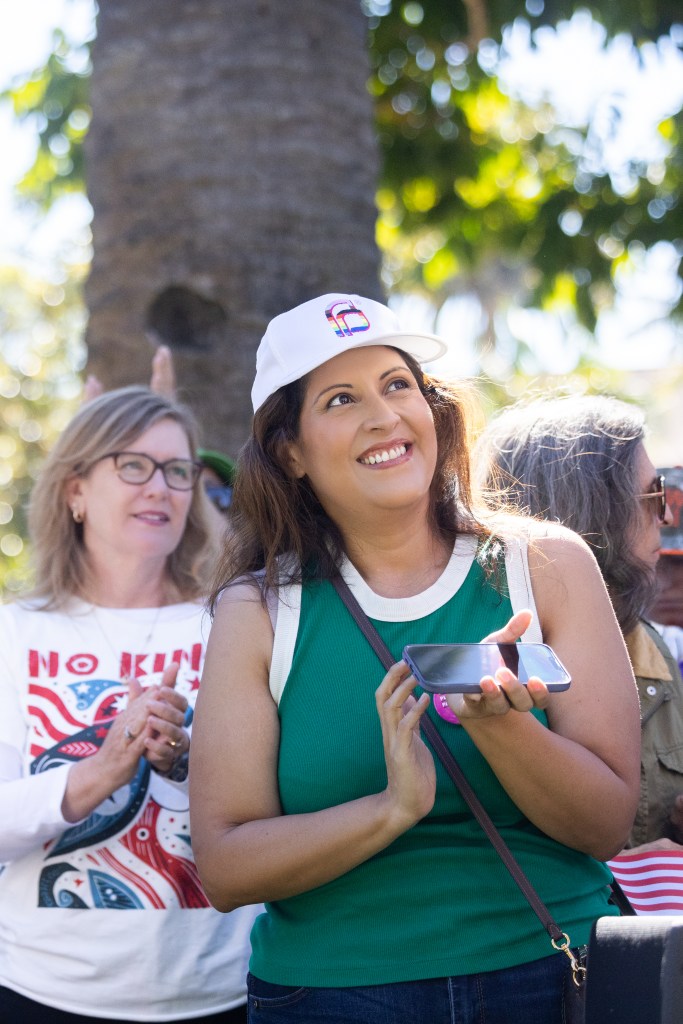
There’s an element of caution you take, as a parent, and you want to shield your kids from whatever is going on. That doesn’t mean they aren’t aware of it, but for my kids, we try to avoid the TV news, the rhetoric that’s so intense.
You have public administration and land use planning master’s from USC. Is there anything you wish you’d worked on in Goleta? The Fairview interchange. [Laughs.] Yeah, that could have been done better. I love that field. It ticks all the boxes from systems to community, and it’s so interdisciplinary.
My first planning job was in Downey, where I grew up. Our home had a white picket fence. We really had that kind of American dream house. Before we moved to Downey, our home was right across the street from a freeway off-ramp, so I grew up right between two major freeways most of my elementary days. And did not have any access to park space or green space. That was a low-income, mostly Latino community.
And the county development on Goleta’s borders? Goleta will be heavily impacted by development right on our borders, and what has been so challenging is trying to find where we can have any input other than just public comment. That’s a tough spot to be in. It’s really frustrating for our residents.
When I was running for council, at almost every single door I knocked on were people who wanted their everyday issues addressed. They expect their local government to make sure that there’s adequate public safety, that roads are safe and clean, that parks are safe and clean. And I agree.
It brings me a lot of fulfillment to work with a really dedicated city staff that feels the same way. Most of the city staff live in Goleta, grew up in Goleta, and are raising their families in Goleta. I think that’s part of the city’s special sauce.
You have a day job, too, as the advocacy and engagement VP for Central Coast Planned Parenthood. What will happen now that healthcare funding is on the line? There’s so much that could have ripple effects in the community. Planned Parenthood is a safety net reproductive healthcare organization. Nearly 70 percent of the patients that go to any of the six health centers rely on Medi-Cal, which plays a huge role in healthcare for the low-income community. That’s a significant part of the overall revenue for the organization. Across the Central Coast, it’s 30,000 patients a year.
It will have an impact on STI [sexually transmitted infection] rates, which are already a very big concern throughout California, and testing and treatment. Wellness exams, where cancer screenings happen, where preventative healthcare happens, all of that will be impacted. Particularly in Santa Barbara, there’s no other healthcare organization that can absorb that magnitude of patients.
Healthcare is an area that truly affects everyone. Having a healthy community benefits everybody in every possible way. I think that’s why you see healthcare continues to be one of the top issues for voters in any community.


You must be logged in to post a comment.