
Cooking Coyote with Betty Fussell
Legendary Food Writer’s Last Memoir
Is About Aging in Santa Barbara and Elsewhere
By Matt Kettmann | Photos by Macduff Everton
December 10, 2025
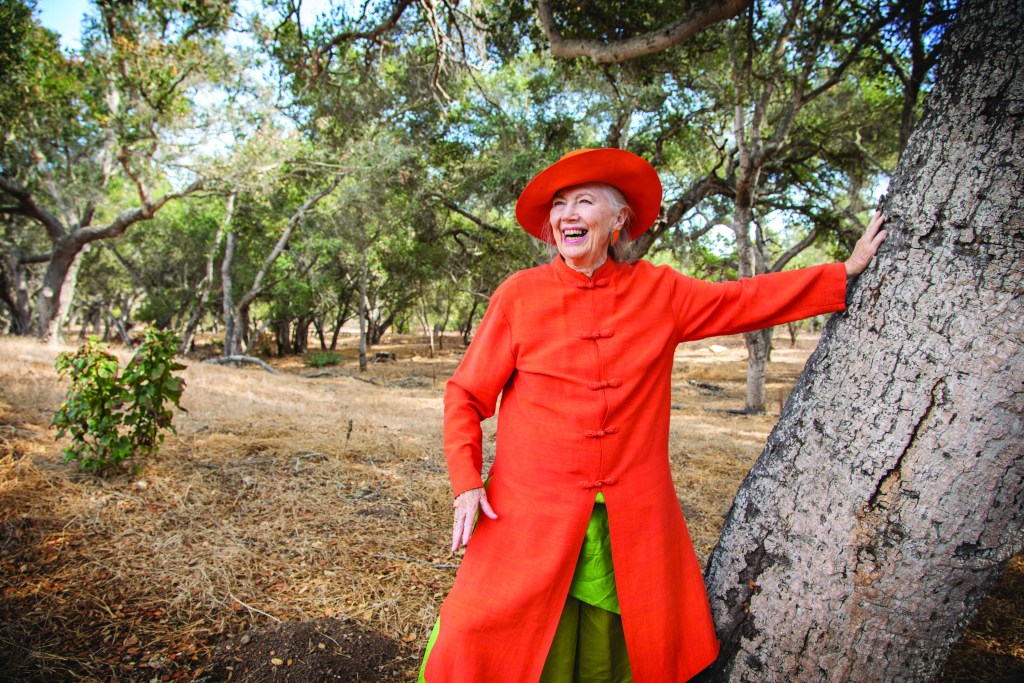
If you have yet to discover this section of the bookstore, somewhere between the rote cookbooks and stale wine country guides, there’s an entire genre of what’s best called food literature. This timeless collection serves the mindful musings of authors such as MFK Fisher, Ruth Reichl, and Anthony Bourdain, with occasional dashes of George Orwell and Jim Harrison in the mix.
Near the top of that soufflé is Betty Fussell, who started penning prose about proteins, corn kernels, and all else a half-century ago, steadily publishing 12 books and winning all the sorts of awards that matter. For the past baker’s dozen of years, Fussell has ladled over the lands of Casa Dorinda, where she relocated from New York City in 2012 to live in the same retirement residence beloved by her late friend Julia Child.
Fussell, of course, did the opposite of retiring, instead bringing a vibrant, colorful, perhaps often disruptive presence to the tranquil environs of the Montecito complex. She continued to write and thrive, and now, at a spry 98 years old, Fussell is unleashing her last memoir on us all.
How to Cook a Coyote: The Joy of Old Age (Counterpoint Press) is a joyous, invigorating romp through Fussell’s waning years, proving incredibly insightful and emotionally meaningful even to middle-aged men such as me. I could not put the 161-pager down, due to such deliveries as this: “We are all going to be evicted from these bodies. When and how is the only question. Slow-motion or sudden. I knew long ago I didn’t want to fight it. I’d like to dance with it, at least, hungry till the end of our foreplay.”
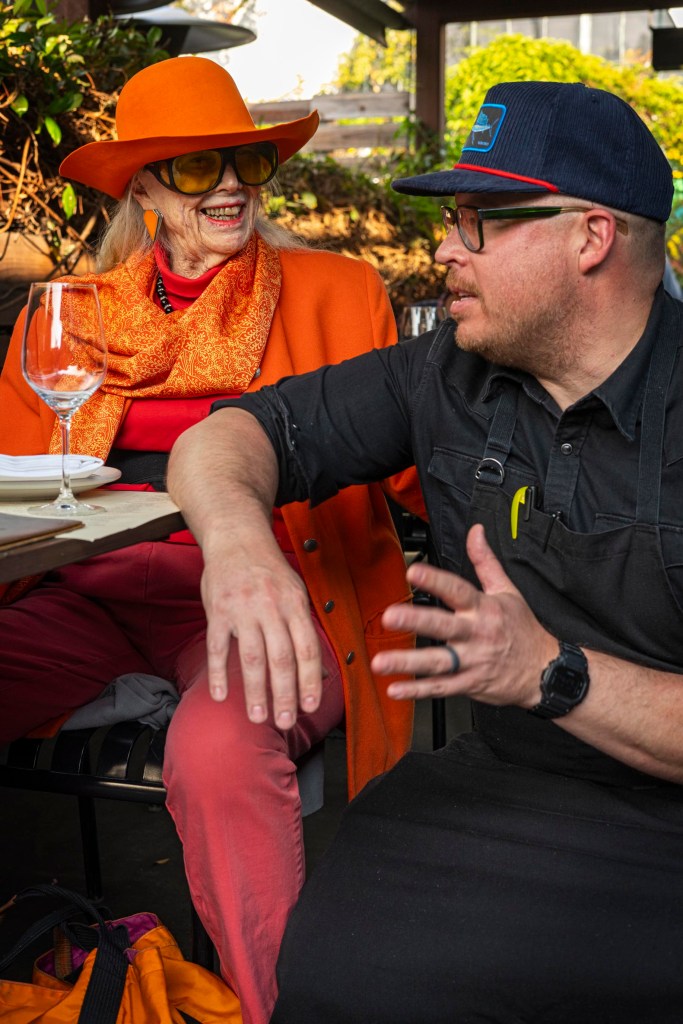
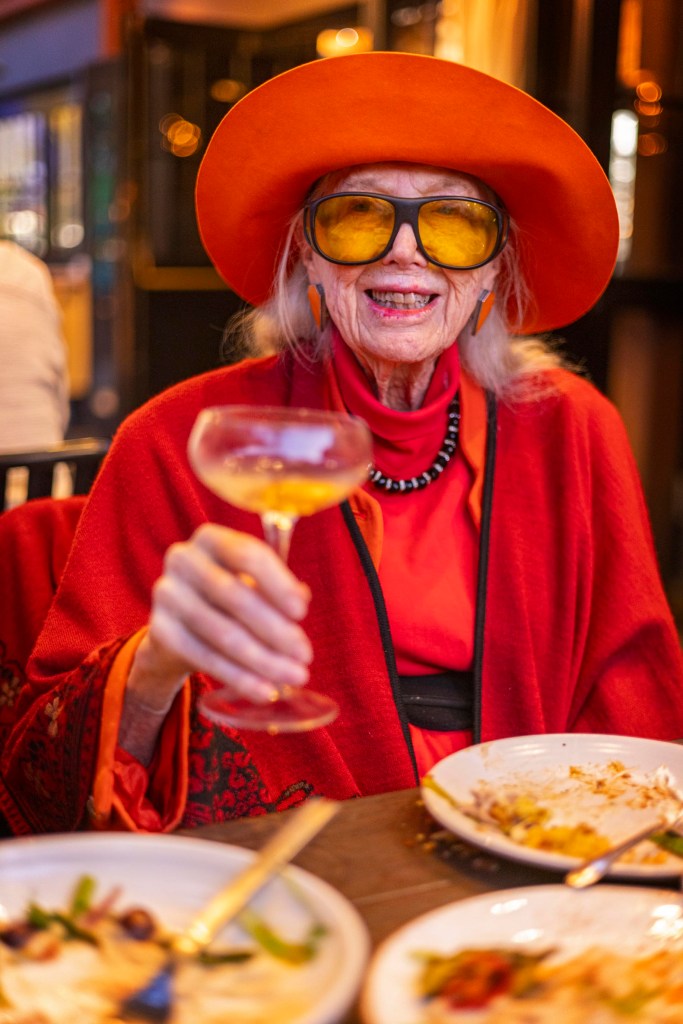
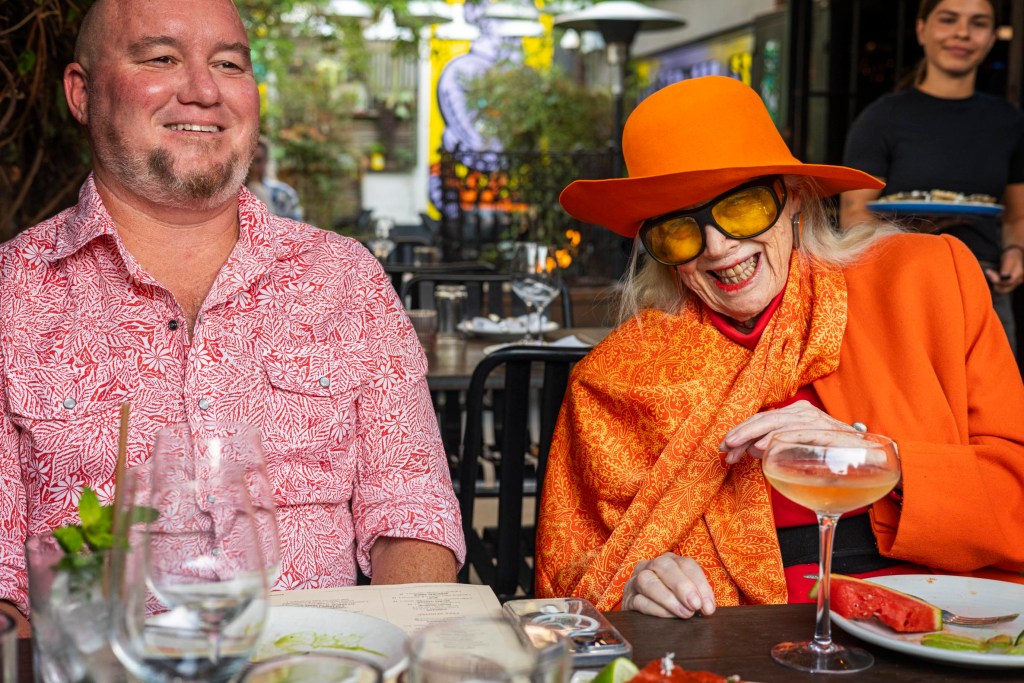
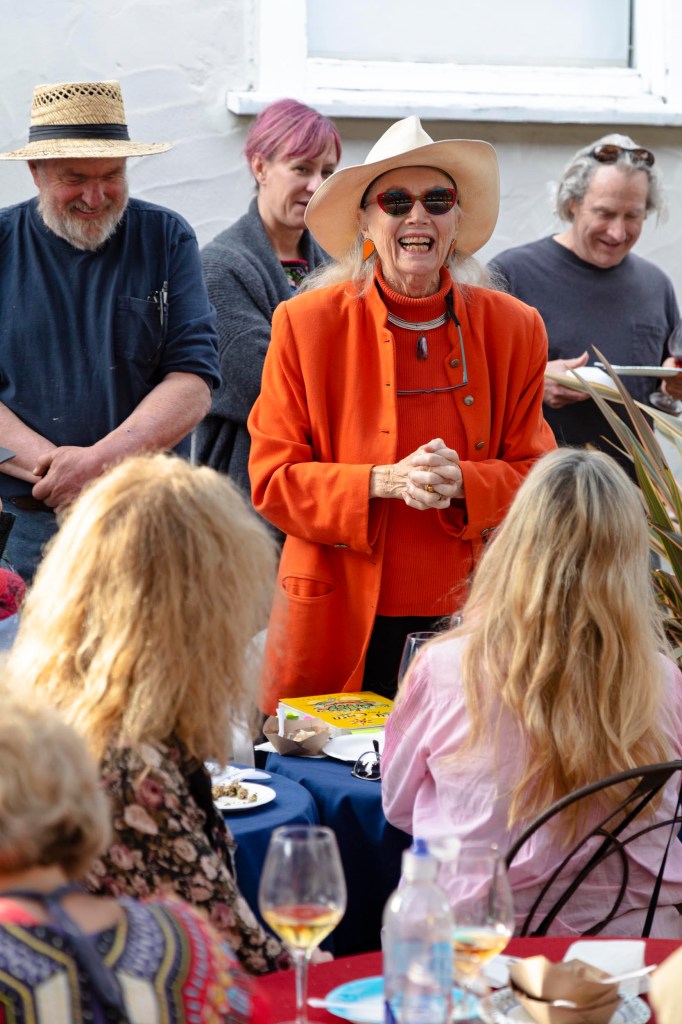
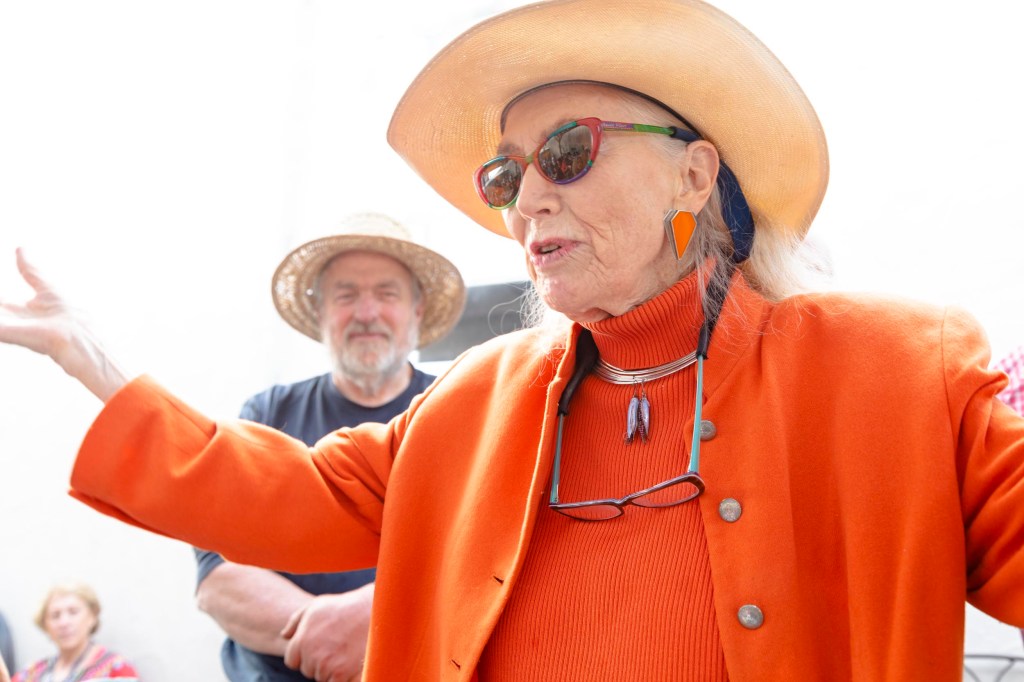
To prepare for this article, I invited Betty to dinner at The Lark with her friends, the artist Mary Heebner and the photographer Macduff Everton, whose birthday happened to coincide with our rendezvous. Betty arrived in a brilliantly orange outfit, elevating the scene imaginably, and drawing out the establishment’s top crew, most notably chef Jason Paluska, to attend to all of our needs. Over oysters, pighead toast, lamb ribs, and duck confit — much of which we helped her eat due to her near-blindness — we enjoyed what was certainly my favorite dinner of the year, if not the decade, talking about the here and now and the where and before.
“This book took 10 years — things kept changing,” she told us. “I was trying to write about the shell we all live in. The world is so limited to this shell. The shell kept changing. When COVID came, that was a different kind of shell.”
And then, I suggested, our bodies become that shell.
“Exactly, as we all find out,” she agreed. “Eventually we find out that it’s our own, and that coyote is us.”
I’d highly suggest getting to know her coyote and your own. Here are two excerpts from How to Cook a Coyote, one about her move to Santa Barbara and another about the brilliance of our farmers’ market.
The following are excerpts from How to Cook a Coyote by Betty Fussell:
Timequake
The year 2012 was when all my shit hit the fan at once, leaving naught but a turd behind. By November, Hurricane Sandy had blown me from my blacked-out apartment in a New York stripped of power back to the West Coast, where I began.
Come to think of it, 2012 was my eighty-fifth year on Earth and the most tumultuous of my life. Privately and professionally. Professionally, my calendar was jammed with lectures, writing workshops, book interviews, and conference panels around the country. Privately, I was trying to get the hell away from the East Coast, where I’d spent the last sixty-five years.
I was trying to be orderly about it. I’d flown to California a full year before Sandy hit. At eighty-four, I knew it was time to pick the place for my Final Move. I wanted the sunshine, birds, bees, and trees of my original homeplace, but not the inland desert. I wanted to be lulled to sleep by the rhythm of waves.
Where else but Santa Barbara? The one place in California where mountains run east to west along the sea to leave a strip so narrow there’s no land left for the ticky-tacky developers who gulped down my earlier home and spat out the Inland Empire.
Besides, I had a friend from junior high school and a couple of college pals who lived there. I flew out to check the emotional climate of several old folks’ homes and instantly fell for Casa Dorinda. The Casa had been built by William Henry Bliss and his wife, Dorinda, beginning in 1916, in a spirit of adventure. As members of posh New York society, they envisaged a little country cottage in the wilds of the West.
They landed on forty acres of oak and redwood forest, with a creek running from La Cumbre Peak above to Butterfly Beach below. Here, Chumash people had pounded acorns and grilled fish for millennia. Here, Spaniards had planted olive trees, built tile-roofed missions, and raised cattle for centuries. Here, the Blisses would stake their claim to a new style by erecting a Spanish hacienda with Italianate touches overlooking the great lawn of an English manor house. Behold “Caliterannean.”
I signed up instantly for the Casa’s waiting list and put my New York apartment on the market. Now I could say goodbye to blinding columns of glass and steel, goodbye to the choking exhaust fumes at the corner of Seventh Avenue and Fourteenth Street as I fought my way up the subway stairs. I’d have to wait until they had a vacancy, but that would give me time to sell and clear out where I was.
That, however, became messy. In May, my ex-husband, Paul, by then living in Oregon, sorted out his life by dying. In September, I landed in the ER of Roosevelt Hospital with a transient ischemic attack, a ministroke. In October, Hurricane Sandy hit and flooded Lower Manhattan, and I was evacuated to the Upper West Side.
On November 4, I flew out on the first plane from Newark to Los Angeles and on to Santa Barbara. Two weeks later, the Cross-Country Moving Company truck limped into Santa Barbara with a load of broken boxes and missing jewelry.
Saturday Soup Opera
Food is a daily joy when you’re old. There’s more than breakfast to be savored in Santa Barbara. Every Saturday morning at 9:00 a.m. prompt, I go to the weekly farmers market downtown as if to church. The Casa van gives us exactly forty-five minutes to make our rounds, as ritualized as Stations of the Cross.
Fresh Juice Couple, selling liquid blood-orange, lemonade, pomegranate. Then Chris the Mussel Man, in crocheted hat hung with mussel shells, doling out mussels and sometimes oysters from the beds at Hope Ranch. “Hey, babe, give me some sugar!” he yells, asking for his weekly kiss.
Next the Raw-Butter Boy with a truckload of unpasteurized milk, thick cream, fresh butter from the udders of happy cows who eat green grass. Nearby is the Olive Oil Man with local pressings flavored by rosemary, thyme, lavender. Not to mention the Lavender Lady with everything from fresh sprigs to oils, soaps, sachets. And on to Gaviota strawberries, heritage tomatoes, three varieties of avocado, passion fruits, cherimoyas, fresh gingerroot, multiple veggies, and greens waving their just-picked fronds.
Thank God, Elizabeth is still here at the Rancho San Julian stand, the ranch’s beef having survived drought, floods, and fires. Her ancestors took up residence two centuries ago, when a former New Yorker named Thomas Dibblee married into the family of José de la Guerra, commander of Santa Barbara’s Presidio and owner of a fourteen-thousand-acre Spanish land grant. The history of California is in each bite of pasture-fed flesh and marrowed bone.
All winter long, flowers bloom and perfume the air. Orchids of all colors and kinds, birds-of- paradise that grow like weeds. Van Gogh sunflowers, rainbow-colored gerberas, purple fuchsia, blood-red and salmon-pink begonias. I greet the Begonia Man, who’d arranged flowers for my niece’s wedding over two decades ago. Everything here is personal.
At the market I use my walker as both grocery cart and aggressive tank to weave at full speed through crowded aisles, attempting to avoid baby strollers that claim right-of-way for their human cargo and malingering teenagers who stop midstream to chat. I play the old-lady card and shout “Beep beep!” I worry about losing my dark glasses when I peer closely at spots on this furry peach or feel up for ripeness that pebbled avocado.

My fingers fumble with crumpled bills, dropped coins, plastic bags that refuse to open. Since I lack one-dollar bills, I ignore the basket in front of the costumed lady who blows a long Tibetan horn. But I can’t ignore the string band of elderly gents fiddling to entrance a group of tiny tots rooted in awe.
Home again, home again. To turn on Saturday morning’s Met Opera broadcast on local station KUSC. I’ve been listening on Saturday mornings since I was six, when Milton Cross was my host on NBC. Today it’s not from the Met live, but selected opera duets recorded by Pavarotti and Sutherland. I can relive their and my glory years at the opera house in New York while I prepare lunch in Santa Barbara.
Last week it was chicken broth because the Chicken Lady had not just innards but also chicken heads and claws. I like the way their beaked heads bobble on top of the boiling pot, seeming to sleep sweetly on a bed of claws. I always salvage a couple of claws so that I can nibble on their padded palms and knobby fingers, the soft, gelatinous texture of skin and flesh that tastes of bone.
Today I’ll cook moules marinières. Machines have scrubbed those mussel shells spotlessly clean. I chop green garlic and scallions to soften in a pot with a pat of butter and a sprinkle of black pepper. I add water, or fish stock if I’ve got any, deep enough to cover the shells by an inch. When the water boils, in go the live mussels and on goes the lid. By now I’m exhausted, but the sun is high and my tray set with bowl, baguette, and a cold glass of Zaca Mesa Viognier from the fridge.
All is quiet on the patio but for a single hummingbird at the feeder and a few wasps. My opera duo has shifted to the “Miserere” at the end of Il trovatore, and I remember a San Francisco trattoria over half a century ago that surprised me with singing waiters. Leonora began her aria while serving me a hamburger, as her troubadour entered our crowded dining room from the men’s room, rather than the kitchen. The voices of Pavarotti and Sutherland soar to climax as I raise my glass as chalice to thank the mussels for their sacrifice.





You must be logged in to post a comment.