
Seventeen College Degrees, and Still Learning
From Music to Astronomy to Tai Chi,
David Salvia Is Fascinated by It All
By Izadora Hamm | December 24, 2025
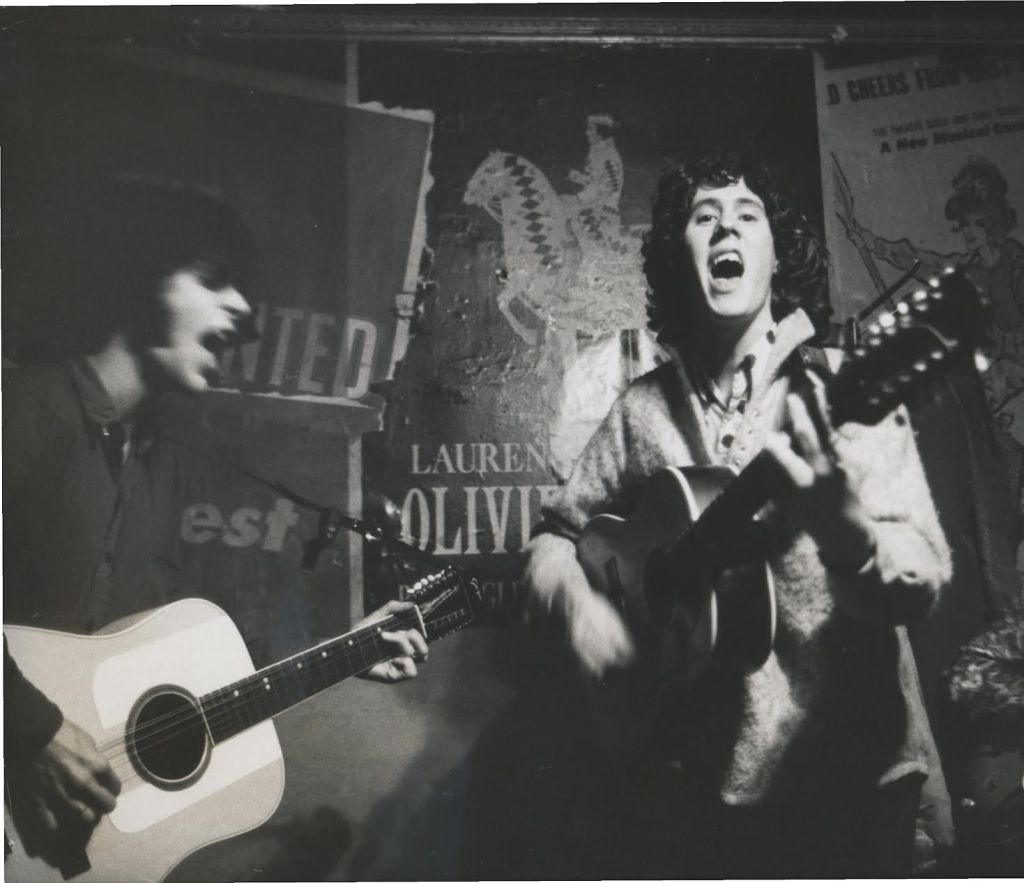
On June 1, 1967, the East Village was alive with chaos and color. Hippies swarmed St. Marks Place, white carnations tucked in their hair, waiting for Jerry Garcia and the Grateful Dead to take the stage for their first East Coast concert.
Before the Dead swept the crowd, an unknown folk group took the stage. Fresh out of the Navy and nursing an irrefutable lust for life, 20-year-old David Salvia performed his song “Nowhere” on a 12-string guitar, shoulder to shoulder with Rick Beers, a friend he had just met.
“Someone told us that Garcia wanted the two folk singers who perform in the park to open for his band,” Salvia said recently. “We’d only met a couple days before.”
Now decades later, the 78-year-old Salvia, a student at Santa Barbara City College, has no shortage of stories. With 17 college degrees and half a dozen professional certificates, and a life full of accomplishments outside academia, he insists there’s still more to learn.
“My mother used to call me relentless,” Salvia said. “I prefer the term persistent. People tell you that you slow down when you’re older, but not necessarily.”
From astronomy and engineering to math, English, history, and philosophy, with highest honors in both humanities and sciences, he’s done it all.
“Memories are waveforms, holographic, and they are certainly not limited,” he said. “I’m still trying to figure out the universe. Does that really ever end?”
With a unique ability to recall memories from decades ago — specific dates, times, places, even the tiniest details — he says having that acute recall is simple: “It’s just a matter of paying attention to the moment.”
From developing his own Rubik’s Cube solving method, to memorizing all 108 movements of the traditional Yang-style long-form tai chi, he remembers moments of life with extraordinary clarity. But what seems to matter most are his relationships.
Meditation in Motion
It was at the old Isla Vista coffee shop, Borsodi’s, that Salvia met Berri Bottomley, his lifelong companion. “We met on December 17, 1974, and stargazed at Devereux Bluffs,” he said.
Together, they’ve explored astronomy, music, and the intricate, fascinating patterns of life. Bottomley calls him a renaissance man. “He is a writer, artist, minstrel, inquisitive intellect, and he does not shy away from hard work,” she said.
That attentiveness and curiosity stretch way back. In 1947, Salvia recalled using his neighbors’ tricycle, stretching and reaching for the pedals. As the neighbors’ children grew, their father rebuilt that tricycle into a bicycle. Suddenly, something that once seemed fixed and stagnant had changed.
While Salvia’s list of hobbies is long, that memory was the spark that ignited his passion, and the very foundation of all that he loves: engineering.
“I’m a musician because I love engineering and physics,” he said. “I have degrees in engineering and physics because I love music. It’s all the same.”
It was in the Navy, stationed in San Diego, that 17-year-old Salvia bought his first guitar.
“We’d sneak over to Tijuana to watch bands cover Beatles songs, then come back and practice the chords,” he said.
At the base’s Anti-Submarine Warfare School for sonar technicians, his curiosity and aptitude for complex systems shone. During every quiz, Salvia had his pencil down before the teacher had even finished writing the equations.
Some competed with him, others admired him. Either way, his 1965 Navy class set a record for the highest average in history. Still, he claims he learned the most from his peers, not the other way around.
“I was in the Navy for two years, eight months, 8 days, 10 hours, and 25 minutes,” he said.
Shortly after, he returned to New York, met Beers, and began his musical tour. The pair traveled across the U.S. and Canada, performing, writing, and later recording a demo with Liberty Records.
Their deep friendship was tragically cut short when Beers died in a freak accident on December 26, 1969, leaving Salvia to continue on his own.
Not long after, his life took another sudden turn. “At any given moment, I’d lose my train of thought, and it was like that for an extremely long time,” Salvia said, referring to a period he prefers not to dwell on.
Over time, with movement, music, friendships, and eventually Bottomley’s steady presence, he found his way back. Patience became his anchor, eventually leading him to master tai chi.
“I was looking for a set of exercises that would exercise every muscle and joint in the body,” he recalled.
Salvia first encountered tai chi in 1969 during an experimental school program in Rochdale, Canada, and vividly remembers a Yang-style long-form demonstration by a visiting master.
He didn’t get the chance to study seriously until 1973, when he memorized the entire long form — 108 postures and about 81 distinct movements. Each movement included what he describes as an infinitesimal pause, a moment of meditation embedded in motion.
Fifty years later, Salvia still wakes up daily at 4:30 a.m. to practice and meets every Friday morning with his 73-year-old student.
“It engages the transverse abdominal muscles,” Salvia said, pointing to the dantian, about four inches below the belly button. “This is where your balance comes from.”
The dantian acts as a reservoir for qi, or life force, he explained, and is the body’s point of balance. “I’ve learned in meditation to never throw the first punch, to be articulate and thoughtful. But I’ve defended myself with it a handful of times,” he said.
Shooting for the Stars
It wasn’t until 2006 that Salvia decided to return to school. Still working on his memory, he enrolled at SBCC to pursue his passions, especially astronomy.
“I’m embarrassed to say that it wasn’t until I was 35 that I asked the question, ‘Where is the center of the universe?’” Salvia said.
His fascination with the cosmos began as a teenager when Salvia once walked from Carson City to Lake Tahoe along Kings Canyon Road, spending long nights under an open sky. “I don’t know who could see a sky like that and not become interested in astronomy,” he said.
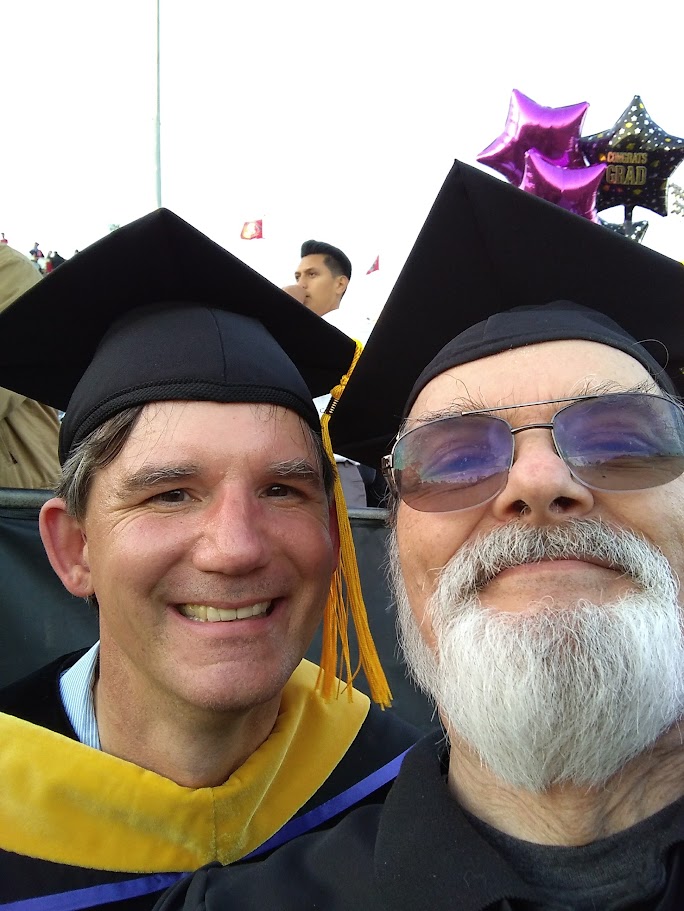
Salvia was shocked to find that SBCC did not offer an astronomy degree and drafted a proposal that originally constituted 42 credits. Unfortunately, it sat dormant for years, caught in administrative hurdles, until 2014, when City College professor Dr. Sean Kelly came on board.
The two quickly connected. “Sean is infectious,” Salvia said. “We bonded over our love for the universe and everything in between.”
Kelly explained that the program was really tailored for Salvia. After trimming the credits and working out the kinks, the program was approved in 2015.
Salvia not only became SBCC’s first student to graduate with an astronomy associate of science degree, but he is also the reason the program exists at all.
“The more we learn, the more connected things seem, and the more beautiful the universe becomes,” Kelly said. “David is unlike anyone I’ve ever met, and I learn from him every day.”
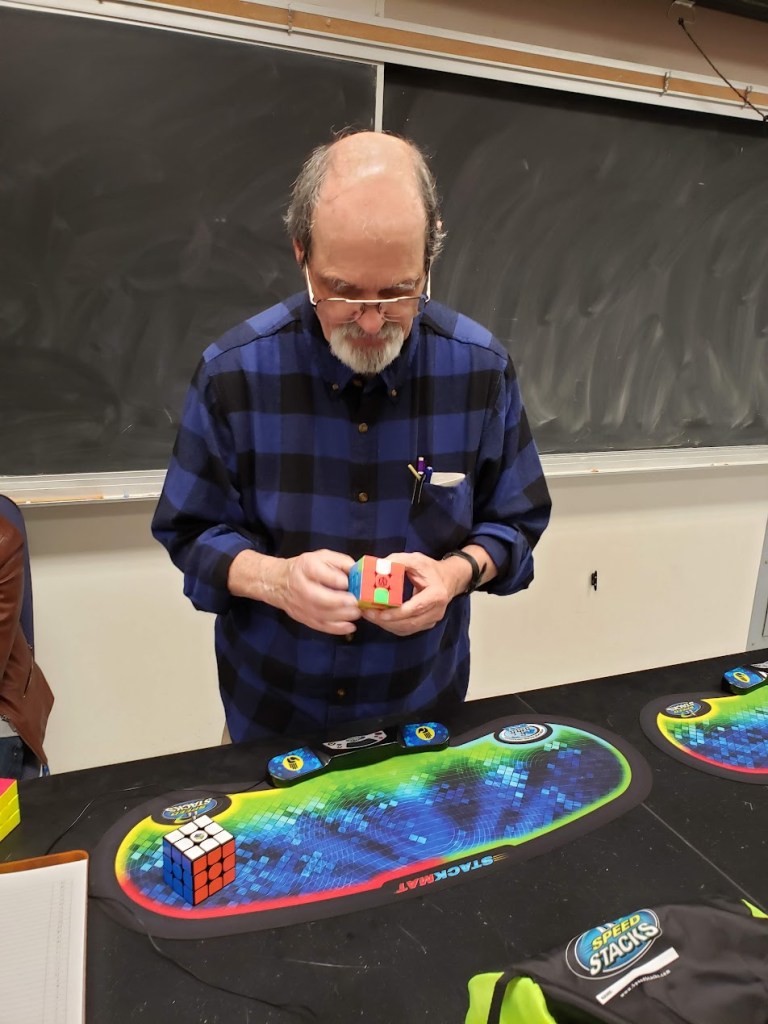
In between astronomy club meetings and early morning stargazes, he taught Kelly how to successfully navigate the Rubik’s Cube using a method he developed in the 1980s — dubbed Salvia Method. “I solved it in an hour the first time, then 15 minutes, then five,” he recalled.
His personal best is 9.3 seconds, and with the help of computer science tutor James Howard, he founded SBCC’s Rubik’s Cube Club.
“He’s always pushing himself in new directions and places he hasn’t been an expert before, gaining expertise along the way,” Kelly said, noting that his friendship with Salvia has inspired him to consider going back to school himself.
I asked him why he continues to learn. By most measures, he has already lived a full life. “Why not?” he said, insisting that no matter how much he has accomplished, there is always more to explore.
“I don’t like to assume. I learn from others. Learn it just for the sake of knowing it. Learn it even if it isn’t conventionally useful. Be curious. Don’t just survive, learn to thrive,” Salvia said.


David Salvia and Berri Bottomly have been close pals since 1974. | Credit: Courtesy
Omnivorous Curiosity
For Berri Bottomley, no single memory fully captures Salvia, but him serenading her mother with the Beatles’ “When I’m 64” on her 64th birthday exhibits his endless attentiveness to everything, and everyone he cares for.
“In my mind, we’re a natural pairing,” Bottomley said. “Something that just is. There seems to be some deep, unshakable bond. Our relationship has been a journey as our lives and circumstances have changed, as we have matured and aged, and as the world has changed around us.”
On a park bench, Salvia played the intricate picking pattern of Paul McCartney’s “Blackbird,” interrupted by a passing airplane, he quietly predicted how far away it was and how long the sound would take to reach the ground.
“Scientists and artists are all portraying aspects they find interesting in the universe,” he said, pulling a guitar pick out of his wallet that he has had since 1967. “Math is a language, physics is how we understand, and engineering is what we make of it.”
The hum of a chord, the craftsmanship of a guitar, the physics of sound and relativity — isn’t it all the same? The world sings, Salvia listens, composes, and the memory loss he suffered in the 1970s only strengthened his resilience.
“Be willing to change direction. It doesn’t matter which way or how, just move,” he said. “Most of what we call old age is atrophy. I wish people would understand how capable they are.”
For Salvia, the question of genetics or merit, nurture or nature is a paramount one. The answer? It can only ever be both.
“What we were exposed to during our formative years affected us a great deal, but we also have incredible potential for growth,” he said.
As the world evolves and Salvia ages with it, he keeps his body a vessel for his ambitious mind — walking, learning, reading, writing, playing guitar, teaching, and mentoring, all fueled by his insatiable curiosity.
“Think about what you can do with your right hand. Then think about what you can do with your left. It’s a lot, right?” he asked. “But what about both? That’s a synergy much larger than this world. The whole is greater than its parts. The universe is simple. It just looks difficult.”
Even after all he has accomplished, Salvia stops short of calling his life well lived. “I have so much left to learn,” he said. “Do more, be more, learn more than you ever thought you would need to. Be relentless.”





You must be logged in to post a comment.