
Welcome to Welcome to Isla Vista
The Santa Barbara Independent Presents
a New Podcast on I.V., Then and Now
By Christina McDermott | January 8, 2026
Some days, the marine layer hangs on to Isla Vista. White fog envelopes the shoreline and stretches along its crowded streets and apartment complexes so that the area is a world of its own, still, quiet, and smelling of salt.
I like these moments. They are special because Isla Vista is so rarely quiet. Daily, bicycles whir, buses grumble up and down El Colegio, bands play music out of living rooms, speakers blare in backyards, and basketballs drum the pavement in Estero Park. And, of course, there are voices, thousands of voices crammed into a little more than a half square mile.
I.V. is rarely quiet, but often, it does feel like its own world. Surrounded by UC Santa Barbara campus on all sides but the ocean, largely developed a little more than 75 years ago, and lacking cityhood status, it operates as an island of high rents, student life, and cyclic change. Its cacophony is full of stories. Simply, I thought it would make a good podcast. I called it Welcome to Isla Vista.
The Origins Were Parking
I am an outsider to Isla Vista, although I live nearby. I did not attend UCSB nor Santa Barbara City College. I am not a member of one of its long-term renting families, nor do I own a home there.
But I.V. is still part of my life. As a housing reporter for the Santa Barbara Independent, Isla Vista weaves its way into my workday, from covering the county’s preliminary rental inspection program to writing up new developments there. I.V. is part of my personal story too; I spent early dates with my partner at I.V. Bagel and circling to find street parking.
Right — parking. I first grew interested in the history of Isla Vista — and how it related to the area’s present reality — because I could not find any parking. One day, while trying to snap photos for a story about I.V., I looked down a street lined with cars and understood what folks in the public comment period meant when they called the situation dangerous at a recent Planning Commission meeting.
I.V.’s rent nightmare stories, ones I’d heard from students and former students alike, made for compelling stories I wanted to tell. But the crowded streets tipped me toward the most interesting questions in journalism: Why and how does this place operate the way it does? I knew little about I.V.’s history, but this problem, unlike my lack of personal experience, I could remedy.
Light filled UCSB’s Special Research Collections reading room one late afternoon in March, when I sat at a desk and began to read county documents. On spiral-bound pages, I began to uncover the past of Isla Vista’s development: timber initiatives that stripped the land of topsoil, oil schemes that failed (we were a county intertwined with oil ventures then as we are now, albeit with different attitudes toward it), a lack of water that prohibited development, a U.S. Marine base in response to a world war, and then a $1 sale of land for a UC campus. I read about land for a new university location and a corner reserved for private development. Slowly, Isla Vista developed a “then” for me. The “then” began to inform how I understood the now, and the land’s history of exploitation. I could see a story taking shape.


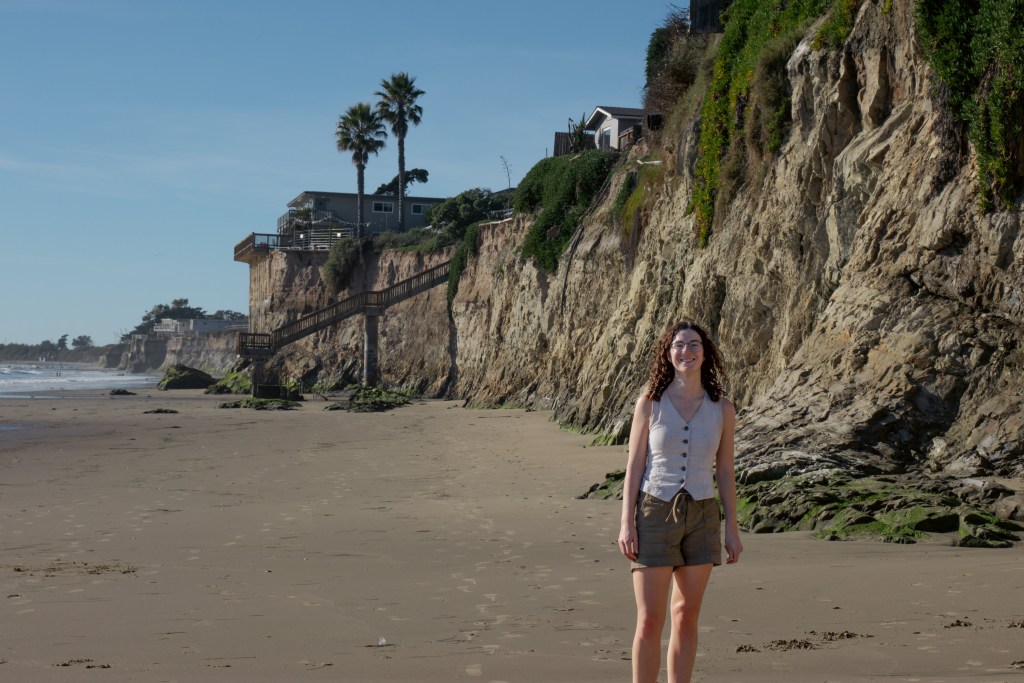
The beach below Del Playa Drive near low tide. Massive supports for houses above are visible now, as the cliff erodes. | Credit: Alisha Genetin
Podcast Plans
Before I started at the Independent in August 2024, I worked at a public radio station called KDLG in Dillingham, Alaska. Dillingham is a rural hub in the Bristol Bay region of the state, with a year-round population of about 2,300. Reporting in Dillingham was my first full-time job, after doing intern work for KCSB here at home and KCBX Radio in San Luis Obispo. I spent a little more than a year in Dillingham, writing, recording and producing stories, and compiling and hosting the morning news. For about seven of my 13 months, I was the region’s only reporter.
People in Dillingham treated me with kindness, respect, and patience. They also taught me how to listen. Often, voices other than my own could more effectively deliver an important message — you can hear people’s passion in their storytelling and explanations in the pitch and quality of their voice.
Noise from the world around me told stories, too. I recorded the glug and hum of a fishing boat motor as I interviewed fisher folks protesting the record-low price processing companies paid for their sockeye catch. I captured the hum of sewing machines at a class on how to make traditional Yup’ik garments. I caught the cheer of community members at the town’s big high school basketball tournament. And early in the morning, after thick snow made everything sparkling, quiet, and thick, I recorded the crunch my boots made on hard snow all for myself.
Storytelling with sound, I thought, would also work in sunny Isla Vista. Through a series, I could add to the literature on how this place came to be and avoid getting tired of the sound of my own voice. In June, I told Marianne Partridge and Jackson Friedman, the Independent’s editor in chief and news editor, respectively, my idea for a limited series of podcast episodes: I.V.’s history and its present. They asked questions, offered ideas, and gave me the go-ahead.
Voices, Stories, Histories
One advantage of a community largely built and developed less than 80 years ago is that people were still around who could tell me stories firsthand.
I wanted to hear about Isla Vista from as many people as I could. Over the course of four months, I interviewed 40 people, my recorder placed on tables (sometimes near my laptop during video calls), held snugly in hand, or laid haphazardly on the grass.

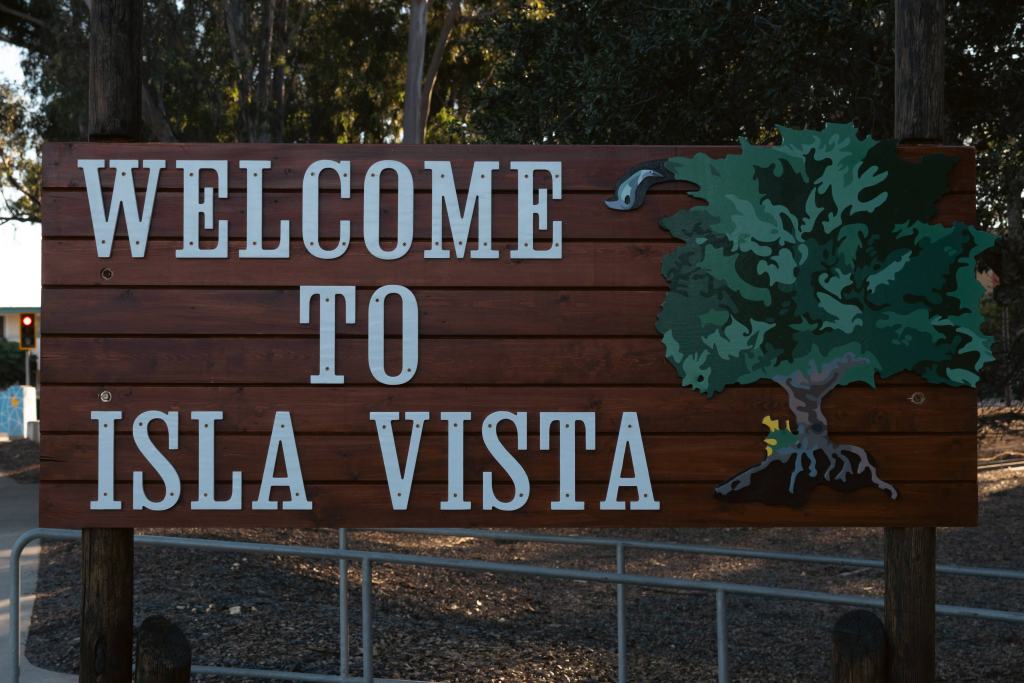
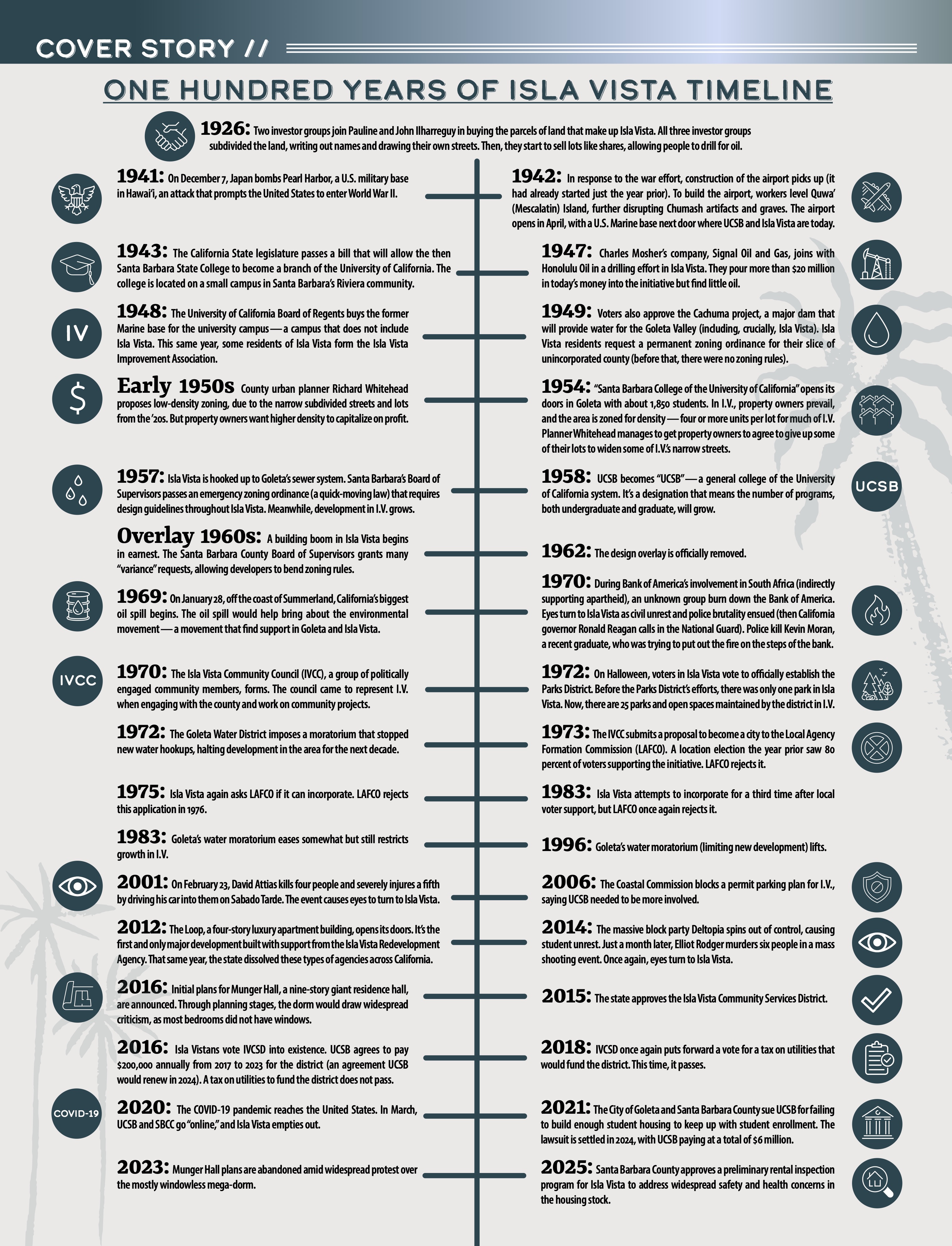
I listened to a story about the year UCSB opened and the journey to the campus through lemon and walnut groves. I heard accounts of the 1970 Bank of America burning, and the political organization that came from it. I learned about I.V.’s fight for incorporation and how the fear of rent control influenced why people at the county level did not support cityhood for I.V. I understood why the sign welcoming a person to Isla Vista off Los Carneros Road had a tree on it.
People told me their personal stories of I.V., from the overcrowding to the live music scene. Stories of poor living conditions were frequent, but so too were anecdotes that showed people’s joy: camaraderie in a village of tepees, a bicycle beer race, or a migration to the coast to watch the sunset.
More recent history — things I could remember — began to take on new meaning. I saw the 2014 tragedy that shook I.V., when a young man killed six people in a rampage, on the news when I was in high school in Washington State. It was one of several news-making mass shootings that occurred during my adolescence. But now, it sat in context: a tragedy, accompanied by a year of unrest, that mobilized more people to support a community services district, according to one of its founders.
Through others, I learned how I.V. emptied out in 2020 during the COVID-19 pandemic when UCSB switched to online learning. Then, 18 months later, I.V. refilled to the brim. Redfin, a real estate website, sent me property data from the zip code containing I.V. that showed how property values shot up in 2022. Recent grads and current students told me stories about the rush to find a place — waiting to apply with the online portals was like trying to get concert tickets, two students said — and expressed frustration that choices were so limited and expensive. Families suffered, too. In 2023, a massive renoviction meant hundreds of long-term, low-income families were forced to leave the community.
Neither UCSB nor I.V.’s landlords were interested in a formal interview. The university answered questions about its involvement in I.V. and housing initiatives via email, and I had the chance to talk to a couple of landlords off the record — talks that, coupled with discussions with a housing developer, helped me understand how owning more and employing management companies (which take a cut of profit) resulted in less labor for the landowners but could increase prices. It’s work, to live nearby and answer calls late at night, or on weekends — work that some landlords do with care. It’s hard work to care.
I met a lot of people personally invested in I.V. — people who worked to help the community. One day sticks out to me: A long-term tenant and I were cycling around Isla Vista as part of an interview. We stopped to speak to a Parks District employee who needed to clear away minifridges that someone had dumped over a fence protecting a county park from the cliff’s edge on Del Playa Drive. The work required the person to put themself at risk to dispose of the fridges before they rotted there or plummeted 30 feet below and risked flattening someone. The person did so despite the risk.
Yes, Isla Vista struggles with garbage left on the street or in yards, but nature lives and thrives here. I should know — I spent a solid week in April reporting on a bear that wandered through I.V.
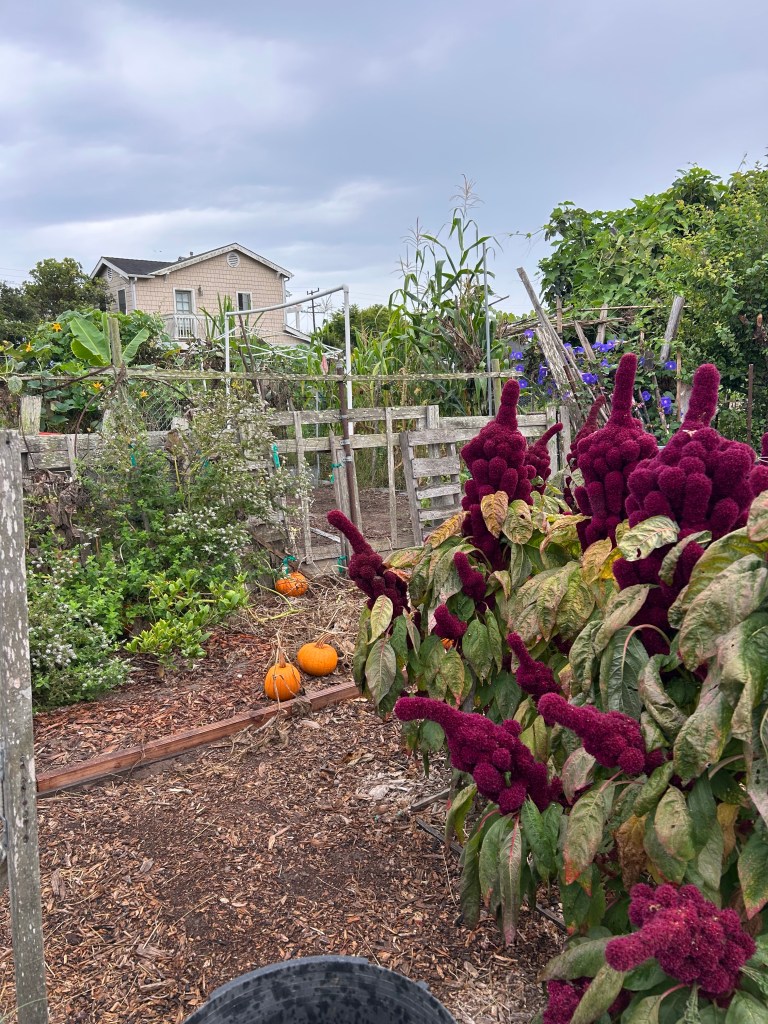
The natural world inevitably slipped into my reporting. I learned that the area is an ancient marine terrace, and the rock forming the bluffs — the Sisquoc Formation — is slightly softer than the nearby Monterey Shale, meaning it erodes more easily than other parts of our coastline. The dangerous bluff edge is fast approaching Del Playa Drive. At low tide, I walked the beach below Del Playa and saw foundation beams, whitewashed and towering like part of an ancient city, carved into the cliff. I picked guava fruit off the ground in the Sueno Orchard. In a misting rain, I toured the nearby Estero Gardens and saw plots producing all sorts of food by families who have lived in I.V. for years.
For all its foibles, Isla Vista is special. You can walk or bike to restaurants, parks, or your friends’ houses. Live bands play every week. In garden boxes, people grow food that anyone can come and harvest. You can meet folks from all over the world here. And on a sunny afternoon, you can take a towel to a park and lie in the grass, smell salt on the ocean breeze, and maybe, if you’re curious, you can listen to this podcast.
Welcome to Isla Vista: The Specifics
The podcast series itself has six episodes. Each episode travels through space and time.
Here’s a breakdown of what’s in store.
January 8: “Welcome to Del Playa Drive” — How did we get from oak forests to oil schemes and later to student housing? Episode One introduces one of the oldest streets in I.V. and delves into I.V.’s early history and development.
January 15: “Rise and Fall of Development: Student Stories, Part One” — In 1954, Santa Barbara College students traded “the campus with a view” for the “campus in the slough.” Developers built more than 4,000 structures in 10 years, receiving variances and helping pass zoning codes to increase density. What was it like to live there? Student stories start in 1954 and finish in 2016, as that housing stock ages.
January 22: “The Near-Then and the Now: Student Stories, Part Two” — Post-COVID, Isla Vista grew even more expensive, all while housing stayed pretty much the same. What is like living in I.V. now? There’s good, bad, and ugly here.
January 29: “Political I.V.” — One night in 1970, a fire broke out at the Bank of America. No one yet knows who set it. But it brought both police brutality and political engagement to Isla Vista. Why does I.V. have such a vast network of parks? Why isn’t I.V. a city? And decades later how did tragedy bolster support for the Community Services District, according to its founders?
February 5: “The Quieter Corner” — Isla Vista is a student hub, but it’s not all students. This episode takes us into the quiet community garden, as well as the homes of long-term homeowners. How has Isla Vista changed from the eyes of people who see crops of students graduate each year? What was the impact of a major renovation that displaced dozens of long-term families? How can we look at I.V. from an artist’s perspective? And what’s with that uniquely shaped dome house?
February 12: “The Cliff’s Edge” — Development has started again in I.V., as new housing laws make it easier to build. At the same time, property owners are cutting back parts of homes on Del Playa as the cliff erodes and parking is even more tightly impacted. Where is I.V. headed? And what are some ways we can make it a better place to live?
Where to Listen: You can check out the podcast on the Independent’s website (with transcripts) at Independent.com/welcome-to-iv and on Spotify and Apple Music. You can also catch it on KCSB.



You must be logged in to post a comment.