

America has never had institutions designed to maximize the potential of its people. It was a patriarchal, imperial hierarchy from inception—designed not to optimize human development but to extract, control, and moralize dominance. For a time, this didn’t matter to everyone equally. White Europeans in particular could survive on the perimeter, outside the system’s most extractive mechanisms, through informal economies, communal reciprocity, and limited institutional exposure.
The Waltons was honest about this. The family survived not because of American institutions but despite them. Crucially, the Waltons were asset holders. They owned their land, their timber mill, their means of production. The show never pretended the system worked for everyone. It showed people with assets working around it.
The people who came through that era without assets survived by means of the New Deal — the one moment in American history when the federal government built trust-based institutions at scale. That wasn’t the system working. That was emergency intervention against the structural logic.
Yellowstone tells the opposite lie. It mythologizes patriarchal dominance as noble tradition, portraying violent hierarchy as authentic American virtue. Yet buried beneath the Dutton mythology lies Elsa Dutton — the real conscience of America, dead in the ground, her voice marginalized so the patriarchal fantasy can continue.
That perimeter The Waltons depicted no longer exists. You cannot live around the structure anymore. We are forced to live inside it.
Patriarchy as Institutional Structure
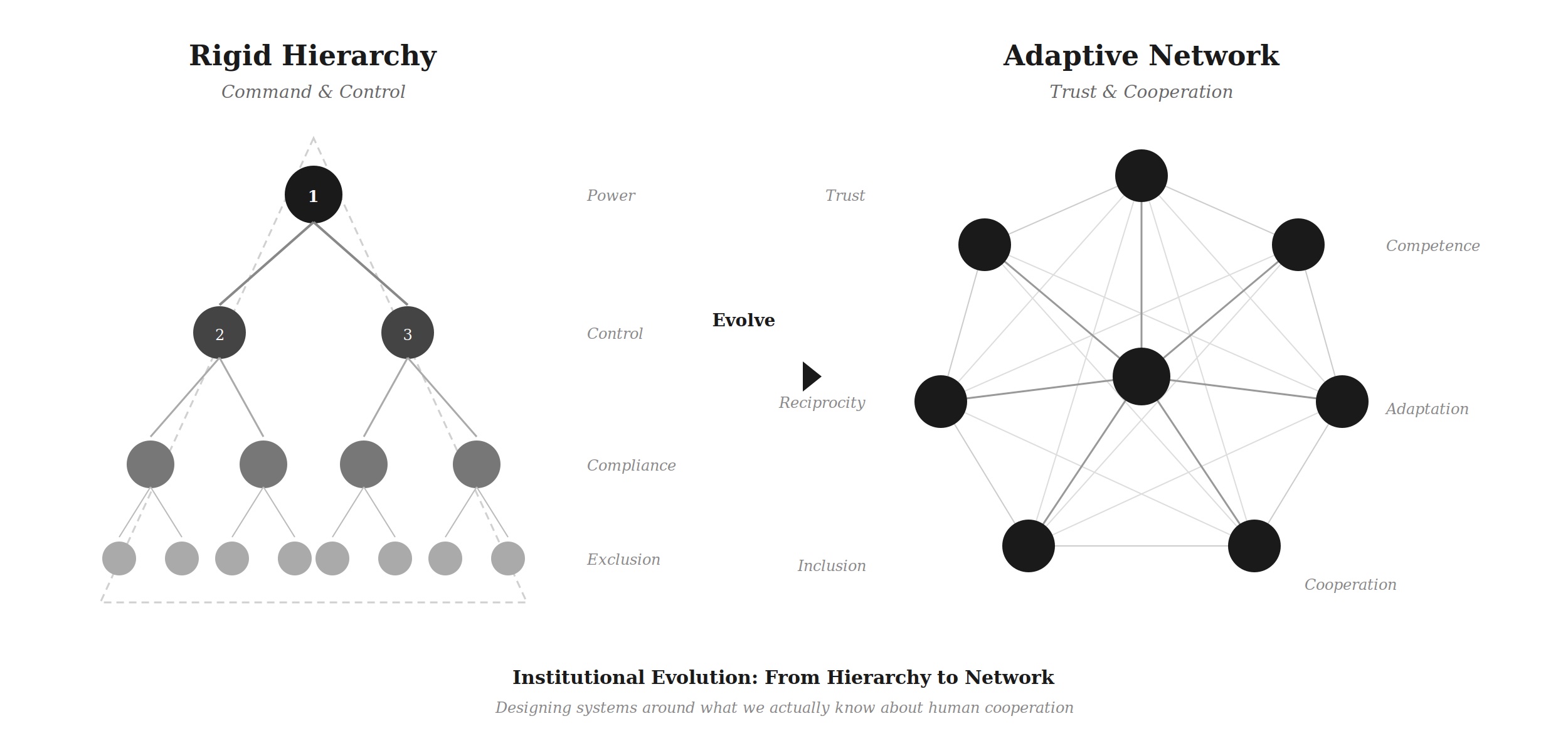
Patriarchy isn’t a feminist slogan. It is a very specific institutional structure: vertical authority rather than horizontal reciprocity, primitive reward and punishment-based compliance rather than trust-based internalized norms, status hierarchy rather than competence filtering, moralized obedience rather than empirical feedback.
The organizing principle is exclusion. When institutions rely on reward and punishment, rather than trust, they produce predictable outputs: antisocial elites, narcissistic leadership, wealth moralized as virtue, poverty moralized as failure. These aren’t cultural accidents. They’re native outputs of exclusion-based selection.
What Business Should Schools Be In?
Adaptive human systems operate on inclusion. When individuals struggle, support increases. Difficulty signals unmet needs, not moral failure. The system’s job is to bring everyone inside the circle of development. When kids make mistakes, we model calm adaptation and learning by doing.
The business that schools and education systems should be in is maximizing the potential of every child.There is nothing “Leftist” about modern pedagogy, knowledge, or science! This is what developmental science actually shows. Learning requires psychological safety, intrinsic motivation, social belonging, differentiated support — a structure that produces interpersonal and institutional trust!
The business American schools are actually in is maximizing the production of middle managers and workers for corporate America. Grades, rankings, standardized testing, compliance-based discipline — this is labor-market sorting and preprocessing, not education.
American youth athletics operate on the same logic: Participation conditional on performance, absence punished rather than explored, struggle treated as character defect. The “conservative” obsession with banning trans children from sports reveals the underlying principle: Exclusion is the point. The obsession with undocumented immigrants is part and parcel of the same exclusionary structure. Scarcity is the control mechanism. Someone must always be kept outside the circle.
And whatever “conservatives” believe, money makes all the difference. You cannot maximize children’s potential without adequately funding the institutions that serve them. Property taxes — a feudal legacy beloved by libertarian economists — must be abolished, as they have been in Sweden. Every school district should be funded directly by the federal government. Equal children, equal funding. This isn’t ideology. It’s basic adaptive institutional design.
The Closing Window
The network age rewards inclusion: distributed intelligence, trust as infrastructure, competence-based selection, institutional learning. The old American system punishes all of these.
A reform window exists only because administrative capacity partially functions and trust hasn’t collapsed beyond recovery thresholds. That window closes when prejudice and state violence replaces community, relationships, and due process, and the state becomes purely extractive.
Building the American Learning Society
The path forward requires shifting from exclusion to inclusion — not because inclusion is morally superior, though it is, but because inclusion is what actually works under complexity.
This begins locally. Right here in Santa Barbara. On our schoolboards. Institutional reform doesn’t start in Washington. It starts where we actually have leverage. We begin building the American Learning Society one school district at a time, grounded in social and institutional trust rather than primitive sorting mechanisms.
The Waltons showed Americans with assets surviving around broken institutions. Yellowstone sells them lies about those institutions’ nobility. Neither is a future. The future is consciously designing trust-based systems that maximize human development — starting with our children, starting with our schools, starting here.
The perimeter is gone. Everyone lives inside the structure now. So, we rebuild the structure on the principle of inclusion, or we follow other failed patriarchal systems onto history’s trash heap.
The work begins locally. The work begins now.

