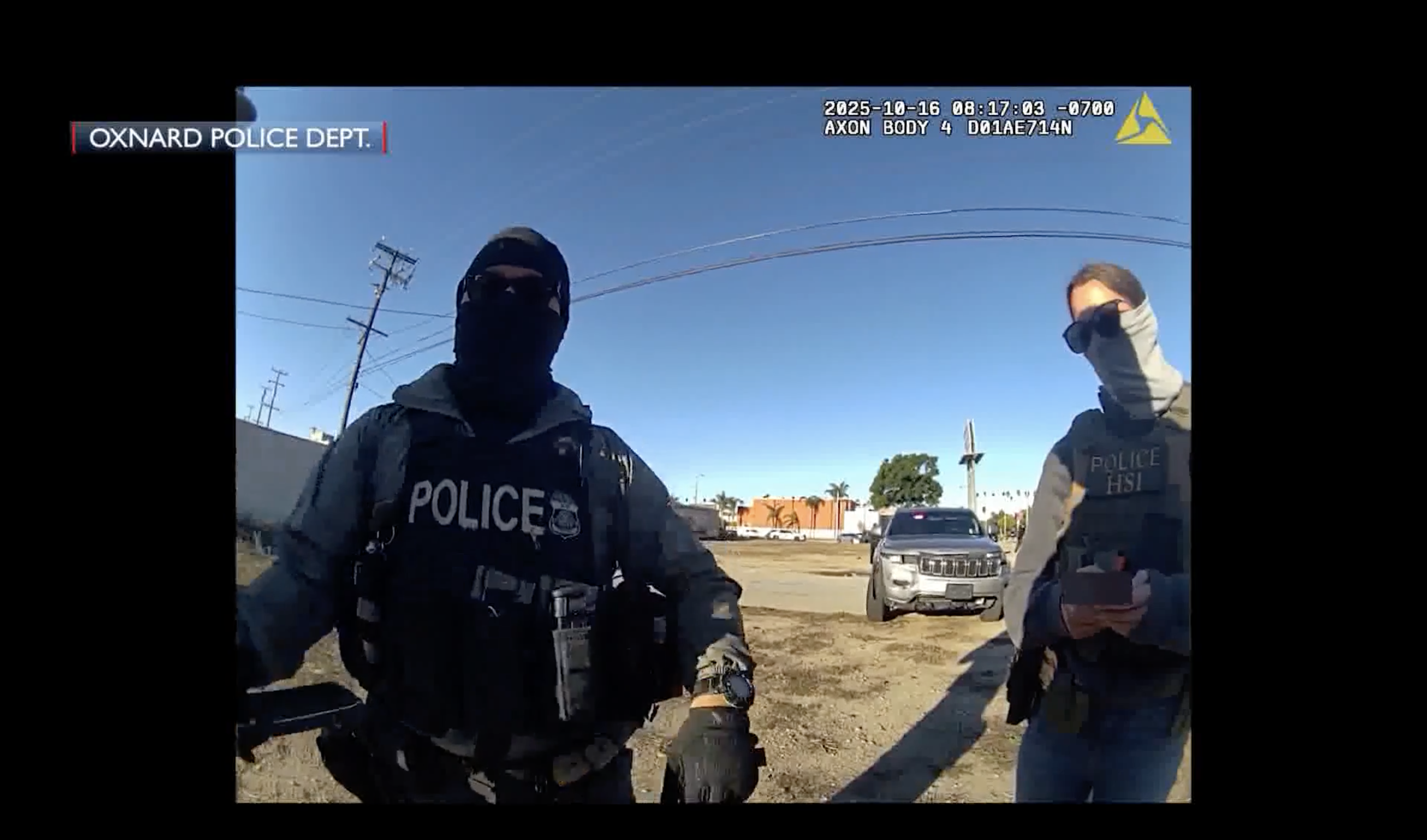
A KEYT news report that aired February 13 documented how federal agents engaged in an ICE enforcement action in Oxnard intentionally T-boned an anti-ICE activist’s truck and then blamed the activist for using his vehicle as an instrument of violent aggression against them. Moreover, the video depicts — with audio accompaniment — how the ICE agents subsequently lied to the Oxnard police officers dispatched to the scene of what was initially thought to be an early-morning road-rage incident.
According to KEYT, ICE and FBI agents were involved, and they told the Oxnard officers how they’d been driving directly behind Leo Martinez — an activist with Ventura County immigrant rights group VC Defensa — when he sped up, slammed on his brakes, and then shifted into reverse, plowing the back of his car into the front of their Jeep.
Based on multiple videos collected at the scene from on-hand witnesses — including one by Martinez himself — it’s evident that the exact opposite had occurred. In fact, the agents can be seen swerving their vehicle out to the side so that the occupants could get a good sideways angle on Martinez’s truck; they then accelerated into the side of his vehicle. In the moment, Martinez was reportedly arrested and taken to a detention center but released three hours later.
Oxnard Police Chief Jason Benites would note to the media the discrepancy between what ICE agents said happened and what his officers were told happened. Last week’s KEYT report, produced by Andrew Gillies, relied extensively on video footage obtained from the Oxnard Police Department via a Public Records Act request, including body cam video showing the conversation between ICE agents and Oxnard police officers. In those videos, the federal agents blame the collision on Martinez.
According to Gillies, KEYT filed a complaint with the Department of Homeland Security’s Office of Inspector General, alleging that ICE agents had effectively taken over an investigation into the incident from the local law enforcement agency “under color of law.” Gillies noted that no one from the Office of Inspector General replied to his demand, but he did receive a muted and dismissive response from the ICE Public Record Act liaison officer. His request was rebuffed on the grounds that the request “failed to demonstrate a particular urgency to inform the public about a government agency involved in the report.” Not only was the agency being complained about placed in charge of the investigation, Gillies noted, but it was now also responding to media inquiries. In his complaint, Gillies had alleged the video information sought depicted violent action, abuse of power, and government agents providing false information to local police.
This news report is of a piece with a growing number of similar reports that highlight the significant gap between what federal immigration agents say happened during charged incidents in which force was deployed and what the observable facts appear to be.