
The Santa Barbara Woman
Who’s Chosen to Live Outside
for 57 Years
Suzanne Describes Herself as an
89-Year-Old Homeless Person of Privilege
By Ella Heydenfeldt | March 12, 2026
Long before I met Suzanne, I was uneasy with the phrase “homeless person.” It seemed to flatten too many lives into one shame-colored noun. The older words — vagrant, hobo, derelict, transient, drifter — have mostly fallen out of favor. But “homeless” remains, clinical and expansive, at once a description and a verdict.
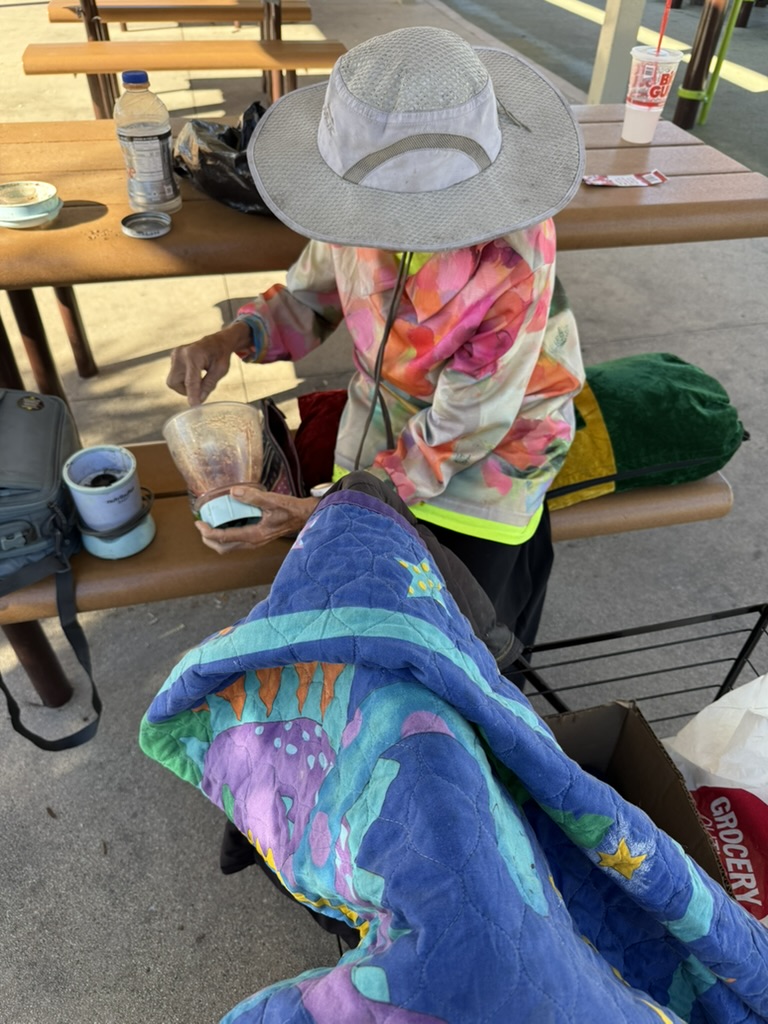
Suzanne sleeps in a sedan on the industrial edge of Goleta, but to call her homeless is too small a box to fit her life. She has lived in cabins, shelters, halfway houses, and tents. She has worked inside the system and refused it. At 89, she owns almost nothing, and still, she is not poor. She is, in her words, a privileged homeless person — a phrase that sounds like an oxymoron until you watch her mix berries in a baby blender plugged into a picnic-table outlet at a park.
“I have been outside, by myself, for 57 years,” she said matter-of-factly. “I’m amazed I’m still alive.”
She has lived and worked in nearly every shelter in the Santa Barbara area. She camped for a time along Mountain Drive, a ridge road above the city where some people park and never quite leave. She has helped others navigate shelters, advocated for residents with trauma, confronted staff when she believed people were being mistreated, and once took unhoused people to a dentist who gave discounts.
When asked how she is doing, she often responds, not with an inventory of her own needs, but with questions about the state of the world — Israel and Gaza, Ukraine, Venezuela, Greenland. Her sense of scale is planetary.
“I don’t think any injustice is being done to me,” she said. “I don’t blame the government.”
Suzanne’s homelessness is, in her words, a system rejected, rather than one that rejected her.
Context Is Key
Worldwide, more than 100 million people have no shelter. Whether the reason is due to war, famine, or natural disaster, their homelessness is not a choice.
In America, the shape of homelessness began to shift dramatically in the late 20th century, when deep federal budget cuts collided with rising rents, stagnating wages, and the dismantling of mental health infrastructure. Federal investment in subsidized housing dropped by billions.
At the same time, inner cities gentrified, and single-room-occupancy hotels — once a last line of defense against homelessness — were razed or flipped into boutique hotels and expensive condos. Large numbers of people with severe mental illnesses were left to navigate city streets and temporary shelters. Between 1955 and 1980, 75 percent of psychiatric hospitals closed as they lost state and federal funding.
Over these decades, homelessness became more permanent — especially for people who aged into it. Today, roughly one in five unhoused people in the United States is older than 55. Many entered homelessness later in life, after job loss, illness, caregiving responsibilities, or the death of a partner. Whatever the case, they are among the most vulnerable of those living on the street.
A Story to Tell
Homelessness, as defined by global institutions, is a condition of lack. Suzanne’s version is something else. To her, it is a protest supported by individuals and her community. By her own account, she has been unhoused for half a century — 40 of those years in Santa Barbara.
After many conversations over a few months, Suzanne told me her history. She was born in Pasadena during the final years of the Great Depression and grew up during World War II. Her parents were, as she tells it, equal parts artistic and austere. Her mother worked as a nurse’s aide in the OB ward of a Catholic hospital; her father was a Shakespearean actor turned police officer. As a child, her family moved to Burbank, where she remembers air-raid sirens warning of a Japanese attack that never came. Eventually, she ended up at UC Berkeley, where she earned a degree in sociology in 1958.
From there, she said, her life moved to New York City, where she helped tenants at the Henry Street Settlement House form grievance committees. In the 1960s, she returned to Berkeley, this time to work at Head Start, then a new federal educational program for children from low-income families. But that ended when, Suzanne said, she “didn’t want to pay taxes to a government that killed people in Vietnam.”
Europe followed — twice, both times in pursuit of love. After the second, she returned to California with a different outlook on life: She wanted to wake up under trees. First in the Santa Cruz Mountains in a cabin, then a tent in Santa Barbara, then shelters, and finally a car.
After a fall last spring sent her to a convalescent care center, a businessman she knew offered her a used, faded-gold sedan. She accepted it reluctantly.
“I hate it,” she said. “It leaks. It’s cramped. But it’s mine.”
Her car is now her bed and sometimes her bunker. She sleeps curled across the backseat, knees tucked, the windows cracked just enough to keep the glass from fogging over. She keeps a cup and a bag for her business, disposing discreetly at trash cans — the not-so-snazzy part of living sans a house.
Suzanne maintains what might be called high-functioning homelessness. She is strategically parked near a public park that offers benches, bathrooms, water fountains, and an outlet to power her blender — a key item given that she has just one tooth.
She is deeply embedded in the neighborhood’s informal supply chain: food and the occasional gift of money from neighbors. She makes sauerkraut and talks often about feeding her microbiome. Clothing, ideally not made in sweatshops, comes from thrift stores. “I would say I’m far more self-sufficient,” she said.
She does not panhandle. She does not collect Social Security, and she attempts to stay away from any taxpayer-supported institutions. She used to support herself by recycling bottles and cans. Now, at 89, she survives.
Peace of Mind
Suzanne has never used drugs or alcohol — “no chemicals to solve problems,” she said — but her inner life has not been untroubled. She describes being “plagued by anxiety” for much of her early adulthood. She tried different types of 1970s psychotherapy, which backfired. From there, her spiritual experiments widened — Native American vision quests, scripture, Quaker meetings — in a continuous effort to steady the mind.
Her current routine is refined. Mornings begin with Bible readings, journaling, a long walk, and then food. Her diet is plant-based, mostly raw, and selected with care: liquifying berries, vegetables, and nut butters.
When a neighbor leaves a Mandarin orange on the lid of a trash can, she considers it a gift.
“Someone left that for me,” she said, eyes lighting up.
Suzanne has her cart, her lunch box, and a list of shelters and the goods they provide. She makes no suggestion that she is living this way by accident. If anything, Suzanne lives stubbornly, proudly outside. She distrusts the government, believing the system to be fragile — she does not want to be caught depending on something that could be taken away.
Suzanne is not an island. She is part of a loose network of people who keep an eye out for one another. She has relationships, routines, places where she belongs. She attended Quaker meetings for years.
Life’s Lessons
To observers, Suzanne does not appear to be in crisis. She is lucid, spiritual. She speaks slowly, but not aimlessly. She offers advice freely. She is funny. She calls the modern world a technological monster. She worries about the loss of peace, the worship of profit, the “little machines you put in your pocket.”
Chuck Flacks, a city of Goleta Homelessness Services Coordinator, notes that each person’s case is complex. “We have an outreach team who covers the whole city. We are familiar with every case of someone living on the streets,” he said. “We care deeply about each person, meet them where they are, and always offer food, water, and help to take the next right step in their lives. We don’t limit our offer of help to once, 10 times, or 100. We keep making sure everyone is okay.”
Suzanne is well aware of these offers. She has accepted help in the past, asking for specific items that she needs. There are also times where she walks away from help.
If there is a lesson in Suzanne’s life, it is not how to escape homelessness, but how to exist in it. And she knows that, in many parts of the world, being unhoused means death. Still, she moves through her day in a balancing act between survival and living.
For Suzanne, the word “homeless” is not a classification, but a failure of imagination. She survives with intention, refusing what she cannot reconcile, and arranging her days with the efficiency of someone who has learned that permanence is an illusion and belonging is not a matter of address.



You must be logged in to post a comment.