Women’s History Month wraps up at the end of March. It is a moment, advocates say, to revisit where the country stands — or more pointedly, where it does not.
For many Americans, the Equal Rights Amendment (ERA) — establishing equal rights regardless of sex — is a century-old proposal widely assumed to be settled law. Women have the vote. But an explicit constitutional guarantee of sex equality remains unresolved.
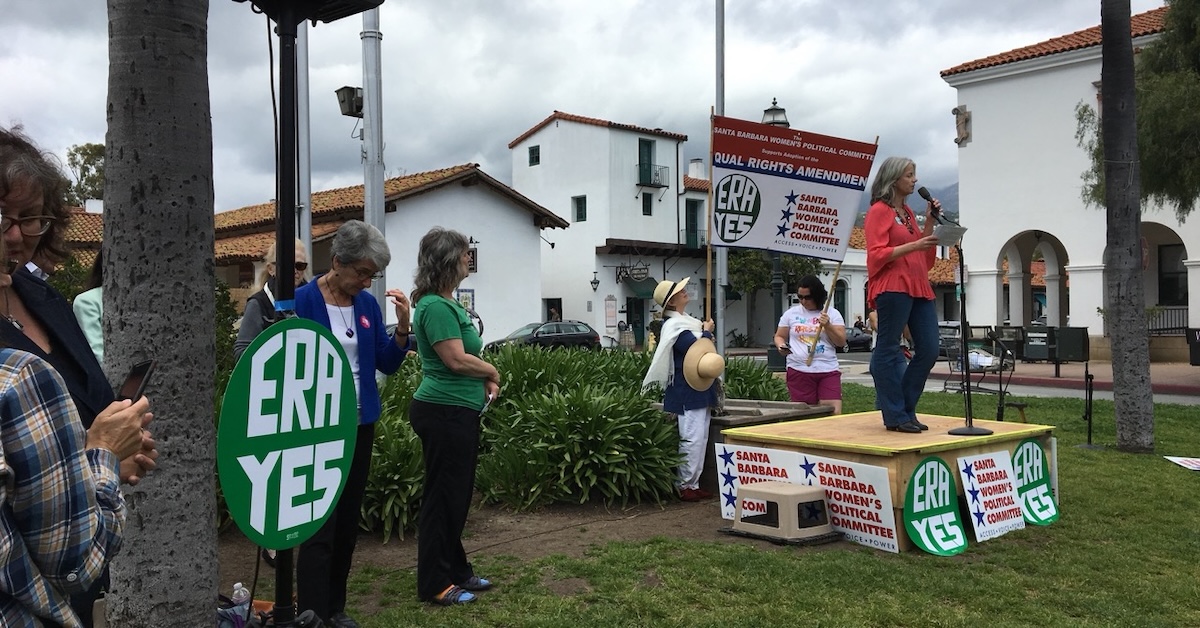
In Santa Barbara, the Women’s Political Committee (SBWPC) has launched a renewed campaign to educate residents about the amendment’s status and to press for its formal recognition as the 28th Amendment to the U.S. Constitution.
“A lot of people are shocked to find out that it hasn’t passed,” said EJ Borah, co-chair of the committee’s Equal Rights Amendment task force.
First introduced in 1923 and approved by Congress in 1972, the amendment states that equality of rights under the law “shall not be denied or abridged … on account of sex.” Congress set a ratification deadline that expired in 1982 after 35 states had approved the measure. Supporters note that three additional states have since ratified it, meeting the 38-state threshold, but the ERA has never been formally certified or published as part of the Constitution.
“To the average American, it’s implied that we are all equal under the law, but it is not codified or enshrined within the U.S. Constitution,” said Christina Pizarro, president of the Santa Barbara Women’s Political Committee.
Founded in 1987, the committee quickly established itself as a local engine for feminist political activity, hosting early events featuring figures such as National Organization for Women cofounder Betty Friedan. Over time, it has backed political candidates at every level of government and helped shape policy conversation. Former state senator Hannah-Beth Jackson, a past SBWPC president, authored some of California’s most expansive gender equity laws, including one of the nation’s strongest equal pay statutes.
The group’s latest push includes a newly released “road map” outlining strategies ranging from congressional lobbying to petition drives aimed at converting awareness to pressure to pass the ERA.
Whether that pressure can translate to an addition to the Constitution is not only contentious, but also legally unclear.
Legal scholars are split on whether the amendment can still be adopted without renewed congressional action. Some argue that the Constitution imposes no binding ratification deadline and that the archivist’s certification would be largely administrative. Others contend the expired timeline renders the amendment legally void unless Congress restarts the process.
Supporters argue the importance of a constitutional guarantee could strengthen legal protections in areas such as pay equity, gender-based violence, educational opportunity, and reproductive health care. Pizarro described the ERA as “the umbrella amendment … which will codify equality across the United States.”
Recent data suggests the gap in regard to equal pay remains wide. On Equal Pay Day this week, California’s Civil Rights Department reported that women and people of color remain disproportionately concentrated among the lowest-paid workers across nearly eight million employees surveyed. Locally, the Santa Barbara County Commission for Women has been promoting the state’s Equal Pay Pledge — a coalition of more than 200 employers committed to narrowing wage disparities.
Aside from pay equity, the ERA carries a range of potential implications that have pulled it into broader political conflicts. Its potential implications for abortion law remain a flashpoint, while opponents have raised questions about transgender participation in athletics.
The Women’s Political Committee says that the current political climate complicates the path forward. “We must not let it [the ERA] fade as long as Trump is president,” Borah said. “The minute that he’s no longer president, we hope to be ready to pass it.”
For committee members, readiness means narrowing what they see as the gap between the public perception of equality and its constitutional reality — sustaining awareness now in hopes of future legislative action — action that would make equality not implied, but written into the law of the land, in a country that remains one of the last developed nations without it.