

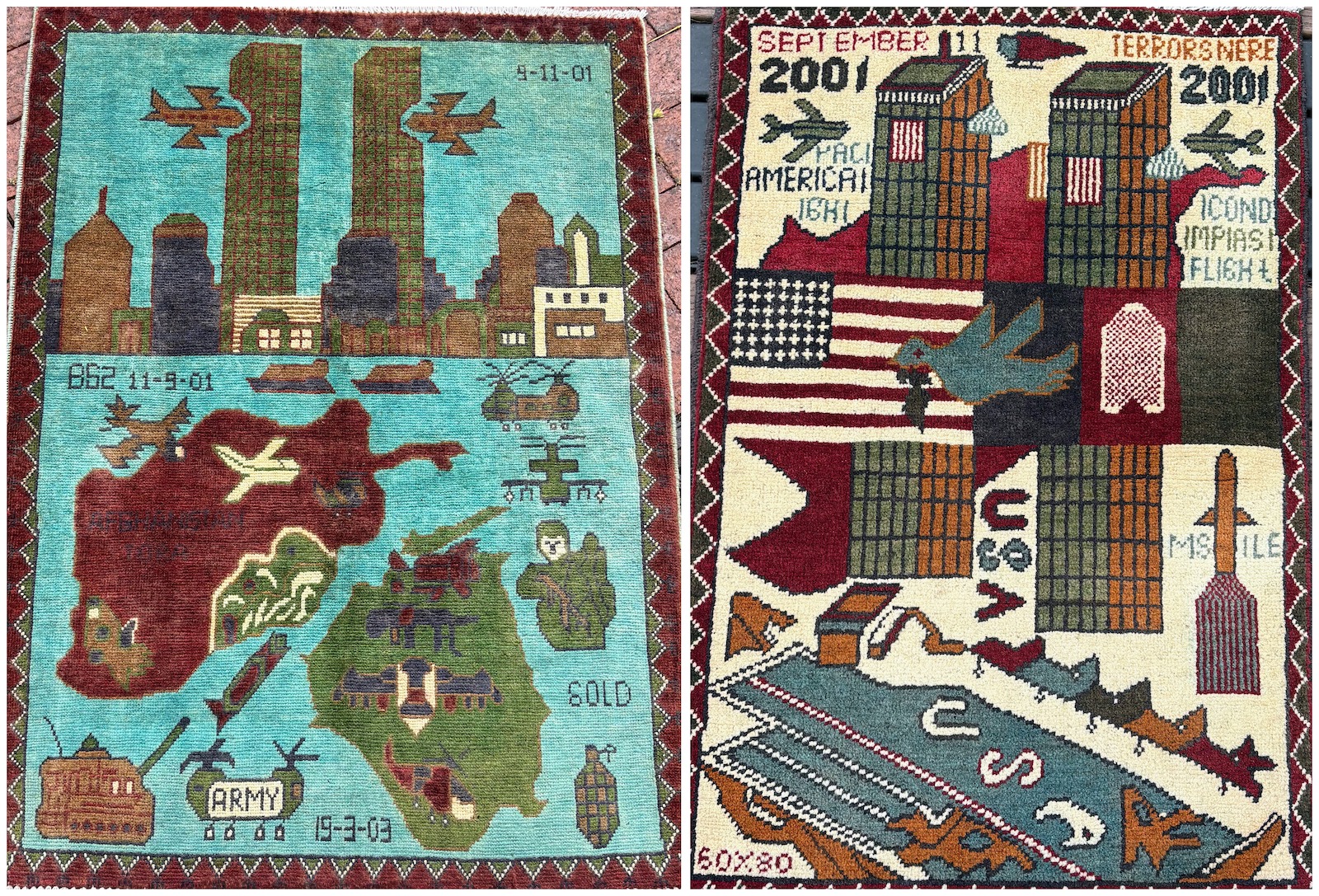
Last weekend the New York Post ran a story about a State Street carpet shop in Santa Barbara. The object of its outrage was a $450 carpet showing two airliners striking the Twin Towers. The store is owned by Masood Azizi, an Afghan immigrant who has sold antique and tribal rugs in this town since 1980. The newspaper ran the predictable headline. The predictable outrage followed. Almost nothing in the coverage was true in the way that matters.
Storytelling through weaving is an ancient art in Afghanistan. For more than a thousand years, women in Central Asia have used the carpet as a medium for genealogy, cosmology, and history. The form is not decorative; it is narrative. Afghan war rugs are the modern chapter of that tradition, exhibited by the British Museum, the Penn Museum, and the Boca Museum of Art, and described by art historians as a major tradition of 20th-century war art. They emerged when Baluch and Turkmen women in Herat and the refugee camps of Peshawar replaced the flowers and birds of inherited motifs with the helicopters and tanks that had replaced flowers and birds in their actual lives. They are a record kept by people who, under successive regimes, were not permitted to keep records any other way.
The 9/11 story entered this tradition for the same reason every other story did. Something happened. The weavers wove it. They did not invent the form to celebrate the attacks; they adapted a form they had used for decades to document the Soviet occupation, the civil war, the Taliban, and the American invasion that 9/11 set in motion. The lower portion of the rug at Tribal Rugs and Art shows tanks, helicopters, and the date of the American campaign. The same loom that recorded the airplanes recorded the response.
The Americans who understand this best are soldiers who served in Afghanistan. They bought these rugs by the thousands and brought them home. Officers wrote about them in military journals. Veterans built online archives to catalogue them; the largest in the world is run out of New York. None of these veterans confused a documentary textile with a celebration of the thing it documents. They knew what they were looking at.
Consider what happened when the Post composed its article. The reporters worked the phones from New York. They didn’t bother to study the British Museum catalogue, the Penn exhibition notes, or any standard scholarship a curious person can find in five minutes, nor to speak with a single Afghanistan veteran or textile historian. They located, instead, two retired New York firefighters and described the rug to them without context. The firefighters reacted as anyone would react to an object stripped of its tradition and presented as a provocation. Their grief is real. The daily used it under conditions that made an informed answer impossible. That asks the firefighters to render a verdict on something they did not understand.
There is a useful distinction between ignorance and bigotry. Ignorance is the absence of information. Bigotry is the decision not to seek it. The information was available; the decision not to seek it produced an article whose target audience is not New Yorkers grieving 9/11. The target audience is the prejudiced reader who already suspects an Afghan immigrant in California must be hiding something, and who closes the tab confirmed in that suspicion. Within hours the story had migrated to firearms forums and Russian state-aligned aggregator sites, both of which understood, correctly, that they had been handed a useful object.
None of this requires a polemic. It requires the habit of questioning our assumptions and the assumptions behind those assumptions. A rug is not a slogan. A weaver is not a propagandist. A shopkeeper who has lived among us for 46 years is not a stranger. The Afghan tradition of recording war in textile form has been honored by museums and by soldiers because it honors the dead and injured. The companion rug in Mr. Azizi’s shop shows the towers, the date, and at its visual center the American flag and the Afghan flag side by side, with a dove of peace flying between them, an olive branch in its beak. A weaver who sympathized with the hijackers does not weave that composition. The Post chose not to see it.
Masood Azizi arrived in Santa Barbara the year I did, from a country we then called an ally against the Soviets, in the same migration that brought the weavers whose work he sells. He is one of us. The rug on his sidewalk is a memorial, woven in the traditional language of its makers. The civic task is not to shout back at the Post but to think more clearly than the tabloid. Structure precedes culture. Always. We must learn what we are looking at before deciding how to feel about it.

