

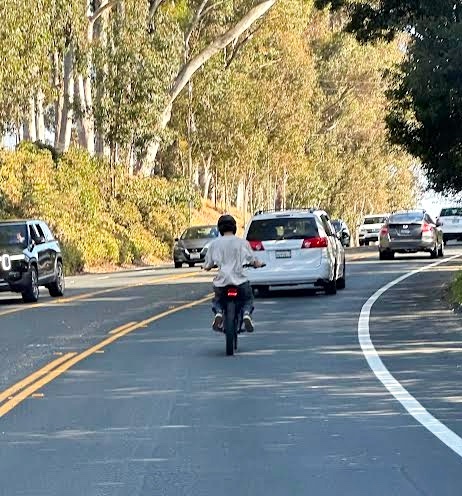
I used to own a 50cc Vespa scooter to get around town. There was something fun and romantic about it, and it fit the Santa Barbara roads and lifestyle nicely. Top speed was about 30mph, downhill with a tailwind. It was easy to park, very fuel efficient, and genuinely fun to ride. To operate it, I had to pass a motorcycle written test to get a license, carry insurance, register it with the state, and get a license plate. It wasn’t a big deal and seemed fair. The scooter had real performance, real responsibilities, and real consequences if something went wrong.
We have a business on State Street, so I see e-bikes on a daily basis. I find myself trying to make sense of the e-bike situation, but it just doesn’t add up.
Any e-bike rolling past often weighs 60 to 80 pounds, is able to hit 25-35 miles per hour, is ridden by people of all ages, and requires nothing from the rider. No license. No plates. No registration. No insurance. And, in most cases, no helmet. None of the things that the Vespa required even though they are very similar in performance and size. The difference is that one runs on gas, the other on electricity.
The performance gap between my old Vespa and a modern e-bike is very small. A 50cc scooter tops out around 30-35 miles per hour on a level road. A legal Class 3 e-bike caps out at 28. The out-of-class machines (not class 1, 2 or 3), openly sold under the e-bike label, hit 35 to 45. Same speed envelope. Same kinetic energy in a crash. Same risk to the rider and to the pedestrian on the sidewalk, but two very different treatments under the law.
The reason is mostly historical. In 2015, the Legislature passed Assembly Bill 1096, which carved e-bikes out of the motor vehicle ode and parked them in the bicycle code. The thinking was that e-bikes were bicycles with a little motorized help, to be used by adult commuters at reasonable speeds to replace car trips. That was a fair perspective in 2015, but it is not what is on our streets in 2026.
PeopleForBikes, the trade group that helped write the original law, has told the federal government that many of today’s products are deliberately misclassified and pose a public safety threat. It is a loophole that has been blown wide open.
The injury data points in one, clear, deadly direction. A 2024 JAMA Surgery study found a 30-fold rise in e-bike injuries and a 43-fold rise in e-bike hospitalizations from 2017-2022. Head trauma alone jumped 49 fold.
At Rady Children’s Hospital in San Diego, e-bike injuries became the number one cause of trauma ER visits in 2025. Closer to home, the Santa Barbara Police Department logged 10 e-bike collisions in 2022, 73 in 2023, and 107 in 2024. In two-thirds of last year’s crashes, the e-bike rider was at fault. Cottage Hospital treated 84 e-bike trauma patients between October 2022 and October 2024. Forty of them were between the ages of 11 and 20. Nineteen had serious head and neck injuries. In May 2025, a Santa Barbara e-bike rider was killed on State Street. That was our first e-bike fatality but the Civil Grand Jury report that followed said it would not be our last unless something changes.
Other coastal California cities have been scrambling to do something with the limited tools state law allows them. Encinitas declared a state of emergency in 2023 after 15-year-old Brodee Champlain Kingman was killed on his e-bike. Carlsbad, Hermosa Beach, and Manhattan Beach passed urgency ordinances that include helmet rules, sidewalk bans, geofencing for rental fleets, and impound authority. Carpinteria’s new ordinance took effect on March 9. San Diego County now allows cities to ban e-bike use by riders under 12. Santa Barbara passed its own ordinance last year, with fines from $100 to $500.
At the state level, the conversation is moving. Assembly Bill 1942, the E-Bike Accountability Act, would require Class 2 and Class 3 e-bikes to be registered with the DMV and display a license plate. A companion bill, AB 1557, would tighten the e-bike definition and lower the Class 1 and 2 assist speed cutoff from 20 to 16 mph.
Here is the question Santa Barbara has not really had out loud yet. My old Vespa and a modern e-bike have roughly the same speed range and the same crash physics and dynamics. One required a license, plates, a helmet, and insurance, and for a rider to be at least 16. The other requires none of it.
Is that distinction still defensible in 2026? Are e-bikes still bicycles or have they outgrown the category these past 11 years? If they have outgrown it, does the age of the rider matter? Should the parent who buys an out-of-class machine for a 12-year-old carry some legal accountability when something goes wrong?
This is an issue that needs to be addressed and, more importantly, enforced. We all see it on our streets and what the Cottage Hospital data shows. The State Street Master Plan is meant to unlock a downtown that works for residents, families, and visitors. The conversation that builds downtown must include this one for it to be meaningful.
Santa Barbara needs to decide what it believes about who this city is for and what rules are needed to support that. The question is on the table, and it is not going away. Let’s hope it’s made before we lose another life.

