

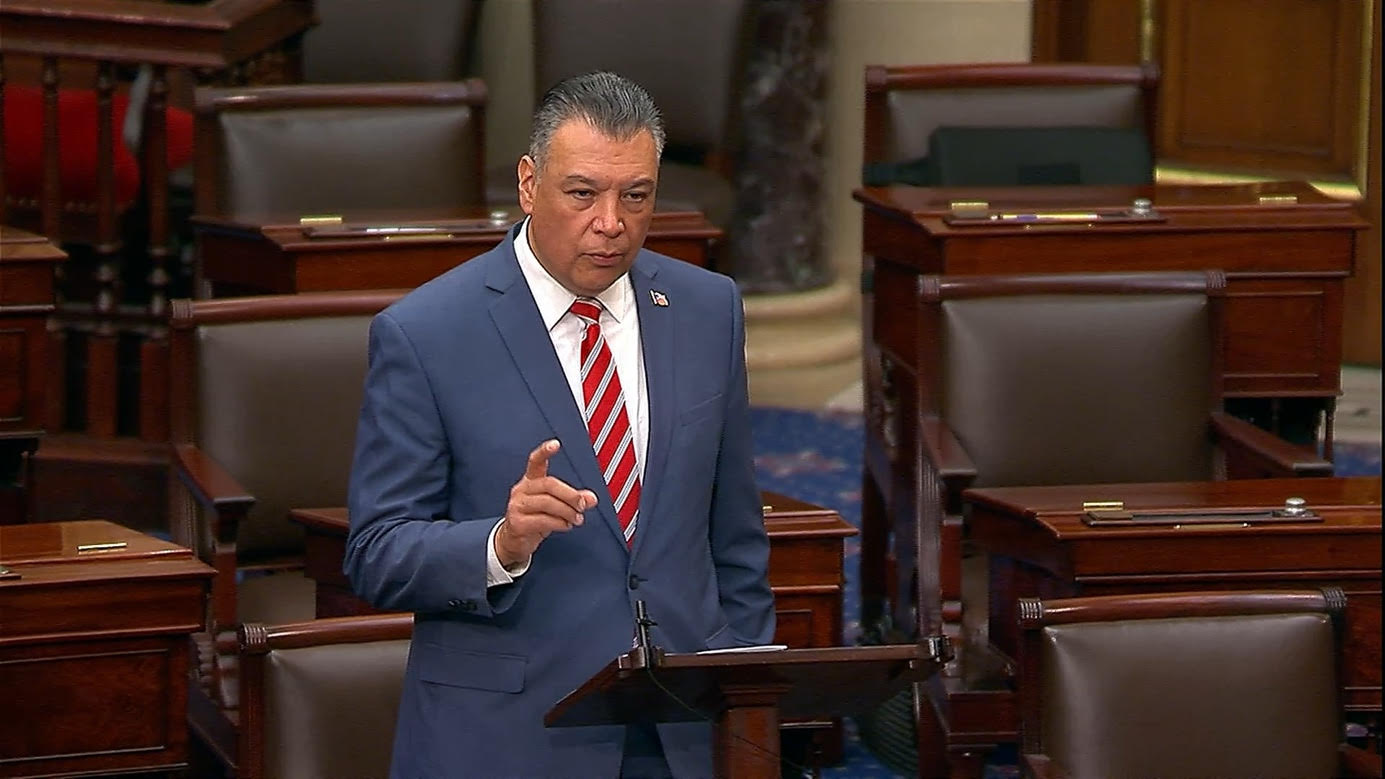
California’s senior U.S. senator, Alex Padilla, condemned the Supreme Court’s Louisiana v Callais ruling at a Senate Judiciary Committee hearing on May 20 and held the Senate floor with Democrats to oppose the Supreme Court decision that will effectively eliminate another key component of the landmark Voting Rights Act.
“In 1965, Congress enacted section two of the Voting Rights Act, which prohibited any election practice that denied or a bridge the right of any citizen to vote on account of race or color. When the Supreme Court then interpreted section two to require proof of intentional discrimination, Congress responded pretty unambiguously. It revised section two to prohibit any election practice that resulted in the denial or abridgement of a citizen’s right to vote on account of race or color. There was no real question as to what that language meant,” Padilla said.
As California’s Secretary of State from 2015-2021, Padilla oversaw the state’s elections. He is an original cosponsor of the John R. Lewis Voting Rights Advancement Act . His speech to the Senate, addressing the presiding senator as “Mr. President,” is below.
Mr. President,
Our late friend and colleague, Congressman John Lewis, once said: “The vote is precious. It is almost sacred. It is the most powerful nonviolent tool that we have in our democracy.”
Mr. President, today that sacred right is under assault.
And with its recent Callais decision, the Supreme Court of the United States has dealt our right to vote another devastating blow.
Sadly, this ruling did not happen in isolation. It’s the culmination of a decades-long effort to undermine the Voting Rights Act of 1965 and the promise of American democracy itself.
As Justice Elena Kagan wrote in her dissent, this decision marks “the latest chapter in the majority’s now completed demolition of the Voting Rights Act.”
All in what appears to be is Donald Trump and his allies’ attempt to cling to power.
Not by addressing the exploding cost of living that’s crushing so many families across America, not by ending this unauthorized war in Iran, but by undermining our democracy, rigging electoral maps, and gaming the system in their favor.
What’s clear with the Callais decision and earlier voting rights decisions by the Supreme Court, is that they have rejected both the text and the purpose of one of the most important laws of American history.
You see, the Voting Rights Act was born out of struggle.
Including the struggle of Americans who marched across the Edmund Pettus Bridge decades ago and endured incredible violence and persecution – simply for demanding that democracy in America truly include everyone.
When the Voting Rights Act finally became law 61 years ago, America made good on a promise: that our democracy would truly belong to everyone.
And the results were undeniable.
In just the first decade after its passage, the disparity in voter registration rates between white and minority communities dropped from 30 percent to 8 percent. Huge progress.
And communities that had long been denied a meaningful voice in their government gained representation in local city halls, in state legislatures, and yes, right here in Congress.
And the law enjoyed decades of bipartisan support. Its initial passage and reauthorization had been bipartisan.
In fact, the last time Congress reauthorized the Voting Rights Act in 2006 – it passed the Senate unanimously.
Yet, we know there’s been always those determined to undermine and weaken this landmark law – including Chief Justice Roberts himself.
When he was a young lawyer in the Reagan Administration, he wrote memos attacking the Voting Rights Act and devising legal arguments to undermine it.
And he succeeded. Beginning with the Supreme Court’s 2013 Shelby County decision, he and the Court’s extreme majority began dismantling the law’s core protections.
In the Shelby decision, the Court declared that the law’s preclearance protections were no longer necessary because of how far we had come as a country – ignoring the mountain of evidence that they were presented with showing the chronic problem that voting discrimination continued to be.
And the consequences of that decision were both predictable and swift.
Republican state legislatures immediately unleashed a flood of new discriminatory voting bills, many turned into laws. Everything from restrictive Voter ID requirements, to closing polling sites in minority communities, to restricting voter registration drives and attacking early voting.
It’s no surprise, then, that the participation gap between white and minority voters soon began growing again after decades of narrowing – including and especially in the states that were covered by section 5 of the Voting Rights Act previously.
Now, according to one Brennan Center analysis, as many as 9 million more ballots would have been cast in the 2020 election without the Shelby decision of 2013.
And now, the Callais decision goes even further.
This decision has already thrown elections into chaos with states racing to redraw political maps ahead of this November’s midterm elections.
You don’t believe me? The Supreme Court has already given Alabama permission to use a map found by a lower court to be intentionally racially discriminatory. But the Supreme Court is sanctioning Alabama’s use of that map.
The state of Louisiana, who just had a primary election yesterday, dropped the state’s House primary elections – even after absentee voting had already begun – in order to redraw Congressional districts for the current year.
And as we speak, in South Carolina they’re debating whether to redraw the map to entrench Republican power.
Colleagues, this is not representative democracy. It’s a political power grab.
Sadly, Callais is only one part of a broader effort to skew our upcoming elections and make participation in our democratic process harder for millions of Americans.
We see it in efforts to purge voters from the rolls using flawed federal databases.
We see it in attempts to impose burdensome ID requirements that threaten to disenfranchise women, students, seniors, Native communities, and both rural and blue-collar voters who may lack passports or their original birth certificates.
And we certainly see it in Trump’s obsession with the SAVE Act which would make it harder for eligible Americans register to vote, stay registered to vote, or actually cast their ballot.
Colleagues, all of these efforts are rooted in the same dangerous idea: that political power can be preserved by restricting rather than expanding voter participation.
That’s un-American. We’re living in a pivotal moment for American democracy.
In the difficult days of Jim Crow, Americans chose to organize, to march, and to sacrifice to pass the Voting Rights Act.
And now following their example, Americans today are marching again.
Last weekend, thousands from across the country gathered in Alabama and returned to the Edmund Pettus Bridge – determined to carry the legacy of the Voting Rights Act and the Civil Rights Movement forward.
A new generation is taking up the torch to defend the principle that in a democracy, every voice matters and every vote counts equally.
Colleagues, we have a duty to join them – beginning with the passage of the John Lewis Voting Rights Advancement Act to restore the protections gutted by the Supreme Court.

