

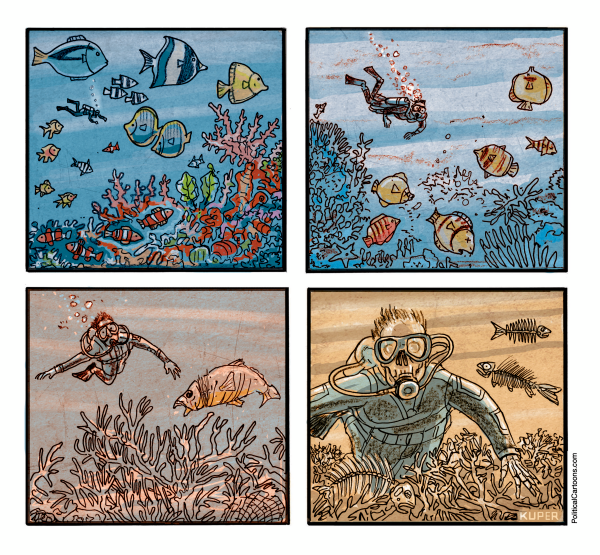
A few days ago, my wife, Donna, asked me why I spend so much time thinking about environmental issues. “We won’t be around to see how it all turns out,” she said.
She’s probably right. At 85 years old, I am much closer to the end of my journey than the beginning. But her question stayed with me because I realized the answer is simple. I worry about it because I have children and grandchildren, and because I have spent a lifetime watching changes take place that most people never had an opportunity to see.
For more than six decades I have made my living on, in, and under the ocean. I have spent thousands of hours diving along the California coast and in other parts of the world. During that time I witnessed environmental changes that would have been difficult for me to imagine when I was a young man.
When I first entered the water as a diver, giant kelp forests covered vast stretches of the California coastline. Abalone were abundant. Marine life flourished in places that today bear little resemblance to what I remember. Over the years I watched pollution take its toll in some areas, overharvesting in others, and more recently the collapse of ecological relationships that once kept marine environments in balance.
One of the lessons I learned from decades underwater is that nature functions as a unique system. Every plant and animal plays a role. When enough pieces are removed or damaged, the effects eventually spread throughout the entire ecosystem.
What concerns me today is that I see the same thing happening on a massive scale.
Many people still think of environmental issues as separate from economics, politics, immigration, or war. I don’t believe they are separate at all.
When drought affects agriculture, food becomes more expensive and livelihoods disappear. When fisheries collapse, coastal communities suffer. When fresh water becomes scarce, competition increases. When storms, floods, and wildfires destroy homes and businesses, people are forced to relocate.
Human beings have always migrated when conditions become difficult. We are seeing that happen throughout the world today. Each year millions of people are forced to move in search of safety and opportunity, causing political tensions to increase. Governments struggle to respond. Economic pressures build. Social divisions deepen.
History teaches us that instability leads to deadly conflict.
For that reason, I believe climate change is becoming much more than an environmental issue. It acts as a force multiplier, making many existing problems worse. Environmental stress contributes to migration. Migration contributes to political tension. Political tension contributes to conflict. Conflict, in turn, leaves behind damaged infrastructure, polluted environments, and additional human suffering.
The cycle feeds upon itself.
What troubles me most is that humanity possesses remarkable intelligence and technological capability. We have walked on the moon, mapped the human genome, and created computers capable of performing calculations that once seemed impossible. Yet despite all of these achievements, we continue to disregard the damage to the natural systems that make our existence possible.
During my lifetime I have watched California experience prolonged droughts, devastating wildfires, coastal erosion, and dramatic changes within marine ecosystems. None of these events occur in isolation. They are dire warnings that larger systems are under stress.
Nature ultimately has the final say. It does not care about political parties, national borders, economic theories, or military power. Every society depends upon healthy oceans, clean water, productive farmland, and functioning ecosystems. When those systems begin to fail, the consequences eventually reach everyone.
I don’t claim to have all the answers, but, I know what I have seen.
What I have seen convinces me that protecting the environment is no longer simply about saving whales, forests, kelp beds, or endangered species. It is about protecting the foundation upon which human civilization itself depends.
Perhaps future generations will someday look back and wonder how a species capable of such extraordinary accomplishments could have been so careless with the planet that sustained it.
I hope they never have to ask that question.
That hope, more than anything else, is why I continue speaking out.

