

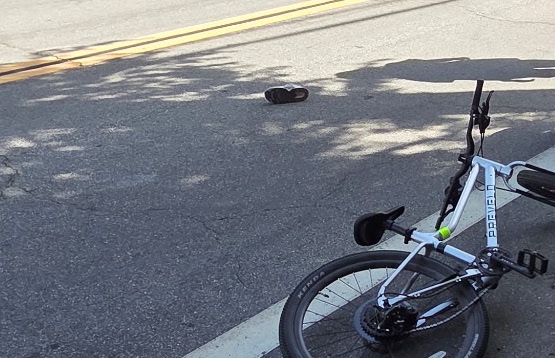
Sometimes being a bike safety researcher is heartbreaking. Last week an eight-year-old boy was hit while riding his bike on my street. He is badly injured with cracked ribs and a broken clavicle.
It didn’t take a road safety expert to predict that it was only a matter of time till there was a tragedy in the neighborhood connected to San Antonio Creek Road. The community is at the interface of urban and rural area. There are no sidewalks, narrow shoulders, and traffic flowing between the 154 and Cathedral Oaks Road.
With a growing number of young kids in the neighborhoods, parents have been organizing to improve road safety, under the auspices of Walk San Antonio Creek. When the group gets together, parents wring their hands, concerned about fast speeds and sightlines obstructed by sharp turns, hedges, and the sun.
Walk San Antonio Creek has made some progress. They have installed signs that ask people to slow down and recently had the speed limit reduced by five miles per hour.
Research on walking and biking safety is clear. Safety requires physical separation between vehicles and people walking and biking. Infrastructure is the best way to save lives and reduce injury. It is also the best way to promote more biking and walking.
While our region has made progress with infrastructure, installation of walking and biking paths is slow going.
There are a lot of reasons why. Infrastructure can appear costly, though I would argue it is cheap in comparison to the cost of medical care and emergency response for people that are injured or die. Infrastructure also requires coordination across governmental and community organizations, which takes time. Additionally, in Santa Barbara, our region also lacks data on where people are walking and biking, as bike and pedestrian data collection programs are in early stages, making it difficult to know where to prioritize more investment.
Still, we are seeing more people on bikes, especially kids. Providing them safe passage is something that the community should accelerate with public support and government dollars.
I hear a lot of concern about teens on e-bikes. I see the risks too. Kids are going fast and we wish they would clip their helmets. Yet, like smart phones, the pandemic ensured that e-bikes are here to stay. A recent survey by my lab at UC Santa Barbara shows that over 50 percent of bikes in the City of Santa Barbara are e-bikes. We worry about kids on e-bikes being safe, but they, and their parents, are trading safety for increased freedom, social connection, and independence. The reasons parents allow their children to ride e-bikes are complex and diverse.
Whether we are trying to protect children on rural streets or reduce the negative impacts of e-bikes, all the evidence points to one major solution: Build bike and pedestrian infrastructure as quickly as possible. It will keep our community safe, reduce carbon emissions, increase physical activity, and improve social connection.
In an interview with John Burke, the CEO of Trek Bikes, he said if the infrastructure of Copenhagen showed up in Santa Barbara, within weeks we would be begging to pay to keep it. I agree. We don’t know what we are missing.
There are a few ways you can get involved to improve safety for bicyclists and pedestrians of all ages. First, if you see or experience and safety incident report it to BikeMaps.org. These data go to our regional decisions makers through our Active Transportation Data Dashboard. Next time you feel frustrated with road safety issues, reach out to your councilmembers to let them know that safe and accessible streets are a priority to you. Finally, support organizations like MoveSB County and Strong Towns SB, groups in our community that are advocating for safer streets for all modes of transportation.
Making a community that is safe for bicyclists and pedestrians is best for everyone. I suspect that the car driver that hit the eight-year-old boy on my street is suffering. Better infrastructure protects us all and creates a community that has less carbon emissions, more social connection, and increased physical health. There is no place better suited to biking and walking than Santa Barbara!

