

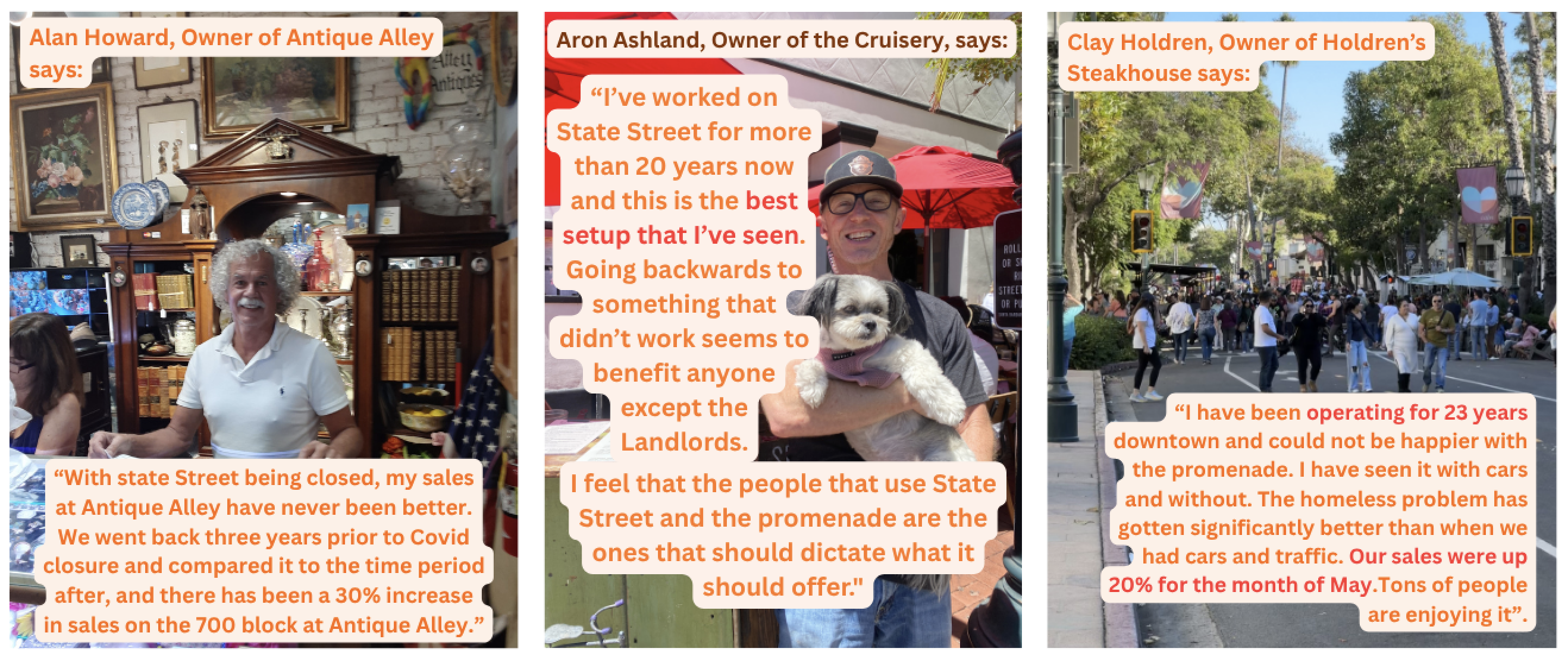
Businesses for State Street, a group of business owners and Santa Barbarans, writes to respectfully ask that the mayor and City Council carefully review the following facts and comments supporting the creation of a fully car-free State Street.
It’s time to bust some myths about State Street.
Myth: State Street should have automatically reopened when the COVID emergency ended.
State Street was temporarily closed because of COVID. What happened next is a separate question. Once the street was closed, residents, visitors, businesses, and city leaders had a chance to evaluate the results. The idea that reopening should have been the “default” is an opinion, not a legal or planning requirement. Cities modify streets all the time based on changing conditions and community goals.
Myth: The closure has created economic decline.
This is untrue. State Street’s commercial vacancy rate is lower today than it was before the pandemic. The highest vacancy rates remain on blocks that are open to vehicle traffic. Local retail challenges began years before the promenade and are largely tied to national trends like e-commerce and department store closures.
Despite competing with increasing online business trends, vacancies on State Street are going down, not up. Radius Commercial Real Estate’s Quarter 1 2026 retail report stated: “…vacancy along State Street between Gutierrez and Sola Streets (400-1300 blocks) has declined significantly. After peaking at 48 available storefronts in Q4 2020, vacancies have returned to approximately 30 — on par with mid-2019 levels.”
Myth: State Street’s primary purpose is moving cars.
State Street is a public space, not a highway. Its purpose is moving people, supporting businesses, providing access, and serving as the civic and cultural heart of the city. The Draft State Street Master Plan notes that before the closure, the street moved a measly few thousand cars per day — such a low number that it was just above the minimum measurement threshold. Residents know that State Street, with its mid-block crossings and long red lights, was never a preferred route through downtown.
Myth: Customers choose other destinations because access is difficult.
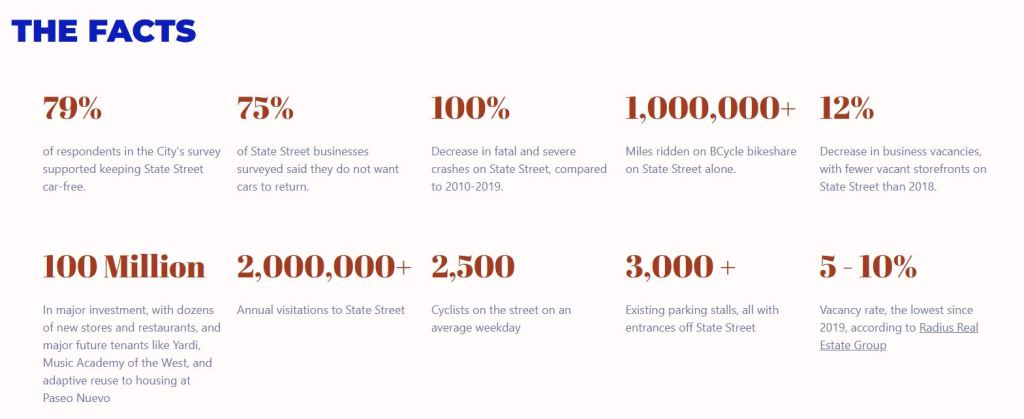
Downtown Santa Barbara has over 3,000 parking spaces on the blocks between Chapala and Anacapa in lots and garages. Entrances to this parking has never been on State Street. Most successful downtowns ask people to park once and walk. That is a feature, not a flaw.
Myth: There is not enough transit access to the street and golf carts are not a substitute for accessibility.
True. But almost nobody argues they are. The current setup with the electric golf cart transit, called The Loop, does not meet transit demand (but thank you to Friends of State Street for creating it!). Full transit service should come back to State Street, seven days a week–not private vehicles. The presence of vehicles would only slow down transit and increase dangerous vehicle conflicts.
Myth: Drivers now circle endlessly and create more pollution.
There is no evidence for this. If traffic had simply been displaced, we would expect widespread gridlock on adjacent streets. There is no study that shows that traffic on Chapala, Anacapa, or any other street has increased. Also, all access to parking on parallel streets remains the same as before.
Myth: Cars moving at 20 mph were safer than today’s environment.
This is patently untrue. Before the closure, lower State Street was the third highest injury corridor for pedestrians and cyclists in the entire city. There were 45 crashes on State Street in the mere six years before 2020. Since cars were removed, serious crashes on the promenade have dramatically declined. Cars remain the leading cause of severe traffic injuries and fatalities. That is not true of pedestrians, bicycles, or scooters.
Myth: Residents feel less safe because of bikes and disorder.
Safety concerns should be taken seriously. But homelessness, mental health issues, and enforcement challenges existed long before the promenade. Reintroducing cars does not solve those problems.
Claim: Retailers avoid State Street because there are no cars.
In Strong Towns Santa Barbara’s survey of 40 businesses, 75 percent preferred keeping State Street car-free.
The Radius report also noted that EoS Fitness took 24 Hour Fitness’s space at 820 State Street. Other new businesses include a furniture store at the vacant CVS at 1109 State Street. Music Academy of the West is remodeling the old Forever 21. Yardi Systems is currently in conversation with the city to convert the Macy’s building into their global headquarters, an upward of $100 million deal. Would Yardi be interested in investing in car-free State Street if it were an utter failure?
Myth: People want their “traditional” State Street back.
The city’s own survey found overwhelming support for keeping State Street car-free, with 79 percent of the 5,700 respondents saying they want no cars. Thousands of residents have expressed support for a permanent promenade through written and spoken public comments. The petition linked on the Business for State Street website here has over 3,000 signatures overall. There are also over 700 comments. Anyone interested can read them here.
Why we would take one of the most popular public spaces in Santa Barbara, make it less safe, less pleasant, and less distinctive, without clear evidence that doing so would solve the problems its critics claim it will?
June 30 is the big day. City Council will discuss whether to extend Title 31 and keep State Street car free, or revert it to the 2019 layout. Repealing Title 31 would mean a complete loss of outdoor seating on State Street, removal of the pedlets, removal of the bike lanes, and destruction of a beloved promenade. Continuing Title 31 means creating confidence for businesses and the public that the city is committed to a pedestrian-focussed street, with possibilities for experimentation to create more seating and slow down e-bikes. Let’s keep it moving forward.
If you can’t make it at 5 p.m. for public comment, email council a comment to Clerk@SantaBarbaraCA.gov. You can also sign the petition.
This article was revised for clarity and correct links on June 26, 2026.


You must be logged in to post a comment.