

A new report being cited by opponents of Diablo Canyon’s continued operation carries an alarming title: “Worsening Newborn/Infant Health in San Luis Obispo County and the Diablo Canyon Nuclear Reactors.” Its author, Joseph Mangano of the Radiation and Public Health Project, claims that radiation from Diablo Canyon, California’s only remaining nuclear plant and largest single source of clean electricity, is demonstrably harming the babies of San Luis Obispo County.
It is a serious charge that deserves close scrutiny. The report does not survive it, because the evidence is not there.
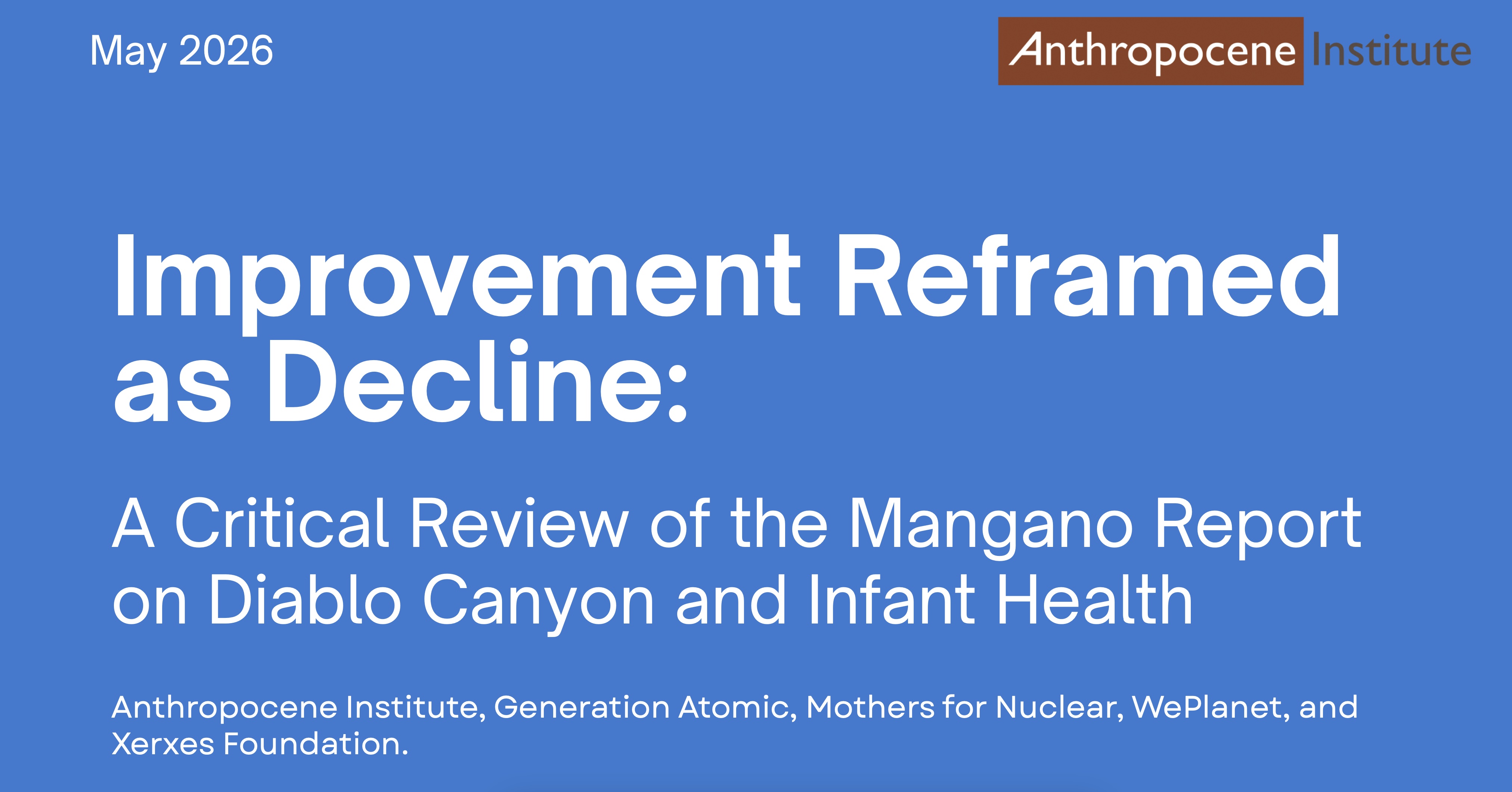
Mangano’s central claim is that infant health in San Luis Obispo County has “worsened.” But the underlying CDC WONDER data show the opposite. Infant mortality in San Luis Obispo County has fallen by 54.7 percent compared to the baseline period before Diablo Canyon opened. That is not a worsening trend, it distorts statistics to turn a substantial public health improvement into a concern. A detailed review of the underlying data, published in May by the Anthropocene Institute, Generation Atomic, Mothers for Nuclear, WePlanet, and Xerxes Foundation documents these discrepancies in full.
So how does a nearly 50 percent improvement become evidence of decline? By substituting a relative comparison for an absolute one. Instead of asking whether infant mortality improved over time in San Luis Obispo County, the report asks whether it improved as quickly as California’s statewide average. Since these real improvements were more modest than in other California counties, that gap becomes evidence of harm caused by a nuclear power plant, according to Mangano.
Presenting improvement as a crisis, in a report likely to alarm parents and influence policymakers, is deeply misleading.
The methodology problem extends to the report’s supporting claims, none of which hold up under examination.
On birth defects, Mangano argues that San Luis Obispo County has a rate 114 percent above the state average, the third highest among California’s largest counties. The figure sounds alarming. In absolute terms, however, it represents 73 cases over nine years. The report provides no historical baseline to show whether this rate is unusual or longstanding, no independent verification, and no analysis of whether local healthcare providers report birth defects differently from the state overall. In fact, the calculated rate of birth defects in San Luis Obispo — 3.31 per 1,000 births, presented as unusual and alarming — is 10 times lower than the rates reported for Western European countries and for the United States as a whole. This strongly suggests that the apparent excess reflects differences in how birth defects are counted and reported, not any real health effect from Diablo Canyon.
The report also points to elevated levels of strontium-90, a radioactive isotope Mangano argues accumulates in the baby teeth of children living near nuclear plants. But the source for this claim is Mangano’s own 2003 study, which has never been independently replicated. Its measurements covered only selected areas with limited sample sizes. More importantly, that same study found California had the lowest strontium-90 levels of any region examined — lower than Pennsylvania, New York, Florida, and New Jersey — despite Diablo Canyon and other plants, now closed, having operated for years. A study concluding California had the lowest measured exposure levels in the country cannot simultaneously serve as compelling evidence that a California county faces uniquely dangerous exposure.
Then there is the question of actual radiation dose, the number that determines whether any of this is biologically plausible.
Diablo Canyon is required by the Nuclear Regulatory Commission to measure and report the radiation dose it delivers to the public. In 2024, that figure was 0.002 millirem per year. The average American receives approximately 620 millirem annually from natural background radiation alone. A single cross-country flight exposes a passenger to roughly 2 to 5 millirem from cosmic rays, up to 2,500 times Diablo Canyon’s annual public dose. The NRC’s public exposure goal for nuclear plants is 3 millirem per year. Diablo Canyon operates at less than one-tenth of one percent of that level.
Mangano’s report never tells readers this. A document attempting to connect radiation exposure to infant health outcomes omits the actual exposure level central to evaluating the claim. Readers cannot meaningfully assess the argument without that context.
No part of our analysis implies that questions about nuclear energy and public health are illegitimate. Such questions deserve rigorous, independent investigation using time-series data, dose-response analysis, matched-county comparisons, and proper accounting for confounding variables. San Luis Obispo County, for example, has maternal tobacco-use rates more than 150 percent above the state average, a well-established driver of premature birth and low birth weight. The report dismisses this factor as too small to matter without quantifying its impact or comparing it against the effects it attributes to radiation.
The health of our children is too important.
Diablo Canyon produces roughly 18,000 gigawatt-hours of clean electricity annually, enough to power more than three million California homes and supply nearly a quarter of the state’s carbon-free generation, it is the largest single source of low-carbon electricity in California, an important part of our contribution to fight climate change and a keystone of the stability of the grid in California, in addition to being one of the largest employers in the SLO county. Decisions about its future should rest on transparent evidence and sound analysis, not statistical framing designed to transform improvement into crisis.
Californians concerned about their children’s health deserve accurate information. When the central claim of a report collapses under examination of the underlying data, skepticism is not cynicism. It is responsibility.
Heather Hoff is a mother and a lifelong environmentalist, and reactor operator and procedure writer at Diablo Canyon Nuclear Power Plant for the last 20 years. Guido Núñez-Mujica is head of Data Science and senior policy advisor at the Anthropocene Institute. He is a climate activist and science communicator with 25 years of experience.

