

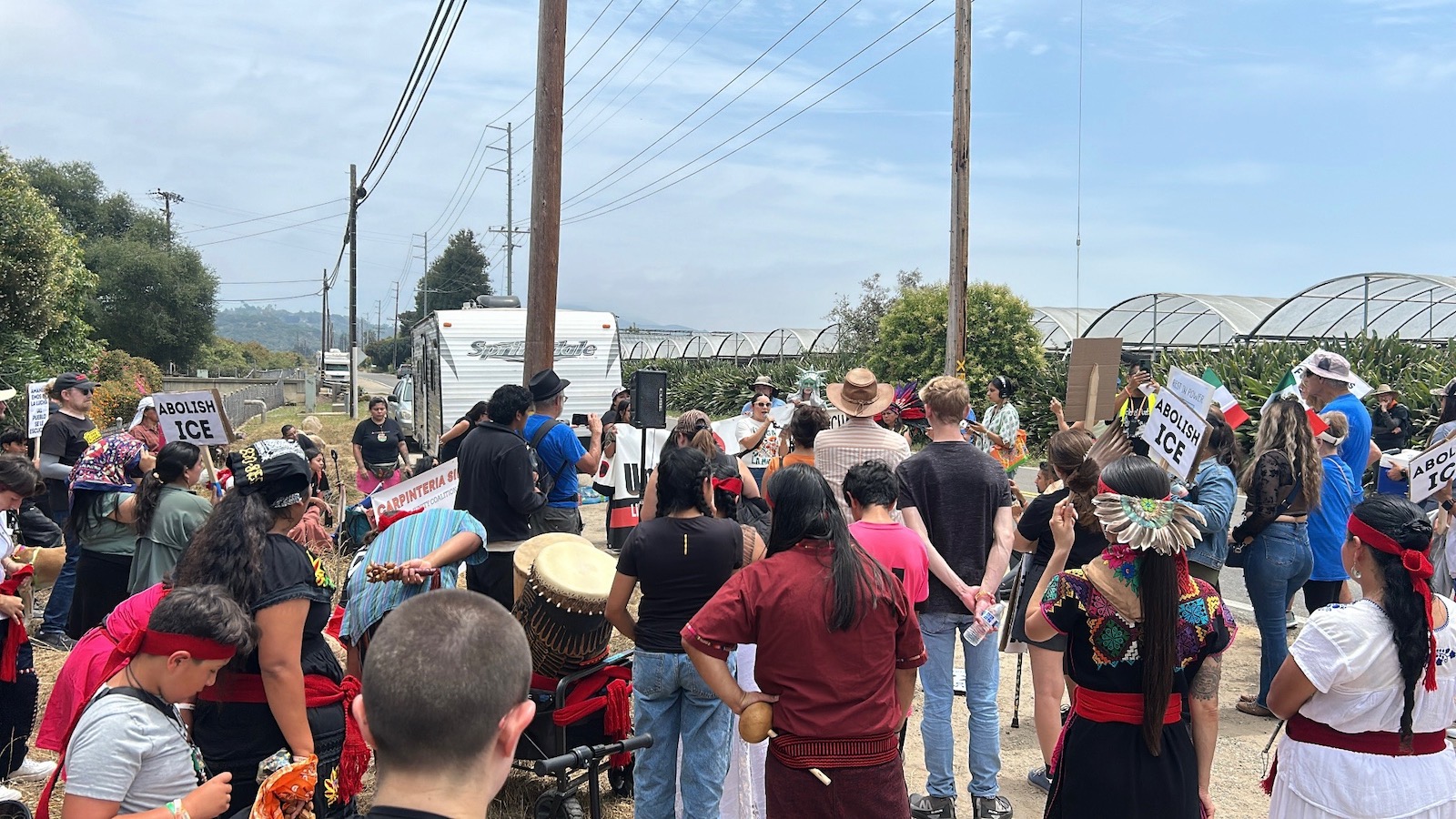
On July 10, 2025, masked agents from the Department of Homeland Security raided Glass House Farms, one of California’s most prominent producers of legal marijuana. They detained 361 workers, including 14 minors, at two separate facilities in Ventura and Santa Barbara counties. While trying to hide, Jaime Alanis Garcia, a 56-year-old father and employee at Glass House’s Camarillo location, fell 30 feet from a greenhouse roof. He died from his injuries days later at the Ventura County Medical Center. His tragic and unnecessary death amplified the fear, rage, and sadness felt across California, particularly in the immigrant farmworker community.
The Department of Homeland Security quickly issued a press release titled “ICE, CBP Arrest at Least 361 Illegal Aliens During Marijuana Grow Site Operation, Rescue at Least 14 Children.” The release highlighted names, photos, and country of origin of four workers with prior criminal offenses to make a strawman case for the federal government’s crackdown on “violent and dangerous criminal illegal aliens.”
DHS claimed its agents raided Glass House for public safety and to save children. The experiences of the workers who lived through the raid tell a very different story. According to Primitiva Hernandez, executive director of 805UndocuFund, which has provided legal and financial assistance to the families of many of those detained, though DHS claimed to have rescued 14 children, federal agents did not treat these kids as victims of human trafficking. Rather, “they were treated as undocumented immigrants” and subjected to much of the same violence as their adult coworkers, while deprived of the case managers supposed to be assigned to human trafficking victims. This hypocrisy was reinforced by outlets like Fox News, whose racialized coverage transformed an issue of labor exploitation into a debate over partisan politics. By framing child labor as a product of undocumented immigration, these accounts divert attention from the structural conditions under which children are exploited in California’s agricultural sector.
Glass House’s own response followed a similar pattern of deflecting responsibility. The company quickly shifted blame to the third-party labor contractor it had hired at the time of the raid. Glass House has since terminated its relationship with the contractor and retained Guidepost Solutions — led by former ICE Director Julie Myers Wood — to strengthen its employment eligibility verification procedures. Yet, this measure does nothing for the employees and families traumatized by the raid, despite the fact that their labor provided the company $200 million in revenue and $97 million in gross profit in 2024. Although Glass House had promised that it would coordinate legal assistance for detainees, the company has not followed through on the promise. Instead, Glass House is now seeking ways to further automate its marijuana production processes to minimize human labor.
Glass House’s response is part and parcel of an agricultural system to which undocumented migrants are crucial, but in which they are treated as disposable. Agriculture, particularly in labor-intensive specialty crops, is a massive industry on California’s Central Coast, generating $4.65 billion in farm-level value alone in Ventura and Santa Barbara counties in 2025. This number just scratches the surface of the agricultural sector’s actual value, since it leaves out the revenues generated by other companies – including farm labor contractors, cooling centers, and shippers — in the region. In contrast, Ventura and Santa Barbara county farmworkers made just $717 million in 2025, at wages significantly below the local cost of living. Nonetheless, the dominant industry organization — the Western Growers Association — steadfastly supports Republican labor policy changes projected to reduce farmworkers’ annual wages by 10-12 percent, with devastating knock-on effects for the local economy and communities. As Hernandez of 805UndocuFund observed, this reluctance to care for farmworkers “is just the way the agricultural industry operates in California.”
Hernandez estimates that roughly half of all ICE detentions in the 805 area code have involved farmworkers, the overwhelming majority of whom are Indigenous migrants from Guerrero, Oaxaca, and Puebla. These communities form the core of the Central Coast’s agricultural workforce. They face heightened vulnerability because of enforcement practices that treat occupation, skin color, language, and appearance as legal markers of suspicion. As a consequence, many community members live in a perpetual state of stress and avoid leaving the house as much as possible. This makes it more difficult to attend school, seek medical care, maintain employment, or participate in community life, thereby amplifying the public health challenges already faced by farmworking communities. The irony is difficult to ignore: Though DHS celebrated the “rescue” of children, Hernandez reports that the resulting fear and loss of household income has forced more children into the fields to support their families, deepening the very cycle of exploitation the raid purported to end.
On the one-year anniversary of the Glass House raid, we remember the life of Jaime Alanis Garcia, and the 2,153 fathers, mothers and children abducted from our counties since 2025. Remembering Jaime Alanis Garcia means refusing to accept his death as an unfortunate consequence of enforcement. Rather, such tragedies are an outcome of an industry built on workers who remain economically essential yet politically disposable. We deserve an agricultural system that values the lives of the people who grow and harvest its wealth as much as the wealth itself. As long as California’s agricultural economy depends on workers whose labor is indispensable but whose rights remain conditional, raids like Glass House will continue to punish the very people who make the region’s prosperity possible.
Matt Kinsella-Walsh is a Food & Trade Policy analyst at the Institute for Agriculture and Trade Policy. He and Danny Sanchez Bravo are graduate strategic researchers at the UC Santa Barbara Community Labor Center. Sanchez-Bravo is also a doctoral student in the university’s Department of Chicano/a/x Studies.

