

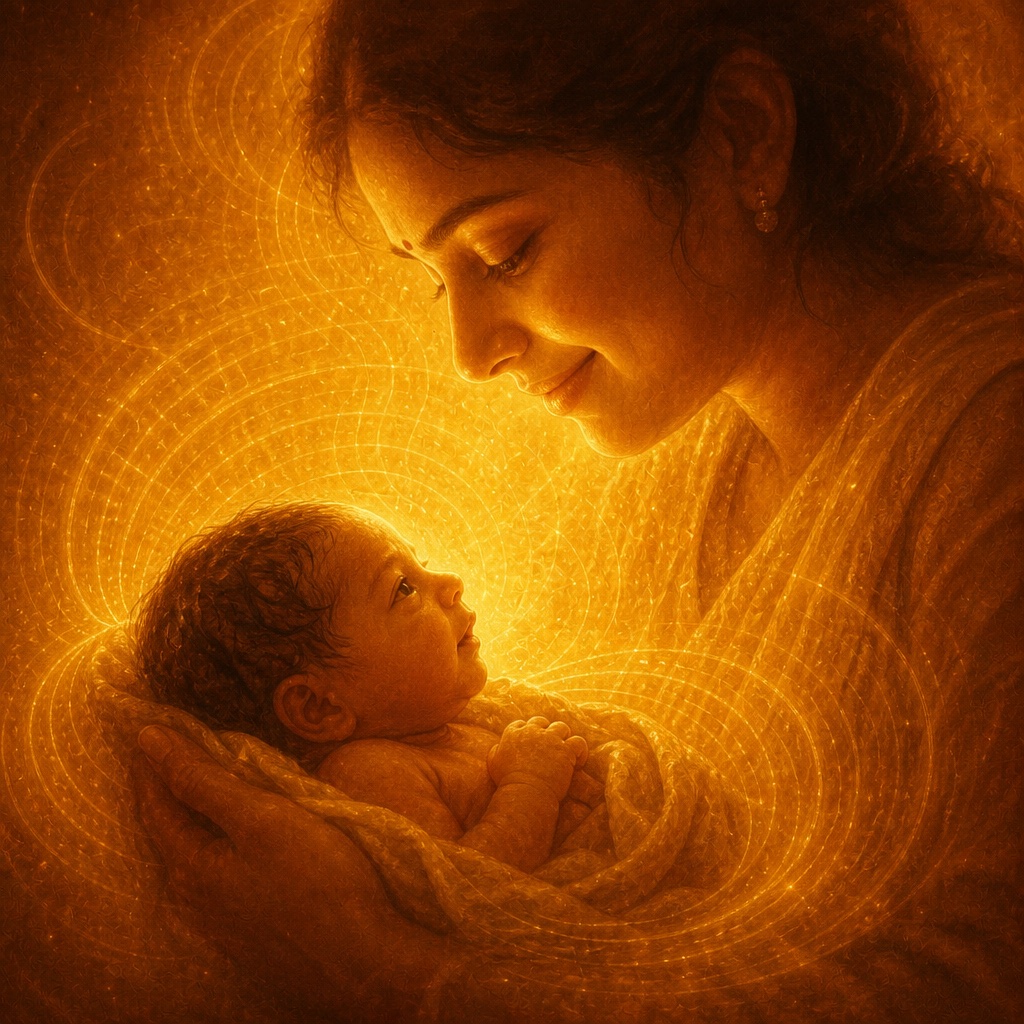
In the womb, by our third trimester, we begin to hear, to listen. Safely suspended within our fluid haven, our ears now fully formed and functional, the dense tissues and waters of the maternal form dampen the sharp sounds of the outside world.
What charm us above all else are the tones of our mother’s voice. We luxuriate within their cadences, absorbing their foundational rhythms as the generative structure of her native tongue. We phase-lock ourneurological development to the musicality of her speech. When born, we emerge attuned her vocal signature, her voice serving as the thread connecting our reclusive oneness inside her to the brash outer world.
Hesitant to transition into infancy, our first vocal experiments emerge from a pure, fluid marriage of physics and biology. We often begin with the most effortless sound we can mouth: “Ahhh,” the spontaneous waterfall of our breath pouring through the open grotto of our throat, requiring neither manipulation of our tongue nor tension in our jaw nor thought. Its sound depends solely on our feelings toward our enveloping cosmos, our mother. When hungry, distressed, and seeking the breast, we express ourselves with urgency, mouthing our instinctual “Ahhh” and quickly closing our lips. The sound morphs from “Ahhh” into “Ma.” Repeating quickly this creates, before language, the sound “Mama,” an overflow of our reclusive yearning to reunite in oneness with oursource.
When sated and safe, nourished with milk, we sink into mother’s arms, breath drifting outward, relaxed, playing with “Ahhh,” allowing our lips to close slowly, “Ahhhhh” now rounded, sounding “Ooooo,” and as our lips touch, humming the sound “Mmmm.” Somehow, our primal cry has become “Aumm” or “Omm, ” the Mother of all mantras, prior to all religions, dogmas, theologies.
Months later, we learn our first word. Years later, our urge-impelled soundings have subsided underground. We inhabit a world of definitions and the cold logic of “mature” language. A sense of isolation nibbles then gnaws at our soul. Missing our fluid oneness, we glomb onto art, music, chanting, poetry, infinity. We blend voices in a choir, intone a mantra, rejecting the noise of daily life. As contemplatives, with like-minded souls we align our heart rates and brainwaves and disappear into shorelessness.
If female, given to transcendence, and carrying, we bathe our fetus in the optimal biochemistry and brain coherence of peace. Giving birth, our influence is potentially civilizational, heavenly.
Eventually, our own children stand independently. When becoming a leader, a caregiver, an artist — or in turn a parent — they carry the coherent, organizing influence that once formed and still nourishes. For in their earliest, most reclusive communions, mother- child nervous systems awaken to a layered coherence in which mother’s slow brain rhythms — those broad theta undulations of calm presence — begin to winnow through the infant’s quicker alpha and emerging gamma bursts, creating a shared field of union deeper than intention and prior to language. A reclusive, cross frequency coupling appears as the neural entrainment of shared intimacy: mother’s steady waves contouring her infant’s brighter amplitudes into feelings of safety. Moments of gazing, touching, and breathing arise simply as shared the warmth within theta-wave tides, the calm attention of alpha surface swells, and the small, luminous joys of gamma sparks.
Inter-brain coupling arrives, simply, as the maternal field itself — the preconceptual harmony in which the newborn’s consciousness awakens and the world begins to feel like a safe, heavenly place one would adoredwelling within.
Contemplatives express such coherence in their creations. Teresa of Ávila, in her Way of Perfection, envisions the highest formlessness of prayer as a form of breastfeeding wherein the soul — an infant at the breast, sucking on only one word or syllable — receives infinite nourishment directly from God. And many centuries earlier, when Dīrghatamas, a blind Seer of India’s Ṛig Veda, sang of the Goddess Saraswati as the primordial source from whom revelation flows as the milk of pure knowldge, he too, famously, drew upon the same field: that vibratory ground within which consciousness — flowing eternally from a single syllable in the highest ether — abides as an infinite field of pure, life-nourishing possibilities.
Neuroscience has discovered that when mothers live contemplatively, prayerfully, and devoutly, during pregnancy their children effortlessly incarnate those qualities, soon to shape communities and, at times, entire nations.
To end a war, Christian and Muslim women in Liberia united as mothers, knowing they could rely on motherhood. They demonstrated how the maternal field serves as humanity’s most enduring source of peace. Led by Leymah Gbowaee, they realized that their desire to protect the lives of their own children transcends bloody religious divisions. So, they forgot their theological differences, united, non-violently brought warlords to the peace table, ended the horrific civil war, were awarded two Nobel prizes, and ushered in the first female head of state in African history.
When societies support mothers, helping them to carry and raise children within the highly coherent, safe, and loving embrace of the maternal field, it elevates the neurobiological “wiring” of their children’s nervous systems to their highest possible North Star, and gives peace a chance.
This is an excerpt from James Powell’s manuscript “The Maternal Field.”

