
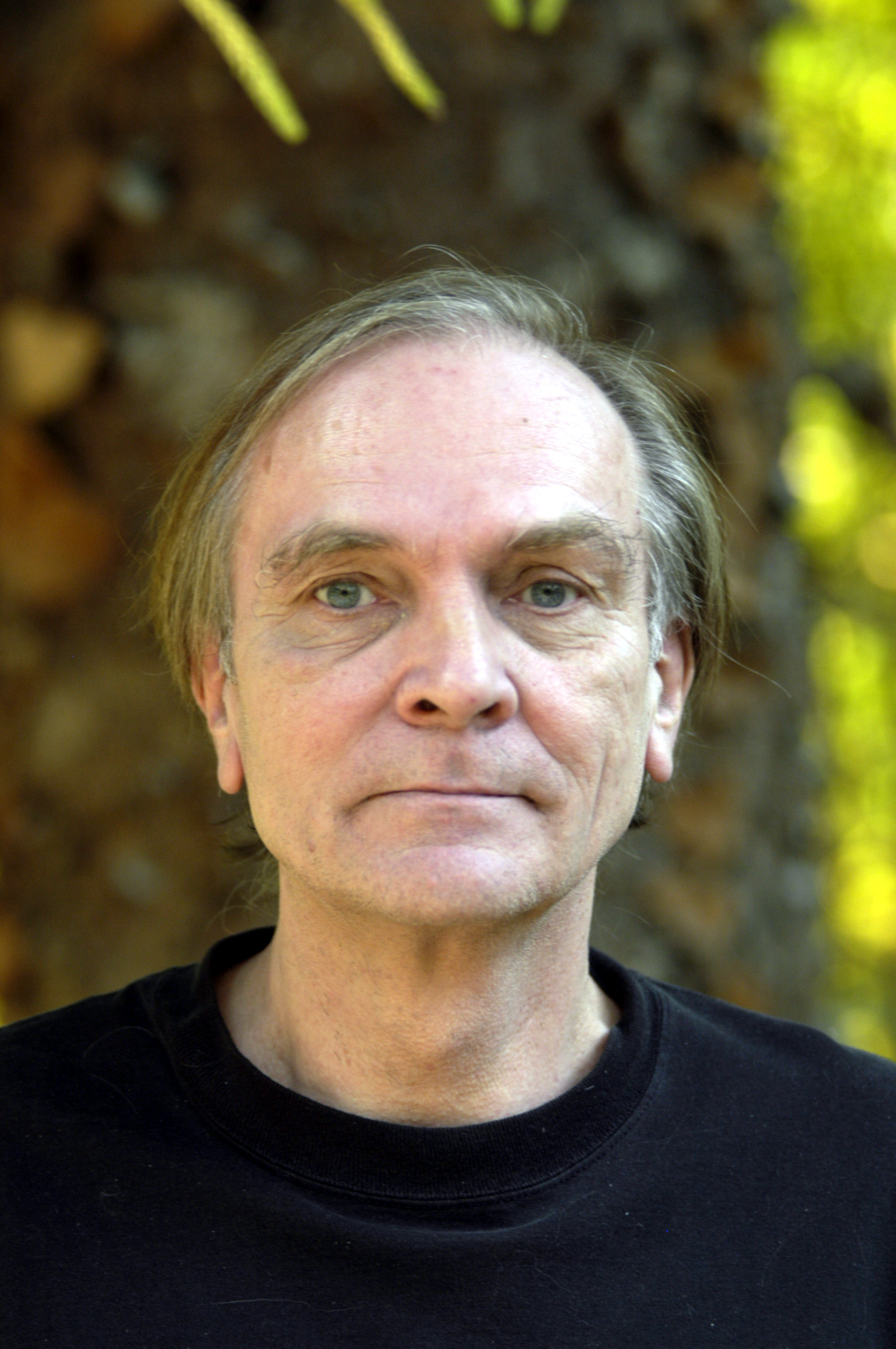
Dick Dunlap was not an open book kind of guy. He had an air of mystique and soft-spoken introspection about him, liberally mixed with a wry wit and easy sociability with a wide range of people. But once you peeked into the multi-chaptered book of who he was, one rich in music, art, and ever-evolving ideas, he was a fascinating read you never wanted to end.
Dick’s book was finally closed on the afternoon of June 2, when he passed on to the next phase, the next gig, after 86 laps around the sun. So ended a five-year struggle with the Big C, in the comfort of his longtime compound and laboratory on Anacapa Street and then the familial company of his late-discovered nephew Glen (that’s a whole ’nother story).
By the end, a jazz playlist had been gently humming in Dick’s room for days. The view from his final bed perch allowed for a direct vantage over the balcony to a family of trees in the large wild backyard, past the historic carriage house turned studio/idea incubator where Dick conspired with his various muses for decades. From his bed, Dick’s attention would naturally drift over to specific bird action in the Dunlap arboretum.
He briefly got lost in the bird reverie on the afternoon that Tom Lackner and I paid a visit, two days before his departure. We spoke about our great love and admiration for Dick’s music, which we were blessed to be a part of in the “hopelessly eclectic” band Headless Household, along with Goletan-in-Seattle Chris Symer. That passionate oddball project lasted 36 years and birthed nine albums, all of which would have been unimaginable without Dick’s audacious fluidity and cryptic charm at the keys.
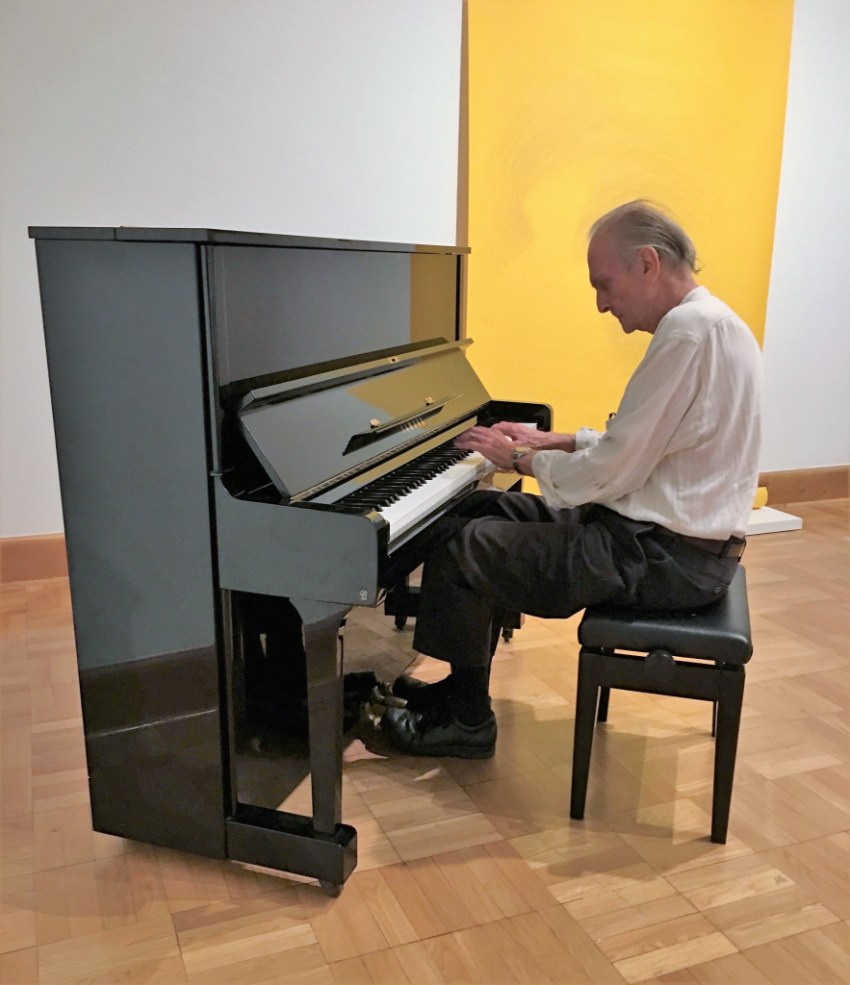
This spot on Anacapa is the house and compound — the legendary House of Dunlap — where his long-standing and long loved pianist wife, Arlene, who herself passed in 2024, taught generations of students. If an incoming student wasn’t up for or geared for Arlene’s serious classical pedagogy, they would sometimes be sent downstairs to study in Dick’s fun zone. But his gift was in mixing fun with serious business, as a teacher. His prize protege was the now prominent jazz pianist Benny Lackner, an ECM recording artist who dedicated his song “Anacapa” to his beloved friend and teacher of old.
Seattle born and bred, Dick was one of those now-rooted Santa Barbarans who came to land here through the passageway of UC Santa Barbara. His unconventional spin on art and music — and teaching — made him a ripe candidate to teach at UCSB’s College of Creative Studies in the early ’70s, where his colleagues included the recently belated composer Daniel Lentz.
The structure of academic life didn’t suit Dick’s free spirit, and he soon found himself pursuing such specialized art artistic terrains as sound art — including Fisher-Price push toys and rubber bands in his palette — which took him to Europe and landed him in the pages of Life magazine.
The aesthetics of Dick Dunlap cannot be easily described or categorized, a mark of his unique voice and being. He excelled in jazz mode but was always venturing outward and seeking new areas of self-expression in music. For an example, proceed to his 18-minute piano improvisation Intersphere (hear at tinyurl.com/DDintersphere), recorded at his major Santa Barbara Museum of Art installation in 1981. Wandering allusions to jazz and new music come together in a brilliant spontaneous suite. In a way, that alternately grounded and searching suite encapsulates his essence as an artist.
On the recent afternoon Tom Lackner and I visited, two days before his passing, we brought along recordings by an ambient side project with the three of us called Cachuma, recorded years ago and which we plan to release, partly in honor of Dick. With that unassuming music doing its murmur dance in the background, we expressed our massive appreciation for his inspiration and quirkiness.
Very softly, he quipped, with pithy profundity, “I’m an accident willing to happen.”
Insight from the Master’s mouth.
The book is closed. And never closed.
by Tom Lackner
The first thing that comes to mind when I remember my friend and collaborator Dick Dunlap are the photographs of him either with our band Headless Household or of him alone. They show a certain inscrutability that was unaffected yet open to the possibility of one entering into his art.
I have known only a few artists who truly are conduits of artistic expression. Everything Dick envisioned became art, whether in his paintings or multimedia installations, or, most importantly for many of us, his music. He was a master not only of technique but of patience and the art of silence. Often in performance or in the studio I would wonder and perhaps get frustrated at his understatement but on listening back, he was perfect for the moment.
He was a much-respected jazz pianist in his hometown of Seattle who came to Santa Barbara to teach painting at UCSB. But he continued to play music, and it was here that I landed in his orbit, playing intuitive, free music and then the slightly more structured left-of-center music of Headless Household.
He and his wife, Arlene, were both beloved piano teachers. Although her field was more the classics and contemporary music, they were a formidable eclectic pair. When she passed away, Dick’s health declined, as is the wont of many long marriages. Before he died, Dick, Joe, and Dick’s nephew Glen compiled some of Dick’s music into an album, Arlene Rising, which was impetus for him to keep involved in music. Hopefully, there will be more of his music compiled from his recordings.
I visited Dick two days before he died. He was calm and not afraid to enter Eternity, as he called Death. As I held his arm, he pointed to a group of crows perched on a dead eucalyptus.
There is a beautiful haiku about passage:
on a withered branch
sits a crow
autumn nightfall
—Basho


You must be logged in to post a comment.