

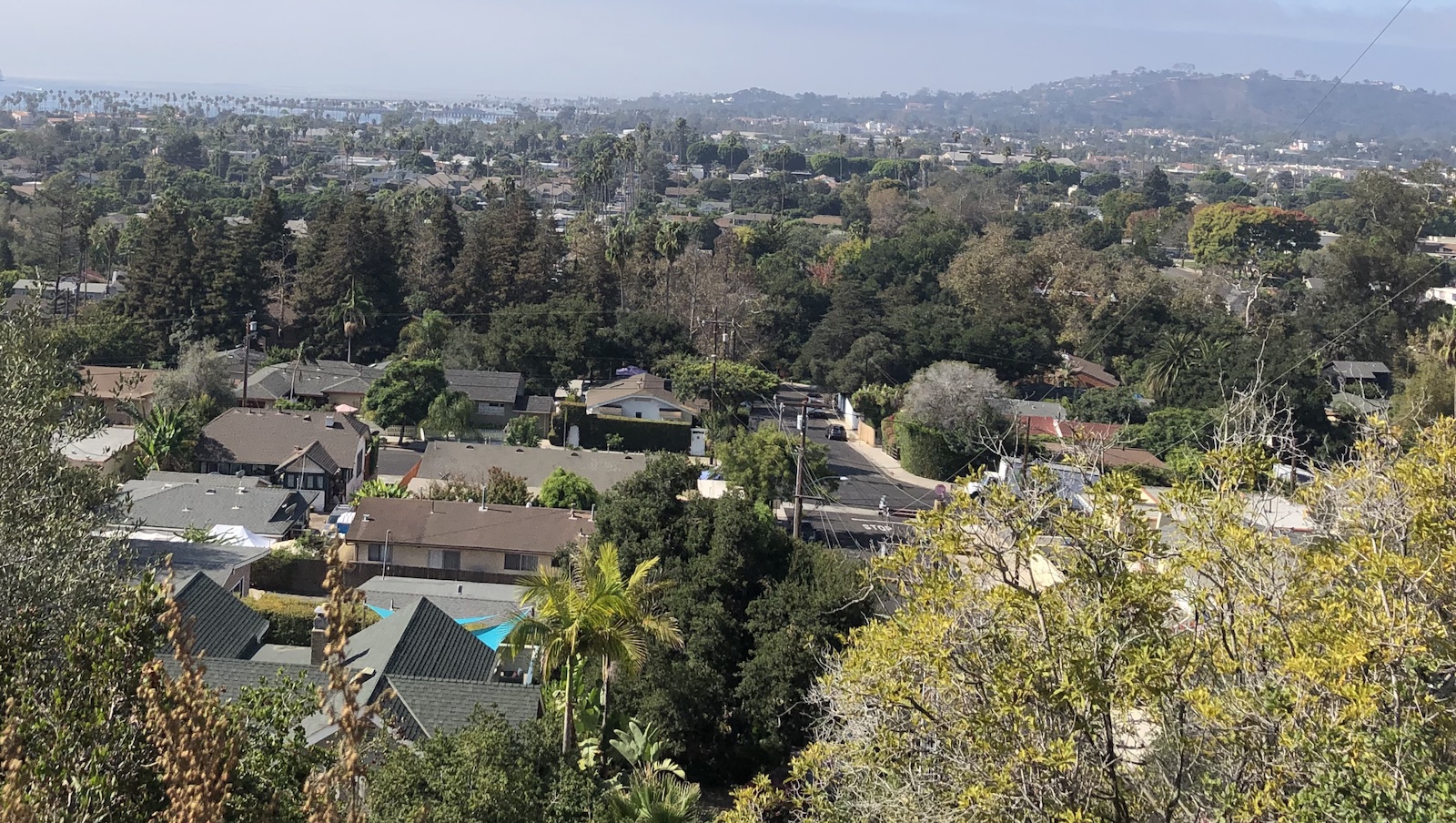
The Santa Barbara City Council is set to adopt a rent stabilization ordinance on Tuesday. Before it does, it’s worth stepping back to ask what we actually know about the impacts of rent control.
I’ll start with what the research actually says in rent control’s favor. The most consistent finding, across different states and eras, is that rent control helps keep people in their homes. And housing stability matters. Forced moves are linked to worse health and educational setbacks, and the damage falls hardest on children and women. Families who spend more than 30 percent of their income on rent (the threshold line for being “rent-burdened”) have less to spend on food and childcare. Rent stability can make a real difference for families years down the road.
The case against rent control is actually weaker than the headlines suggest. Opponents largely cite a San Francisco study, which found the city’s 1994 rent control expansion made covered tenants about 20 percent more likely to stay put, but also led landlords to pull roughly 15 percent of affected units off the rental market over the next two decades. However, the San Francisco rules were targeting small buildings of four units or fewer that were cheap and easy to convert into condominiums. Santa Barbara’s ordinance applies to older multifamily buildings and exempts single-family homes, condos, and owner-occupied duplexes. Also, condo conversion here is governed by a separate set of rules.
When we look at other studies, researchers don’t find much in terms of effects on the housing market. A study spanning four decades of New Jersey’s municipal rent controls found little measurable change in rents, in the quantity or quality of housing, in home values, or in foreclosures. An analysis of 373 California cities between 2010 and 2019 found that cities with stronger rent stabilization had higher median rents (mostly because expensive cities are the ones that reach for it) but also fewer renters forced to move, with no measurable effect on rental supply or overcrowding.
The American housing market has never been a free market. From the late 1930s on, the federal government built the modern middle class on a foundation of subsidies aimed squarely at homeowners. The Federal Housing Administration and Veterans Administration loan guarantees let millions of families buy homes with little money down. This was a period when, it was often said, owning was cheaper than renting. The mortgage interest deduction still costs the U.S. Treasury around $30 billion a year. And here in California, Proposition 13 caps the property taxes of long-tenured owners, transferring billions to those who bought early and stayed.
What all of that produced is wealth. Homeownership became the single largest engine of household wealth in America: the typical U.S. homeowner has a net worth of roughly $396,000, the typical renter about $10,400. This gap has been seeded by public subsidy, and it has compounded fastest in places like Santa Barbara.
We already live in a redistributive society, but in terms of housing, these efforts have largely gone to homeowners. So the question was never whether we help people afford housing. It’s whether we extend that same grace to renters.
So who are the renters this protects? In Santa Barbara, they are not a fringe, but the majority, and among younger residents they are nearly everyone. We know that about 60 percent of city households rent, and among households headed by someone under 45, roughly 85 percent do, according to the latest U.S. Census Bureau data. These are the service workers, teachers, farmworkers, students, nurses, seniors on fixed incomes, and young families who keep Santa Barbara running and, increasingly, cannot afford to stay in it.
And who are the landlords? There’s a serious research gap about landlords overall, but according to the Organizing Knowledge Project at UC Santa Barbara, most here are small, “mom and pop” owners, who are less likely than large operators even to know which tenant-protection rules apply to their own buildings. Passing the rent regulations itself is insufficient, and even having renters and landlords educated on the local and state-level regulations is insufficient. Local organizations such as the Santa Barbara Tenants’ Union and CAUSE, who have long been advocating for better renter protections, recognize that implementation is just as important as the regulation itself, and enforcement through measures like a rental registry is necessary.
Rent stabilization is a tool to prevent displacement for residents. It offers dignity through the ability to stay. While research has shown that it will not do much to hurt the housing markets, it will also not do much to solve our affordability crisis, which must be addressed by increasing the supply of new housing in Santa Barbara and protecting affordable new units. Beyond this particular Rent Stabilization Ordinance, we should ask ourselves what we can do to help our younger and more economically vulnerable neighbors in order to protect the future vibrancy of Santa Barbara for everyone.
Wenfei Xu is an assistant professor in the Department of Geography at UC Santa Barbara and the director of the Urban Data Research Lab.

