

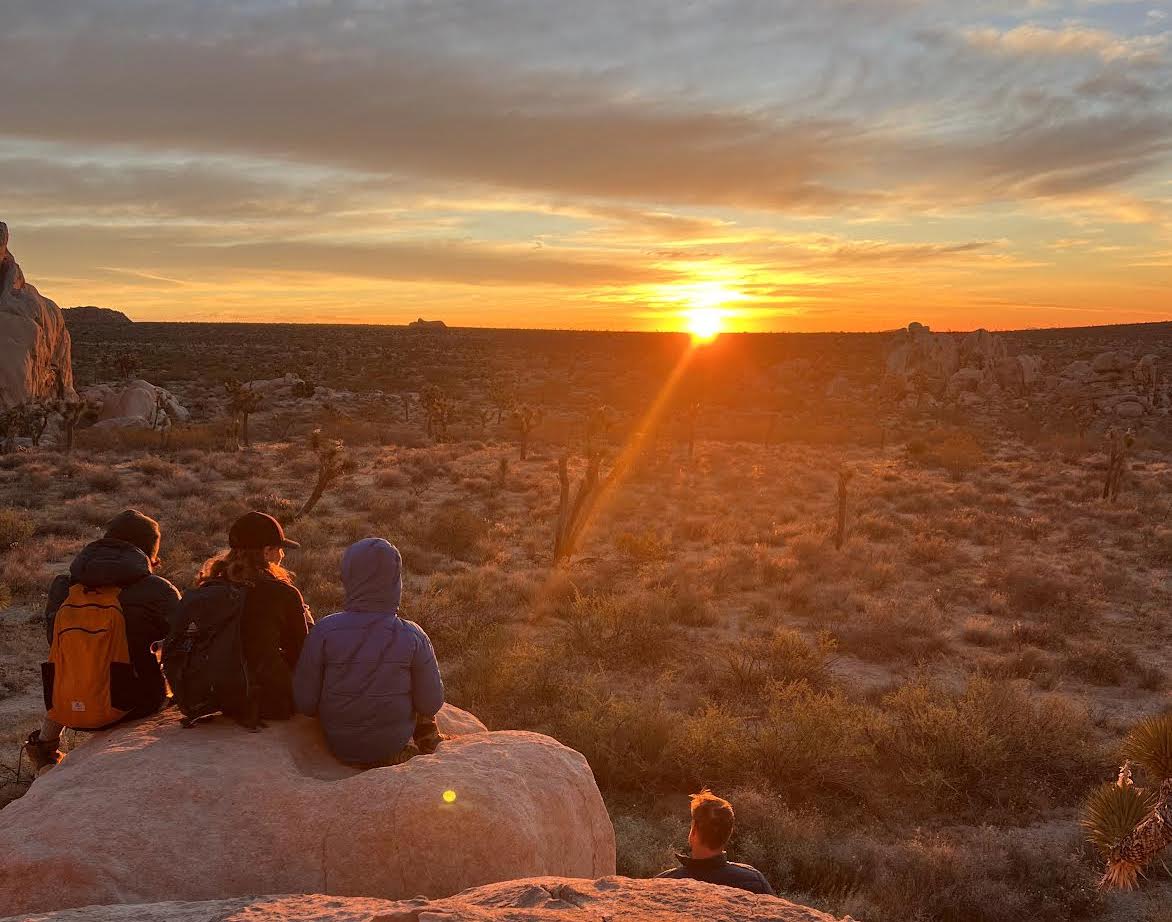
Not too long ago, I had the opportunity to visit a student trail group in Joshua Tree National Park. This group, part of a class trip, was finishing the first day of its week-long backpacking and rock-climbing expedition. I arrived as the students began their first afternoon KBAR, jargon for “kick back and relax,” essentially unstructured time.
In a matter of minutes, with no block schedules, bells, or electronics in sight, students were suddenly confronted with an unfamiliar void of time. To a precious few, this was a wonderful, fleeting opportunity for art, music, reading, or games, or a moment to sit in a circle and talk, relax and unwind, or lay in the shade in collective solitude.
But for most, it was paralyzing — an anxious state of idleness, an inactive tedium without digital distractions to fill the void — a symptom of having been able to avoid this exact condition for the majority of their lives. Yet perhaps this paralysis in the face of time is an indication of exactly the sort of education our students desperately need.
Earlier traditions of schooling understood free time differently. In ancient Greek times, the original intent of education was to teach people the arts and skills of living free. In fact, the etymological roots of our words for “school” and “scholarship” come from scholé, the Greek word for leisure, which in Greek culture was considered an ideal, the epitome of human progress.
As technology continues to save time and reduce labor, we are increasingly likely to live in a world with less work and more unstructured time. Education, then, must do more than prepare us for employment — it must prepare us for meaningful leisure.
How to Educate in a World with More Time
What does it say about our culture when we are unable to meaningfully occupy our free time, arguably our most prized possession? What does it say about our schools when students are taught to actively avoid it?
If technological innovation continues at its current rate, these are questions we’ll need to address soon. Self-driving cars, virtual assistants, and checkout-free stores are just some of the time-saving possibilities of the present and near future. The modern worker, on average, reports one to two hours saved each day by utilizing artificial intelligence, and that’s just the time being reported.
While there is endless speculation on how to best educate the next generation to remain relevant in an AI-assisted workforce, there is little discussion on how to live a purposeful life when work, as we define it now, is perhaps no longer the dominant priority. Few ask how we should educate to live in a world with more time.
Education Preserves Our Humanity
The point of active, leisured pursuits is not to compete with professionals, but to voluntarily apply and extend one’s mental and physical capabilities in activities that may resemble work but are freely chosen and therefore rewarding for their own sake. Furthermore, such activities cannot be automated. Because they are freely chosen, there is no incentive to make them more efficient. Pleasure is derived from the experience, not the efficiency of delivering a final product. This is less about the pursuit of happiness and more about the happiness of pursuit.
In this age of automation, shouldn’t we be actively teaching and exposing ourselves to such activities and skills?
In many ways, this may involve simply returning to the or reinvigorating the basics: art, music, sport, shop class or manual skills, public speaking, debate, and the humanities, to name a few.
Additionally, the doubling of our lifespans over the past century, and the expected quadrupling of those living over the age of 100 in the next three decades demands an increase and acceleration of adult education, as “old age” is the only phase of life that is actually increasing in length, not our collective youth.
Or, as many schools are already offering these sorts of subjects and skills, perhaps we need to reframe the “why” behind it all. If the majority of our future economic output may require drastically less input from humans, what are the aims of an education? Where do we go, what do we do, and most importantly how do we live once our most basic needs, necessities, responsibilities and obligations are met, or increasingly handled by machines? What sorts of activities, lifestyles, and states of being lay beyond necessity and are instead valuable and worthwhile in and of themselves, serving as their own reward?
Rather than pitching things like music, art and sport as essential components of an economically productive life, perhaps it is time to return to the original aim — teaching free people the arts and skills of living free — when work, as we define it now, is perhaps no longer the primary arena in which we realize the full potential of our uniquely human lives.
The Value of Free Time
Students today have access to the most powerful and accessible information database our world has ever seen. Many will enter professions with the most advanced, “labor-saving” technology ever created. Yet if they struggle to fill a simple block of KBAR on an outdoor education trip, might something be missing?
If we don’t know what to do with our leisure — if we don’t know how to occupy it, work it, or use it well, or if we prefer compulsory obligations and passive, digital distractions in its place — we are essentially admitting that we are uncomfortable with our most prized possession, freedom, and incapable of exercising its most direct corollary, free choice.
So let’s ask ourselves again: What might we do — and how might we live — in a world with more time?
Learning for leisure might be a good place to start.
Mike Chapman teaches Advanced U.S. History and serves as Director of Outdoor Education at the Dunn School in Los Olivos, California.

