
Press releases are posted on Independent.com as a free community service.
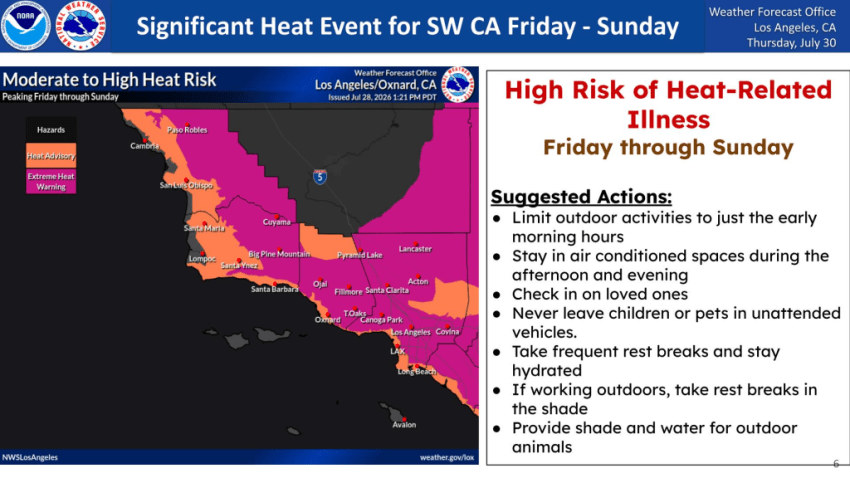
The National Weather Service is forecasting a heatwave throughout Santa Barbara County expected to last from Friday morning, July 31 through Sunday evening, August 2. An Extreme Heat Warning has been issued for the Cuyama Valley and Santa Barbara County interior mountains, while a Heat Advisory covers most of the remainder of the county. Gusty Sundowner winds and low humidity are also expected to contribute to elevated fire weather conditions, particularly across southwest Santa Barbara County.
Detailed weather forecasts are available at https://www.weather.gov/lox/
Community-Based Cooling Relief
In addition to community-based cooling options such as malls, movie theaters, parks, and beaches, the following locations are available to the public to seek relief from the heat:
Cuyama Valley Family Resource Center
- Address: 4689 Highway 166, New Cuyama, CA 93254
- Phone Number: (805) 345-1961
- Hours of Operations: Saturday and Sunday, 12:00 p.m. – 6:00 p.m.
- The Cuyama Valley Family Resource Center is air conditioned (AC).
Joseph Centeno Cuyama Aquatics Center
- Address: 290 Wasioja Street, New Cuyama, CA 93254
- Phone Number: 805-729-7508
- Hours of Operation: Tuesday–Sunday, 1:00 PM–5:30 PM.
If you are an individual who has a disability or other access or functional need (DAFN), and require transportation to a community-based cooling relief location, contact a paratransit provider near you:
- Easy Lift Santa Barbara | Phone: 805-681-1181
- SMOOTH Santa Maria | Phone: 805-922-8476
- Santa Ynez Valley Transit Dial-A-Ride | Phone: 805-688-5452
- COLT Lompoc ADA Curb-to-Curb | Phone: 805-736-7666
High Temperature Precautions and Tips to Stay Cool:
- Drink plenty of cool, non-alcoholic beverages, especially those without sugar or caffeine. Do not wait until you are thirsty to drink. If you have fluid restrictions from your doctor, ask to see how much you should drink while the weather is hot.
- Avoid hazardous activities that may cause sparks and start a wildfire, such as using lawn care equipment and towing with dragging chains along roadways.
- Take care of those who might not be aware of high temperature dangers or be able to react accordingly – especially the elderly, young children, and pets. Check on your neighbors.
- Limit outdoor activity. Try to schedule outdoor activities during the cooler parts of the day, like morning and evening hours. Be sure to wear sunscreen and rest often.
- For those who work outside, be sure to take frequent rest breaks in a shaded area or air-conditioned room, if possible. Stay hydrated and take action by moving to a cooler space if you feel signs of heat exhaustion.
- Take regular breaks in the shade or in an air-conditioned room. A few hours in air conditioning can help your body stay cooler. Taking a cool shower or bath can help too.
- If you do not have air‐conditioning, consider arranging to spend at least parts of the day at another space that is cool. Electric fans may provide comfort, but when the temperature is in the high 90s, they will not prevent heat-related illness.
- Wear appropriate clothing. Lightweight, light-colored, loose fitting clothing works best.
- Know the signs of heat exhaustion. If someone becomes dizzy, nauseated, or sweats heavily, find a cooler location for him or her immediately.
- Know the signs of heat stroke. Heat stroke is much more serious than heat exhaustion. The symptoms are similar to heat exhaustion, but also include hot, flushed skin. With heat stroke, the person often stops sweating and the skin will be unusually dry. If heat stroke is a possibility, call 911 immediately. Heat stroke is life threatening!
- Do not leave children (and pets) unattended in vehicles. It only takes a matter of minutes on a relatively mild day for a vehicle to reach deadly temperatures.


You must be logged in to post a comment.