

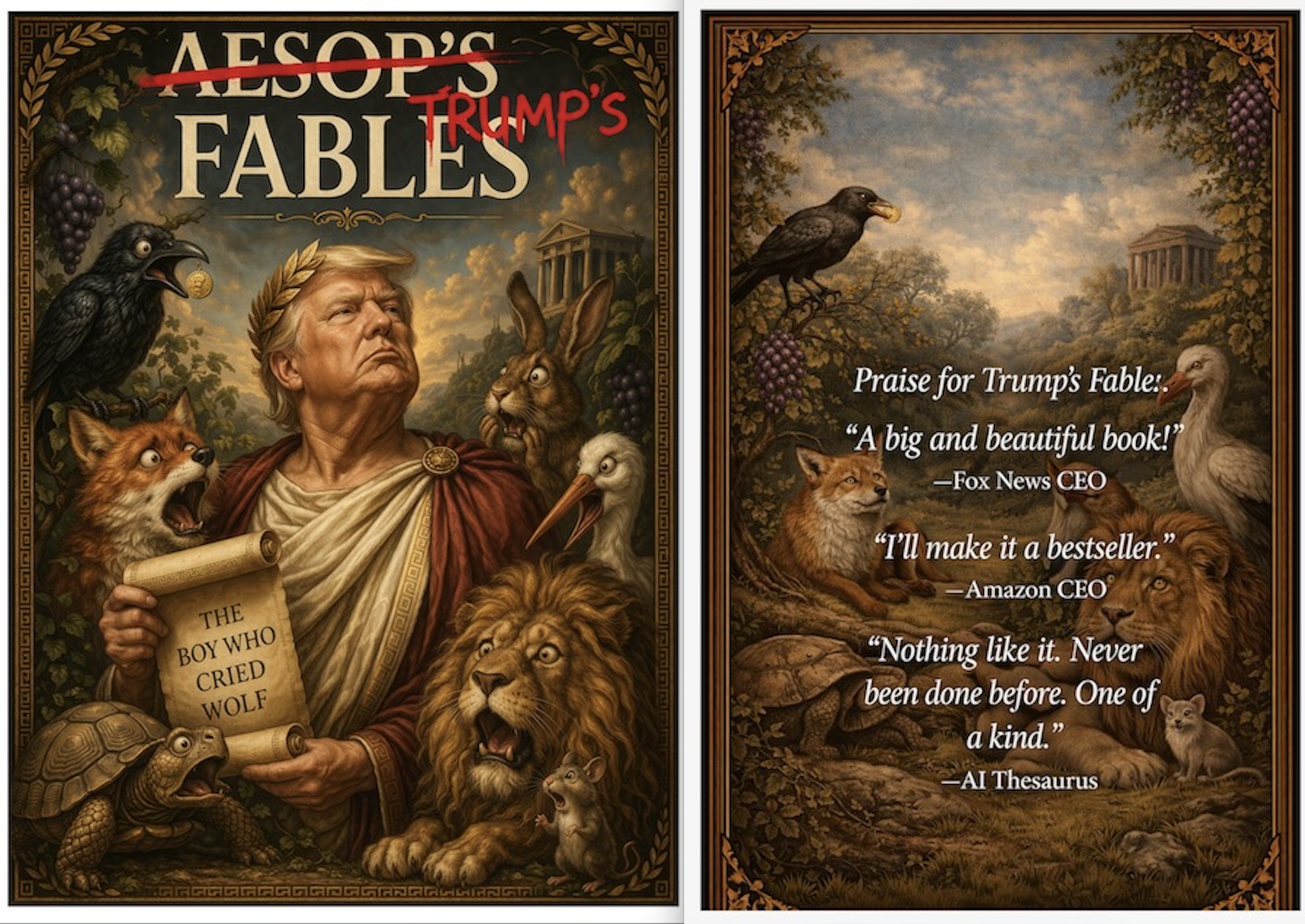
Fables are stories that end with a moral intended to guide people toward making the right choices. Aesop’s Fables is the most famous collection of these tales, and people have praised the moral advice in Aesop’s stories for over 2,500 years. But not anymore.
Since our Fabricator-in-Chief is running out of things to put his name on, and he thinks he knows what is morally right better than anyone else, he has turned his attention to the telling of fables. He signed an Executive Order demanding that the old morals in the stories be replaced with “Trump’s New Morals” — and that the stories be renamed Trump’s Fables. Here’s his list:
The Tortoise and the Hare
A tortoise beats a hare in a race because he continues to slowly race while the much faster hare gets distracted from the contest.
Moral: Slow and steady wins the race.
New Moral: Call your opponent old and slow and dumb and claim he could never beat you in a race, which means that he must have stolen the race from you. But you can still win if the FBI “finds” those “missing” votes in Georgia.
The Boy Who Cried Wolf
A boy tends sheep. Even though there is no wolf, he cries “Wolf” to get attention. When a real wolf appears, no one responds to his call because they think he’s lying again, and his sheep get killed.
Moral: Don’t lie.
New Moral: You get a lot of attention when you lie and you probably won’t get hurt by it, but the sheep that follow you will get hurt. They might even get killed. Of course that’s neither your fault nor your problem.
The Ant and the Grasshopper
An ant works to gather food for the winter while a grasshopper sings and dances. When winter comes, the grasshopper has nothing to eat and begs the ant for food.
Moral: There is a time for play and a time for work.
New Moral: It’s fine to mix play and work. Like being at a wrestling match when you declare your war — or golfing while you’re killing people in your war — or wearing your merch baseball cap while you’re “honoring” our dead American soldiers coming home from your war.

The Goose That Laid the Golden Eggs
A farmer has a goose that lays golden eggs. Wanting more eggs, the farmer kills the goose but finds there are no eggs inside.
Moral: Greed will destroy the source of your wealth.
New Moral: Greed is a tremendous motivator. Take whatever you can from whomever you can and, if you kill the sucker, get another sucker.
The North Wind and the Sun
The North Wind and the Sun have a contest to see who can get a man to remove his coat. The North Wind tries to blow off the coat but the man pulls it tighter. The Sun warms the man enough so that he chooses to remove his coat.
Moral: Persuasion and kindness are more effective than force.
New Moral: Force is more effective than persuasion or kindness because you can increase force. If you increase kindness, they’ll walk all over you. If you increase persuasion, it becomes force anyway.
The Fox and the Grapes
A fox tries to reach some high-hanging grapes but fails every time and gives up, disparaging the fruit as “sour grapes.”
Moral: It’s easy to despise something you can’t have.
New Moral: When you’re growing up and people don’t give you the grapes of love, respect, or empathy, you should despise those things and not give them to anyone else.
Changing old morals into new ones is an ongoing but dicey process for our Fabler-in-Chief. When asked how he would know when the war that he started was over, he said, “[I’ll know it] when I feel it in my bones.” Which sounds eerily like he was channeling the Giant in the fairy tale “Jack and the Beanstalk.” Or maybe not. Because the main point of that story is: Don’t be so dumb that you plant a seed without knowing what it will grow into. Especially if you plant it in a desert.


You must be logged in to post a comment.