

Santa Barbara is a city with a budget problem. That’s not an opinion — it’s a matter of public record. The general fund has been strained for years, squeezed by rising costs, aging infrastructure, and obligations that grow faster than revenue. The city needs stable income, and it needs it badly.
Yet sitting on the waterfront is one of the city’s most valuable public assets: the Harbor. And for decades, the Harbor has quietly generated zero dollars from the single largest revenue opportunity it possesses — slip turnover.
Not low revenue. Not under‑utilized revenue. Zero.
Slip turnover is the moment when a slip returns to Harbor control. It’s the moment when the Harbor could charge reassignment fees, onboarding fees, vessel‑fit fees, commercial reallocation fees, and liveaboard expansion fees — all standard in many public marinas.
But in Santa Barbara, slip turnover never reaches the Harbor at all.
Under the current slip‑permit transfer system here in S.B., when a boat is sold, the slip usually goes with it. The Harbor processes a permit transfer, collects a small nominal administrative fee, and re‑issues the permit in the buyer’s name. If that new permit holder later replaces the boat, the Harbor only performs a vessel‑fit check and updates the record.
What never occurs is true slip turnover: The slip does not return to Harbor inventory, it is not reassigned, and no new permit holder is onboarded through a turnover process. Because the permit simply moves from one private owner to the next, the Harbor never performs the turnover work that would generate reassignment or onboarding fees. And because it never touches the slip in a turnover context, it cannot charge:
reassignment fees
initiation fees
onboarding fees
vessel‑fit fees
commercial reallocation fees
liveaboard expansion fees
Slip turnover bypasses the Harbor, the city, and generates zero public revenue. The Harbor’s stagnation has real consequences, including the loss of businesses like West Marine, which left after decades of serving local boaters.
Instead, slip turnover generates private profit for slip holders, who sell their boats at a premium because the slip transfers with it.
The Harbor gets nothing. The city gets nothing. The public gets nothing.
The financial reality for the city is that the general fund is often in the red. The Harbor’s enterprise fund is stable — but stability is not the same as optimization. The current slip‑permit system prevents it.
Ending permit transfers would:
not displace a single slip holder
not force anyone to sell their boat
not remove anyone from the Harbor
Slip holders keep their slip as long as they keep their boat. The only change happens when a slip holder voluntarily sells their boat — at which point they sell the boat only, because the slip was never theirs to sell. This is not a radical idea. It is simply enforcing the original rule.
The revenue the city walks away from is not small. If the city ended slip‑permit transfers and implemented standard marina fee structures, the Harbor could generate (based on charges at nearby public marinas):
$200k–$300k in reassignment fees
$500k–$600k in initiation/onboarding fees
$30k–$40k in vessel‑fit fees
$200k–$300k in slip‑size optimization
$50k in commercial reallocation
$70k in liveaboard expansion
The City could generate:
$50k in sales tax
$10k in parking revenue
$7k in hotel tax from visiting slip holders — new boat owners who travel to Santa Barbara to take possession of their slip, attend haul‑outs, or spend weekends here, generating overnight stays that produce TOT revenue.
Combined, the city and Harbor could generate more than $1.2 million per year in new revenue — without raising slip rent, without displacing anyone, and without forcing any boater to leave.
Today, that number is zero.
Slip holders have no reason to become angry at this idea because they would not lose their slip. They keep it as long as they keep their boat. But, they may be angry because they would lose the ability to monetize the slip — something they were never legally entitled to do.
The slip was never property. The slip was never an asset. The slip was never guaranteed to produce profit. The city never owed anyone a resale value. Ending transfers does not take anything away. It simply stops giving away public value for free.
Santa Barbara publicly champions equity, diversity, and inclusion. But Harbor policy has created a closed, legacy‑based system where public access is effectively nonexistent.
Ending permit transfers would:
restore public access
make the waitlist real again
allow new residents to enter the Harbor
align Harbor policy with city values
generate over $1 million/year in new revenue
stop subsidizing private profit with public assets
This is not punishment. This is stewardship.
Fool’s Anchorage: A Timely Contrast
The city is now formalizing moorings in Fool’s Anchorage — a fee-based use of public water space outside the main Harbor. These moorings will generate revenue, require oversight, and expand the Waterfront’s operational footprint.
But the contrast is stark:
The city is willing to charge for a handful of moorings outside the Harbor.
Yet it continues to give away the most valuable positions inside the Harbor — the slips — whenever permits are transferred instead of turned over.
The Harbor is a public resource. Slip holders are stewards, not owners. The city is responsible for managing the Harbor for everyone — not just those already inside.
Ending slip‑permit transfers is not about taking anything away. It is about restoring what was always true:
The slip belongs to the public. The city never owed anyone profit. And the Harbor should serve everyone — not just those already inside.
Santa Barbara Waterfront Director Mike Wiltshire responded: The above article incorrectly describes the slip transfer process and associated fees for the City of Santa Barbara Waterfront, which was not contacted or consulted in the writing of the article.
As an Enterprise Fund the Harbor relies solely on revenues generated within the Waterfront to cover all operational costs. A large part of these revenues are generated from slip permit transfer fees and monthly slip fees. When a slip permit changes hands through the slip transfer process the Waterfront collects a slip permit transfer fee. This includes when a current slip holder sells their boat and slip permit to another boater. The slip permit transfer fees as of July 1, 2026 are listed below:
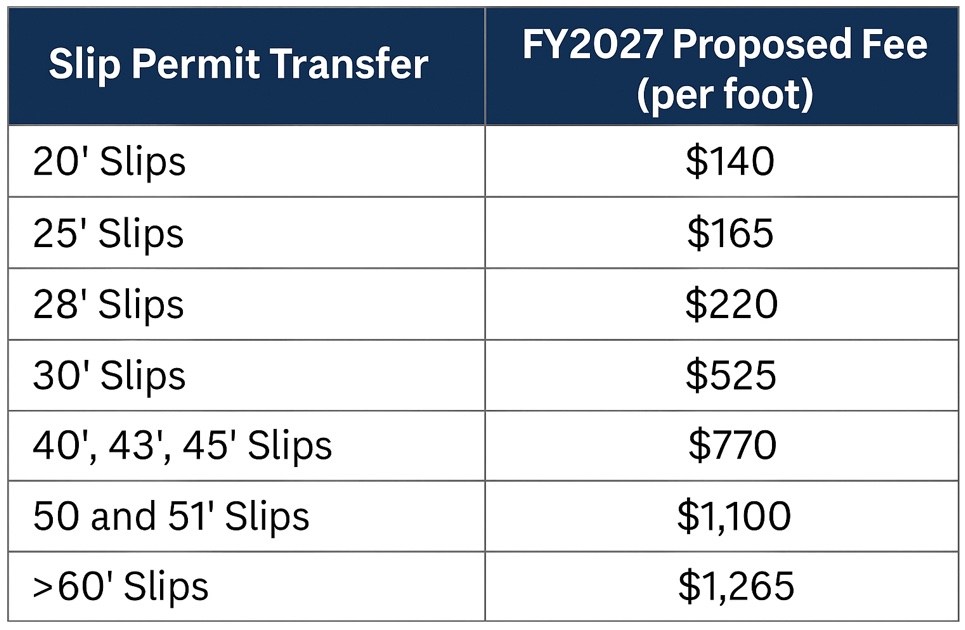
As an example, when a 40-foot slip permit is transferred to a new slip holder, the Waterfront Department collects a slip permit transfer fee of $30,800. In Fiscal Year 2026 the Waterfront collected $1.14M in slip permit transfer fees and $7.46M in slip fees. Slip permit transfer fees and monthly slip fees are reviewed and assessed every year as a part of the annual budget process. These fees are used to cover operating costs and reinvest in the Waterfront and Harbor.


You must be logged in to post a comment.