

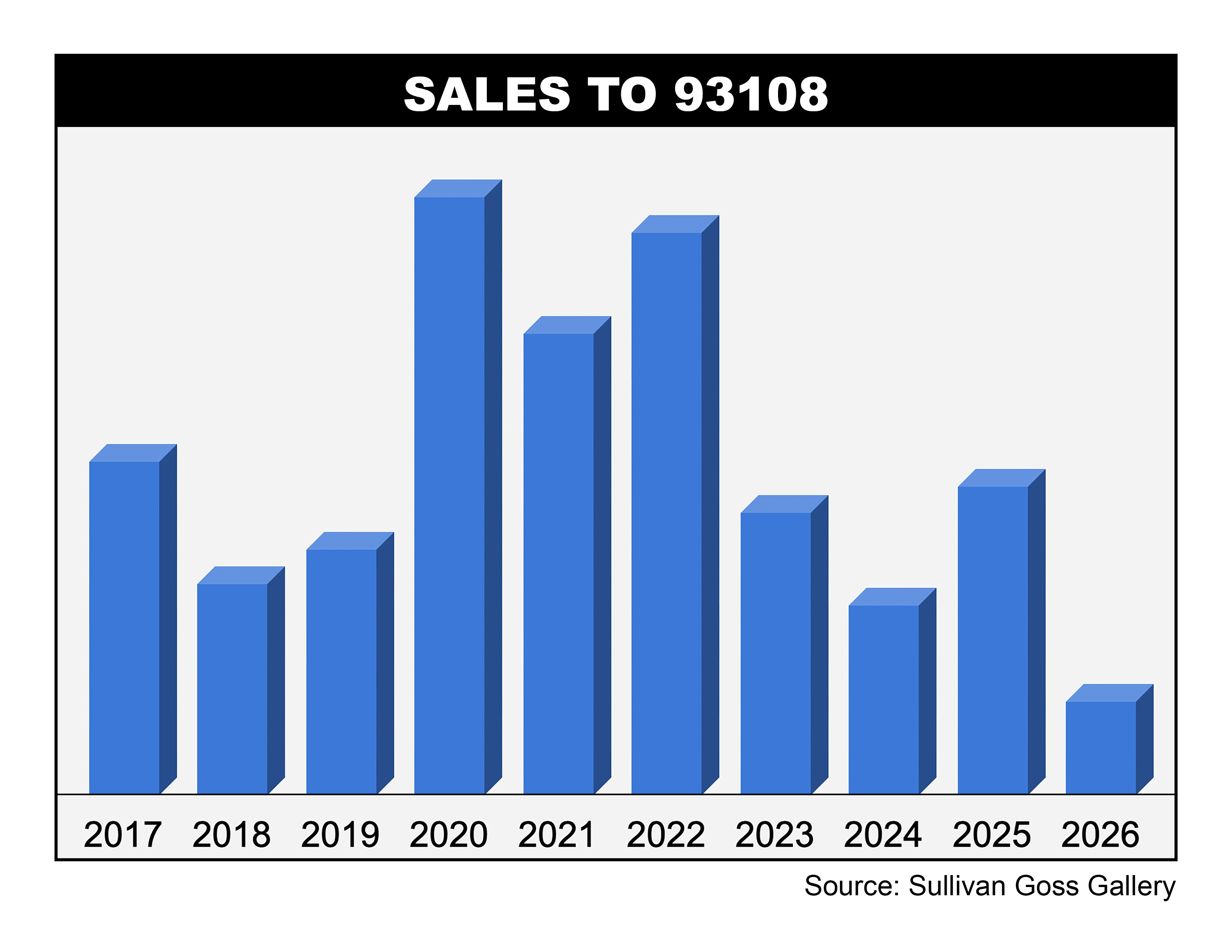
Sullivan Goss Gallery has been part of Santa Barbara’s downtown community for more than 30 years, making it one of the older retail businesses. We regularly collect address information from our customers so that we can deliver, install or ship paintings to collectors when an exhibition ends. We do business with people from all over the country. But most of our sales — nearly 50 percent over the past two decades — are to people in one zip code: 93108, aka Montecito.
In recent years, my colleagues and I have noticed that we have been making fewer and fewer deliveries to our neighbors just down the 101. So while visitors were scarce during July’s extended heatwave, I decided to dive into our institutional database to see if I could get a measure of what was going on. The results were surprising, and suggest that the heated discussion we have been having about cars on State Street might be missing the point entirely.
After many years of slight fluctuation, our business with Montecitans more than doubled in 2020, when people were unable to easily travel, see movies, attend performances or dine out. As a result, people focused their spending on sprucing up their isolation chambers. They remodeled. They built additions. When the new construction was finished, there were bare walls that needed new art. And for the next three years, people came downtown to appreciate art at Sullivan Goss in record numbers.
In May 2020, as the pandemic settled in, State Street closed to auto traffic and many shops and restaurants spilled out onto what became a promenade of people, eager, despite the worldwide pandemic, to carry on with living and be safely around other people. The record sales we had during the first three years of the promenade — and that I know my friends who own restaurants also had, with the explosion of al fresco dining — suggest that State Street’s closure was no hindrance to getting people downtown to shop and dine.
So what happened in 2023 that caused sales to suddenly drop by 50 percent from the previous year to pre-pandemic levels? There still were no cars on State Street. But traffic elsewhere in the area — especially due to construction on the 101 — can absolutely explain the downturn since.
In 2023, the freeway widening project moved north over Ortega Ridge from Summerland and began to have a significant impact on travel between Montecito and Santa Barbara. Since then, with freeway entrances and exits closed through Montecito, traffic in the area has become increasingly tedious and time consuming. As a result, it has become increasingly hard to persuade people from the 93108 to come to downtown Santa Barbara. Now that the freeway construction has overtaken Hot Springs Road, our sales to Montecitans for the first six months of 2026 suggest we will have another record breaking year — but not the kind you celebrate.
We have been fixated on the fight over cars on State Street when what we ought to acknowledge is the impact of construction on the 101. For the restaurants, retail establishments and cultural institutions downtown that rely on business from Montecito — and we all do — the current impact of freeway construction seems far more significant. As further evidence, consider the daily traffic jam that clogs Coast Village Road.
Yet no one has been talking about this. Not city hall, not the downtown business community, not the chamber of commerce.
Locals, especially those from 93108, have more buying power than all of the tourists combined who visit our beautiful city each year. It is locals who sustain the art and culture that make Santa Barbara such a special place. If we continue moving toward a State Street where art and culture thrive, then when freeway construction finally ends, State Street will still be a unique place that locals and tourists alike are excited to visit.
Nathan Vonk owns the Sullivan Goss Gallery in Santa Barbara.

