

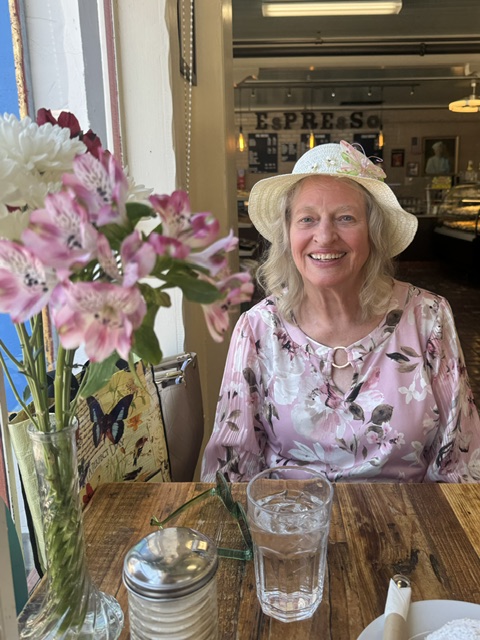
August 26 is the day the 19th Amendment was certified in 1920, giving women the right to vote nationally. I was delighted to learn so much more about the untold story behind the scenes from my friend and client Sue Lean, who relocated to Santa Barbara from Washington State and has spent decades learning and preserving the history of women’s suffrage.
Sue Lean: In 1970, at the League of Women Voters 50th anniversary celebration, I learned women had only had the vote for 50 years. I was stunned.
I would have been about 27. I thought women had been able to vote for a very long time. It came as a shock.
You said six Western States played an important role prior to the passing of the 19th Amendment, one even before statehood. When did you learn this, and which states? Not until 1994 did I find out that allowing women to vote was a state-by-state thing. I was traveling for my daughter’s college graduation, and took a side trip to Seneca Falls, New York, to the Women’s Rights National Historic Park. This is where the first Women’s Rights Convention was held in 1848.
The timeline on the brochure stated: “1910, Washington becomes the first state in the 20th century to fully enfranchise women, inspiring a nationwide campaign that soon brought success in several Western states.” And again. I was stunned.
The Washington State Constitution Amendment came 10 years before the 19th Amendment to the United States Constitution. I grew up in Washington State and had never learned this. And, it was a surprise to know when Washington women won the vote in 1910, there had been no new states allowing women to vote for 14 long years. Fourteen years! I was both surprised and proud to hear this inspired other states and renewed the energy that had once been given to suffrage.
And California was next? Yes. California’s Constitution allowed women to vote in 1911. California was the sixth state, the sixth star on the suffrage flag.
Which were the first? In 1869, Wyoming Territory. In 1890 Wyoming became the first state, refusing to enter the Union without women’s voting rights.
1893, Colorado.
1896, Utah and Idaho.
And then nothing for 14 years.
1910, Washington.
1911, California.
In California, they initially thought women’s suffrage had lost? Yes. It lost in the big cities. It was announced that suffrage for women had lost at the polls. But when the rural votes came in, it passed.
Why do you think the West was different, allowing women to vote before the rest of the country? Was there something about our pioneering spirit? I think that was part of it.
Susan B. Anthony came to the West in 1871, just two years after the Golden Spike was pounded into the railroad tracks marking the Transcontinental Railroad, on a Northwest suffrage campaign tour. She spoke at Washington’s State Capitol at a time when women weren’t allowed to speak in public. She addressed the Washington Territorial Legislature encouraging them to grant women the right to vote.
She left feeling that the people in the West were “freer in mind.”
Susan B. Anthony did not live to see the 19th Amendment become law. She did not. She died, I think, in 1906. But not before declaring “Failure Is Impossible” before she died.
Tell me about the League of Women Voters. Are you a member here in Santa Barbara? I joined the League in 1969 and now belong to the Santa Barbara League of Women Voters. I am a lifetime member, more than 50 years.
It was founded in 1920, six months before the 19th Amendment, from earlier suffrage organizations dating back to 1911. The goal was to help women win the vote in other states, and help women be aware of issues, educated, so that they could use the vote intelligently.
It did not endorse candidates. It was nonpartisan.
Is the League of Women Voters still nonpartisan today? Yes. We don’t endorse candidates. We hold forums so that issues are aired and people can make up their own minds. One of the strengths of the organization is nonpartisan.
And all are welcome to belong to the League of Women Voters? Yes, men, all people are welcome and can join the League of Women Voters.
Voting rights are still in the news today. You have concerns for protecting legal voting, and mentioned to me specifically the proposed SAVE Act. Why does that concern you, particularly for women? The struggle for the right to vote continues both globally and here in the U.S. today.
It sounds innocent. “Show ID” when you go to vote. However, what ID is allowed is going to require a lot of work. Married women often have a driver’s license that does not match their birth certificate. If your name is changed, or you go back to your maiden name, this will complicate, delay, or prevent your registration and legal vote.
Birth and marriage certificates are two documents that are not readily available in your wallet, and they’re hard to get ahold of. For some, it takes a long time to get these old documents. And some people would be told they cannot vote in the next election, because records have been destroyed.
So it’s a real threat, especially to women. The SAVE Act would deny the right to vote for registered voters who have been voting legally for decades.
If passed, right before an election, voters will not have enough time to get their birth certificate and their marriage certificate.
Requiring re-verification at polling places would discourage and disenfranchise millions of legal, eligible women voters.
August 26 is Women’s Equality Day. Yes. The 19th Amendment was ratified on August 18, but it was delayed because there was an effort to reverse the one-vote victory.
One vote? Harry Burn from Tennessee changed his Nay vote to Aye, because his mom wrote him a letter. His mother referenced the suffrage and League of Women Voters leader, Carrie Chapman Catt. She urged her son “to help Mrs. Catt put the rat in ratification.”
Burn was only 24 and his unexpected vote broke the tie making Tennessee the 36th state to ratify and securing women’s nationwide right to vote.
KR: I raised my daughter to be educated on issues and exercise her right to vote, every election. It’s important to be knowledgeable on all sides of issues, vote, and know our history. The actions of individuals today will outlive us and impact our future generations.
I loved talking with you, thank you, Sue, for sharing your depth of knowledge. You are a real gem for our Santa Barbara community!
A Much-Delayed Journey
The 19th Amendment prohibited denying voting rights on account of sex. It did not, in practice, secure equal voting access for every woman nationwide because many women continued to face legal and practical barriers.
The 1965 Voting Rights Act prohibits racial discrimination in voting. Later amendments from 1970-2006 prohibit discrimination based on race, color, or language-minority status in registration and voting nationwide and provide protections for blind, disabled, or illiterate voters.
For local voter information, the League of Women Voters of Santa Barbara hosts nonpartisan candidate and issues forums. Visit the League’s calendar for upcoming 2026 election events.
For the full Q&A with Sue Lean, and to watch the video interview and share your reflections and questions, go to welcometosantabarbara.substack.com. Kathleen Rogers is an independent real estate advisor with eXp Luxury, an SBAOR board member, Chamber ambassador, Rotary member, and active runner/triathlete. @WelcometoSantaBarbara.

