

I strongly support adopting the Final State Street Master Plan, and I want to make two arguments that I think have been underweighted in this debate: that a rebuilt, people-first State Street is the most powerful housing tool this Council has available to it, and that a car-free State Street is not a break with the street’s history but a return to it.
State Street Was Built for People
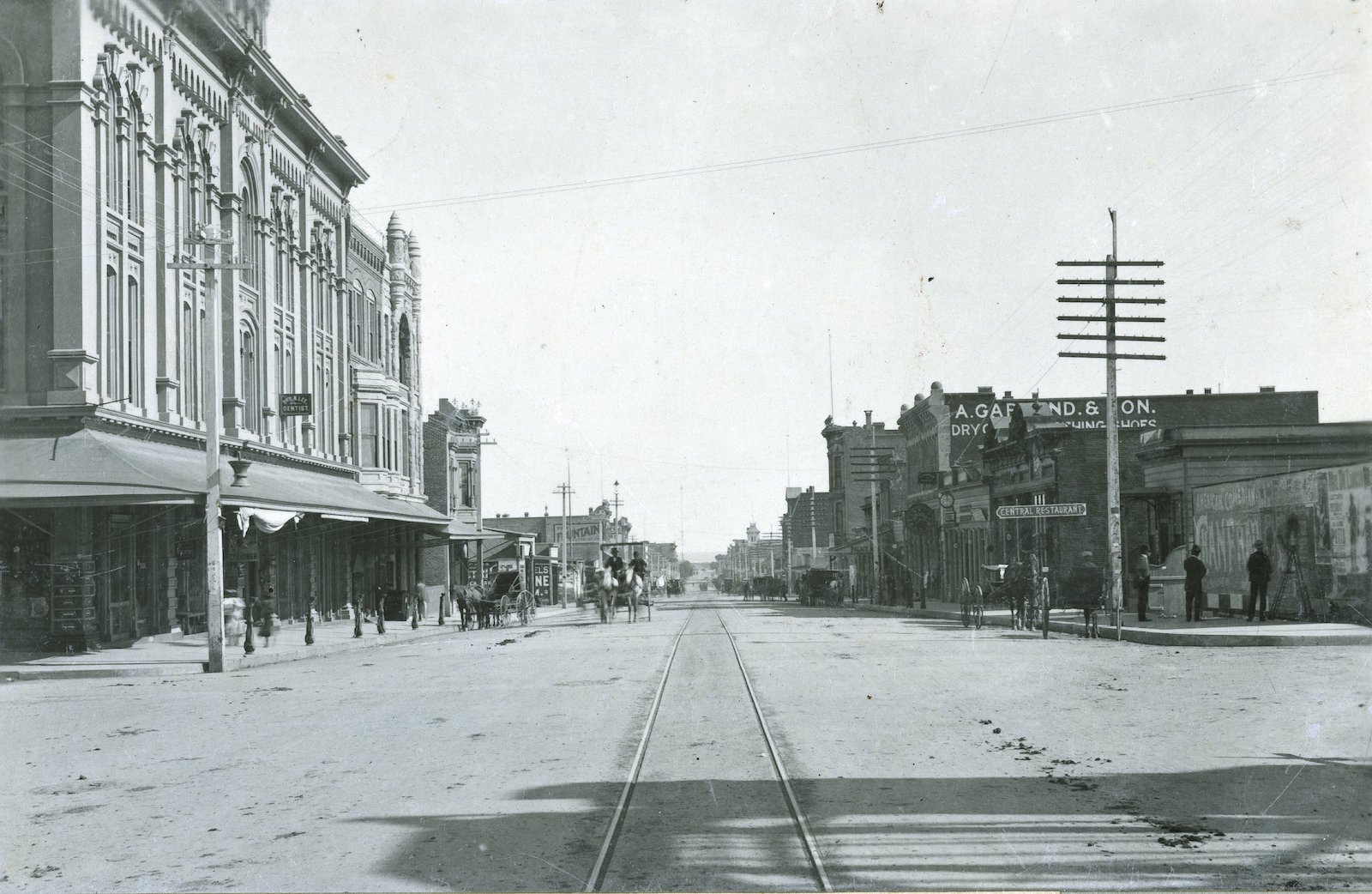
When Colonel Salisbury Haley laid out the city’s grid in 1851, the corner of State and Carrillo was designated the center of downtown. What followed was a century of shared, largely non-automotive use.
It is also worth remembering that when State Street did carry serious traffic, it did so as an early version of the route that became US 101. We then spent decades and a great deal of money building a freeway so that State Street would not carry through-traffic. What’s being argued about now is whether the city’s civic center must also serve as a thoroughfare.
Every Generation Has Improved State Street
Automobile dominance on State Street peaked within living memory and did not last long. By the early 1960s, the street had four traffic lanes, on-street parking, and narrow sidewalks. That configuration coincided with the forces that were pulling life out of downtown in the first place: postwar suburbanization, highway construction money, the explosive growth of the Goleta Valley, and the opening of the suburban La Cumbre Plaza in 1967.
Santa Barbara recognized the mistake almost immediately, and has been correcting it ever since:
• 1964. The General Plan suggested that a portion of State Street become a “pedestrian-oriented shopping street” that “allows the pedestrian to wander at will.”
• 1966–1969. State Street from Ortega to Victoria was rebuilt as a landscaped “drive-through” plaza. Traffic lanes went from four to two.
• 1970s–1990s. The plaza was extended to Ortega, Paseo Nuevo opened in 1989, and the 400 block was rebuilt in the mid-1990s.
• 1999–2007. An $8 million beautification project improved sidewalks and crosswalks.
• 2020. The street closed to regular vehicle traffic.
• 2025. 1.3 million people came to a car-free State Street to shop, dine, explore and gather.
Along the way, the people who suggested going further were treated roughly. Former mayor Sheila Lodge proposed closing just two blocks on weekends as an experiment, and she wrote that she “nearly got hung from one of La Arcada’s lamp posts that night.”
I raise all of this because the loudest objection to this plan is that it changes the character of State Street. The historical record says the opposite. The four-lane arterial was a roughly 30-year experiment on a street that is 175 years old, and the city has been walking it back deliberately, in every decade, since 1964. The Master Plan is not step one. It is more like step nine, and it fulfills the vision the 1964 General Plan was courageous enough to imagine.
The Real Prize Is Housing
I care about this street, but I care more about who gets to live near it, and this is where I think the Master Plan’s value is most underestimated.
Santa Barbara is required to accommodate 8,001 new housing units by 2031. We are not going to build all of those in the foothills or on the Mesa. If they get built at all, a meaningful share will be built on or near State Street.
Two facts make the connection to this plan direct.
First, downtown housing is being approved with far less parking than housing elsewhere, and that is what makes many of these projects financially possible. But it is only defensible to investors, neighbors, and potential residents if they can actually live well without a car. A permanently walkable State Street with a year-round shuttle is the critical infrastructure that makes downtown housing attractive.
Second, the plan’s shared stormwater system, sized to let adjacent properties meet their obligations off site, removes one of the last technical barriers to repeating housing development at scale. That single provision may produce more housing than any policy change this council may make this year.
Permanence Is the Policy
Finally, approving this plan is a signal. Developers and business owners are not making one-year bets on State Street; they are underwriting 20- and 30-year holds.
This is why I hope the council will go further than the plan strictly requires and state plainly that State Street will remain closed to general private vehicle traffic at all hours, with deliveries and service access in an overnight window, and emergency vehicles, the shuttle, and events always accommodated. Half-measures and reversible hours would preserve exactly the uncertainty that has been the real drag on downtown investment.
Ambiguity is expensive. Certainty is free, and it is entirely within City Council’s ability to deliver, if they approve this Master Plan.

