
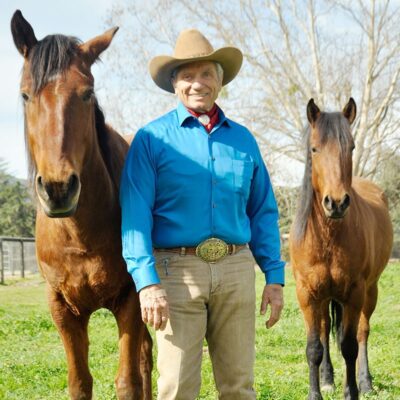
Long before the world called my father “The Man Who Listens to Horses,” I knew him simply as Dad.
Horses were everywhere in our lives. But so was an idea that was surprisingly radical for its time: A horse did not have to be frightened, hurt, or overpowered in order to learn. There was another way.
Dad spent his lifetime looking for that better way. Even late in his life, he would say that he needed two lifetimes. There was simply too much still to learn from horses and too much he wanted to accomplish in one. Eventually, he came to believe that his students would become his second lifetime, carrying what they learned from him forward to their own students and horses.
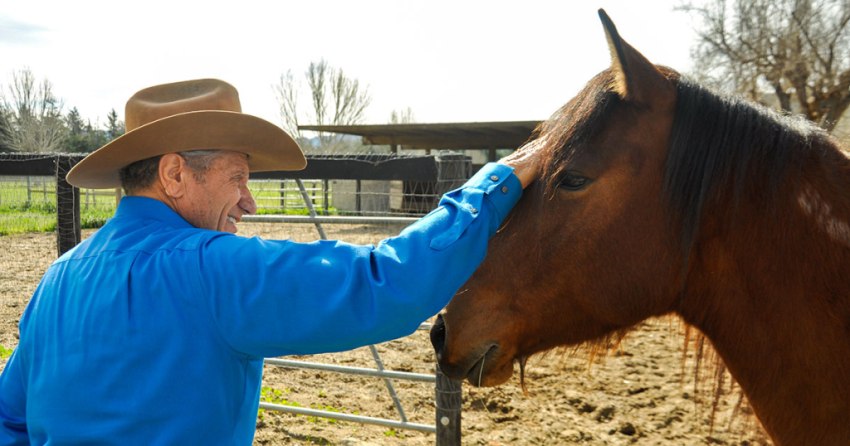
At the beginning of nearly everything Dad did with a horse was something he called “reading the horse.” Before he asked anything, he observed. What did this particular horse need? What was the horse’s body telling him? Was there fear, confusion, curiosity, resistance, relaxation, or willingness?
“Listen first, then ask.” This is an important distinction when remembering Monty’s work. People sometimes speak of “Monty’s Method,” but Dad did not leave behind a rote set of steps. He taught concepts. Horsemanship, to him, was a conversation happening in real time.
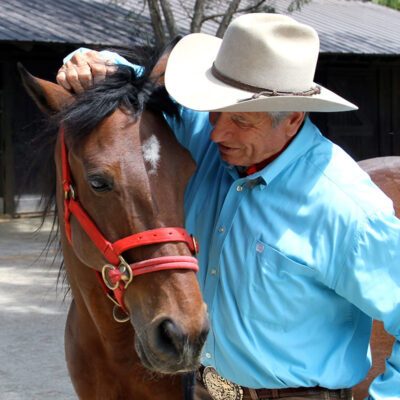
The foundation of that conversation was Equus, the gestural language of the horse. Dad learned much of what became his life’s work by observing horses, including wild mustangs, communicating with one another. He believed that if humans could learn to recognize this language and become more aware of what their own bodies were communicating, they could build relationships with horses based on trust rather than fear.
The horse would answer. Then it was our responsibility to listen again.
From those concepts came Join-Up®, perhaps the best known expression of Dad’s work, and practical applications to starting young horses, loading trailers, overcoming fear, solving behavioral problems, and helping horses and humans understand one another.
But the technique was never supposed to become more important than the horse.
Dad was an innovator because he continued to listen. If a horse showed him something new, he wanted to understand it. He could change his mind and refine an idea. Even after decades of experience, he never believed he had finished learning.
He often said, “An educated horse is a happier horse.”
Education, in his view, wasn’t about submission. A horse that understands what is being asked has less reason for confusion and fear. The responsibility of the human is to communicate clearly enough that the horse has an opportunity to understand.
That philosophy eventually traveled much farther than the young boy observing horses could have envisioned.
One of the most consequential people to recognize the value of Dad’s work was Queen Elizabeth II. Her encouragement helped propel him from a California horseman with unconventional ideas onto an international stage. He demonstrated his concepts around the world, wrote The Man Who Listens to Horses and other books, and introduced millions of people to the possibility that force and violence were not necessary to achieve extraordinary things with horses.
Yet the larger idea Dad carried into the world went beyond horsemanship.
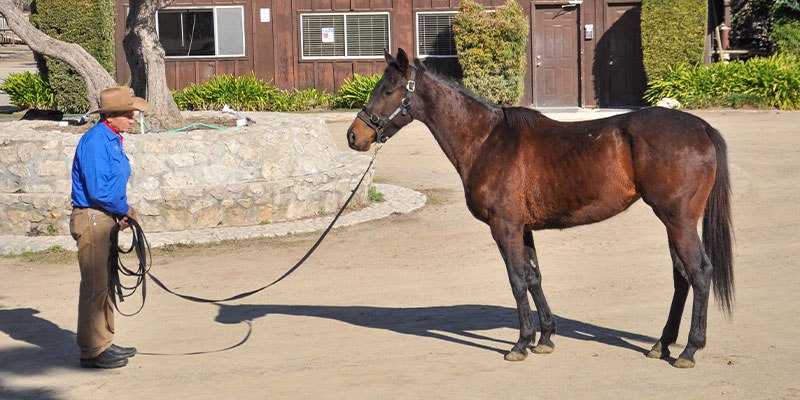
He challenged an assumption about power. When an animal is afraid or resistant, our instinct can be to apply more pressure. Dad asked us to consider another possibility: What if we listened first? What if understanding, communication, and trust could accomplish what force could not?
Over time, those concepts began changing human lives as well as horses’ lives. Through programs inspired by his work, horses became partners in helping veterans, first responders, people affected by trauma, and young people at risk. People discovered that lessons learned from horses about trust, boundaries, communication, and the consequences of our own behavior could follow them out of the arena and into their lives.
His work had begun with a determination to make life better for horses, yet the kindness and courage behind that vision ultimately reached people he could never have imagined when he began.
Today, as I walk around the farm my parents established in 1966, I find myself thinking about how much this place has changed with what we have learned.
It began as a state of the art Thoroughbred racing and training farm. Over the decades, we have continued to rethink and retrofit that original facility to provide horses with more movement, social interaction, companionship, and opportunities to live closer to their natural needs.
That evolution means a great deal to me now, but it is also another example of something Dad practiced throughout his life. He was committed to lifelong learning. The farm was never meant to remain a monument to what we knew in 1966. As our understanding of horses grew, the way we cared for them needed to grow too.
In that sense, the farm learned along with us.
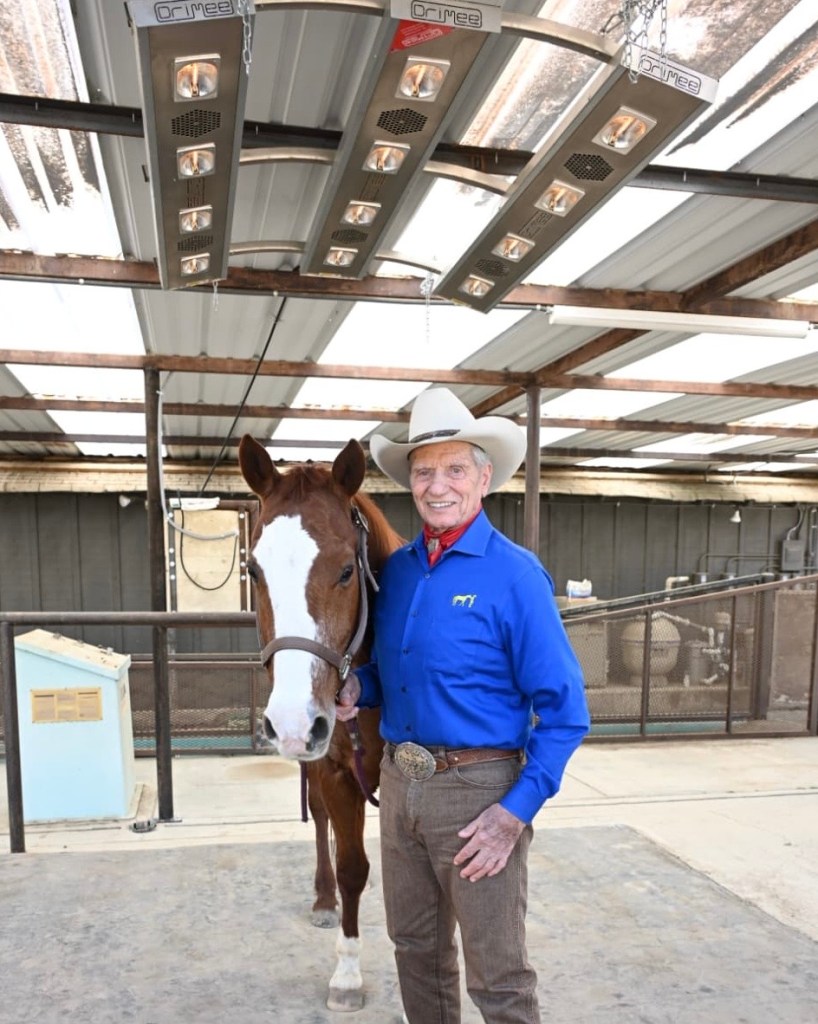
There is a place here today where visitors can simply sit and observe horses living together in a herd. Dad’s recorded voice encourages them to notice what he spent his lifetime noticing: the movement of an ear, a change in posture, the position of one horse relative to another, an invitation, a boundary, a moment of relaxation.
Nothing needs to be performed. Nothing needs to be made to happen. The conversation is already taking place. We only need to become quiet enough to see it.
There is something profoundly moving to me about hearing Dad’s voice there now. He is still directing our attention toward the horse: Look. Observe. What is the horse telling you?
Nearby, the Monty Roberts International Learning Center takes that listening further, from observation into instruction and hands-on learning. Students come from around the world not simply to memorize what Monty Roberts did, but to learn to read the horse standing in front of them. They study Equus and put those concepts into practice. They ask. The horse responds. They adjust. The conversation continues.
And the horse keeps the learning honest.
This brings me back to Dad’s wish for two lifetimes. My father’s first lifetime ended on July 31, 2026. His second did not.
It is alive in the instructors who learned directly from him and now teach others. It is in students who return home and look at their horses differently. It is in the person who gives a frightened horse another moment rather than increasing the pressure. It is in a veteran who discovers something about trust through a horse, a young person who discovers that communication does not require violence, and every horseman or horsewoman willing to ask, “What is this horse trying to tell me?”
And it is here on the farm.
Dad’s voice can still help a visitor notice an ear turn or a subtle shift in a herd. But increasingly I understand that he spent his lifetime teaching us to hear another voice, the horse’s.
Perhaps that is the most important inheritance he left us. Not a formula to preserve unchanged. Not a series of steps bearing his name. But a way of paying attention. A belief that there is always more to learn. And a responsibility to put the horse first in the conversation.
Dad spent his first lifetime listening to horses and teaching the rest of us how to hear them. His second lifetime belongs to all those who carry that conversation forward, continuing to listen, learn and teach, while making room for another generation to do the same.
The horses are still speaking.
May we never stop listening.


You must be logged in to post a comment.