

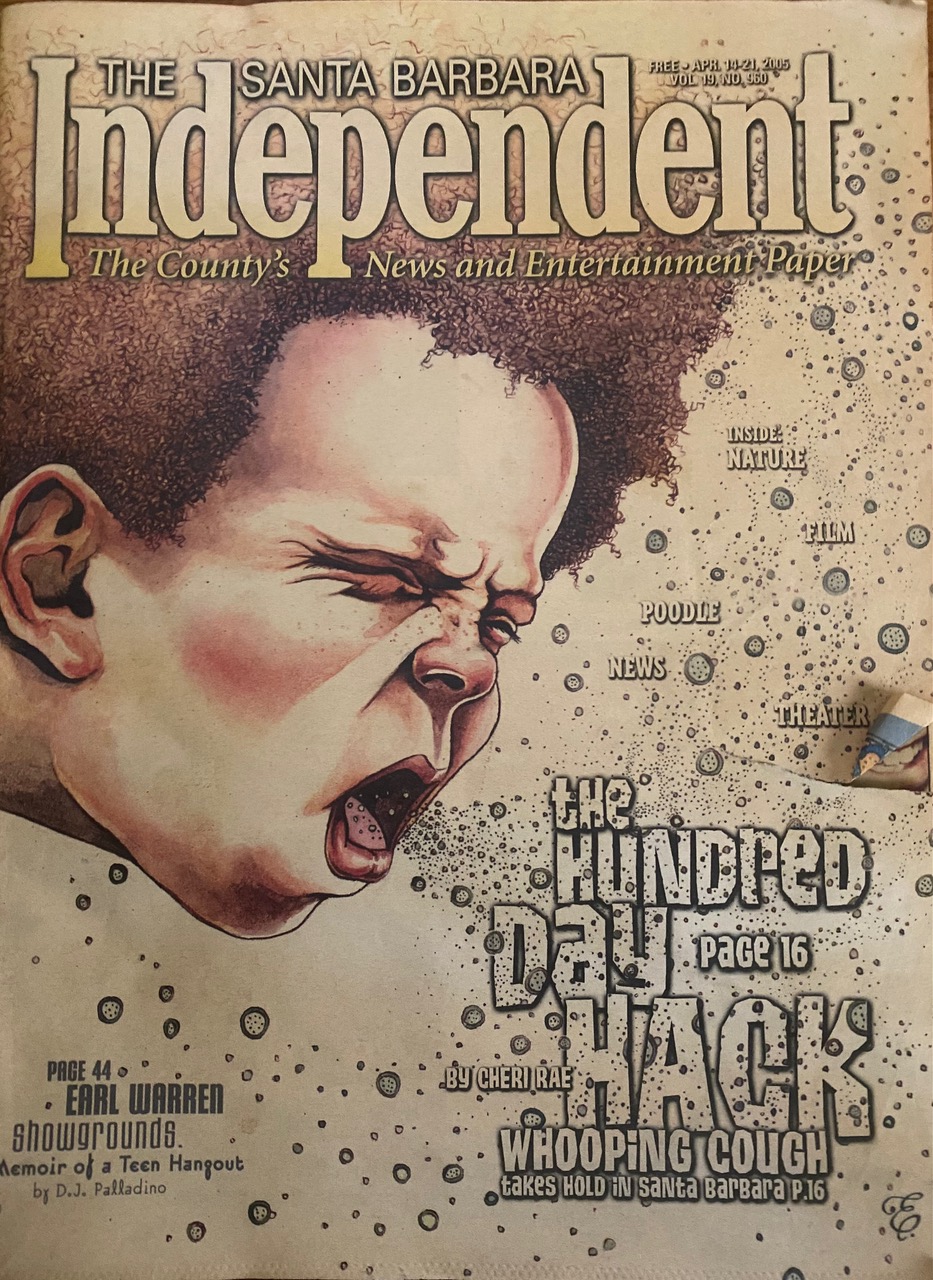
Measles, mumps, whooping cough — diseases nearly eradicated by the widespread use of vaccines are now back with a vengeance without them.
It’s been more than 20 years since my young son’s case of whooping cough (also known as pertussis, Latin for “intensive cough”) introduced me to issues I’d never realized were issues: “herd immunity,” “anti-vaxxers” and “vaccine-preventable diseases” became part of my daily vocabulary. And his unmistakable cough rang in my ears all day and all night. I can still vividly remember it.
My cover story “The 100-Day Hack” appeared in the Independent in 2005 and was reposted on the website of the Children’s Hospital of Philadelphia. A Los Angeles film crew for the Today Show interviewed me in my kitchen; a PBS show, Second Opinion, flew me out to Rochester, NY for an interview.
As our story circulated, I was roundly referred to online as a “sheeple” by “anti-vaxxers,” a label proudly claimed by those who do not vaccinate their children. Emboldened by the current administration, their ranks have swelled as they boldly assert their belief that natural immunity protects them from unseen bacteria and viruses.
Vaccine refusal might sound hip and cool, powerful and righteous but bacteria and viruses are not deterred by personal beliefs. The consequences of contracting one of these vaccine-preventable diseases are not widely understood.
My Family Story
My son was vaccinated with the DTaP (diphtheria, tetanus, and acellular pertussis) as a baby. Unbeknownst to me, many of his classmates were not. Turned out a large percentage of students at his public school had immunization waivers based on “personal belief.” The meant the “herd immunity” there was far lower than optimal to protect all the students. My son, several other children and a teacher were infected with pertussis. His case was reported to the Santa Barbara County Health Department, many others were not.
The Aftermath
Recovering from the wracking cough took months; returning to health took years. He ended up in the care of an asthma specialist to address his damaged bronchial tubes and “twitchy airways.” He was diagnosed with “reactive airway disease” and prescribed an impressive array of daily treatments and emergency medications.
I was in frequent contact with my neighbor, a respiratory therapist, who listened carefully to his breathing. Many times she advised a trip to the emergency room to address his listlessness and the worrisome crackling sounds her stethoscope revealed.
Whenever the air quality was affected due to local wildfires — and there were several during his childhood — we had to take him out of town just so he could breathe comfortably, sometimes for days at a time.
His transformation from a sturdy kid to a sickly one took a toll on his self-esteem and emotional well-being as exhaustion overtook his sense of confidence. Years later, he confessed that because the coughing was so bad, and he needed so many treatments he just assumed he would die while he was still a little boy.
Changing Times and Policies
Shortly after his case of pertussis, the Tdap booster vaccine (tetanus, Diphtheria, pertussis) was approved for use in the U.S. for older children and adults. It is now routinely recommended for pregnant women to protect their newborns from whooping cough — which can be fatal for infants and babies. It is recommended for grandparents-to-be to prevent unknowingly infecting vulnerable young members of the family.
Since legislation took effect in 2015, the “personal belief” exemption is no longer allowed to avoid immunization in California’s public or private schools. Students may, however, receive a medical exemption from a licensed physician; vaccinations are not required in home-based private schooling or independent study programs. Children vaccinated or not, still encounter each other regularly — and spread their illnesses — throughout the community on the playground and sports teams, in dance practice and religious classes, and to parents and other family members.
While measles and issues focused on the MMR immunization schedule currently command national attention–and infections and deaths continue to rise — the number of cases of whooping cough is unclear. The disease tends to follow a three-to five-year cycle of peak infection.
In the post-vaccine era, according to the Johns Hopkins Bloomberg School of Public Health, the lowest number of pertussis cases in the U.S. was in 1976 with 1,010 cases; due to vaccine refusal, the nation has experienced periodic spikes. There were 48,277 cases in 2012; 35,000 in 2024 and nearly 29,000 in 2025. California has reported more than 700 reported cases of pertussis so far in 2026, leading the country. Washington is second with 320 reported.
I fear it’s only a matter of time before resistance to the vaccine allows whooping cough to return with a vengeance and needlessly affect lives unprotected from the bacteria that too-often overcomes its victims. Prevention spurned, infection too late to treat, they begin that cough, that’s like no other cough; the never-ending coughing spasms so violent they cause vomiting, break ribs, and make every next breath a struggle. After months of coughing, it’s a long, traumatic way back to normal life.

