

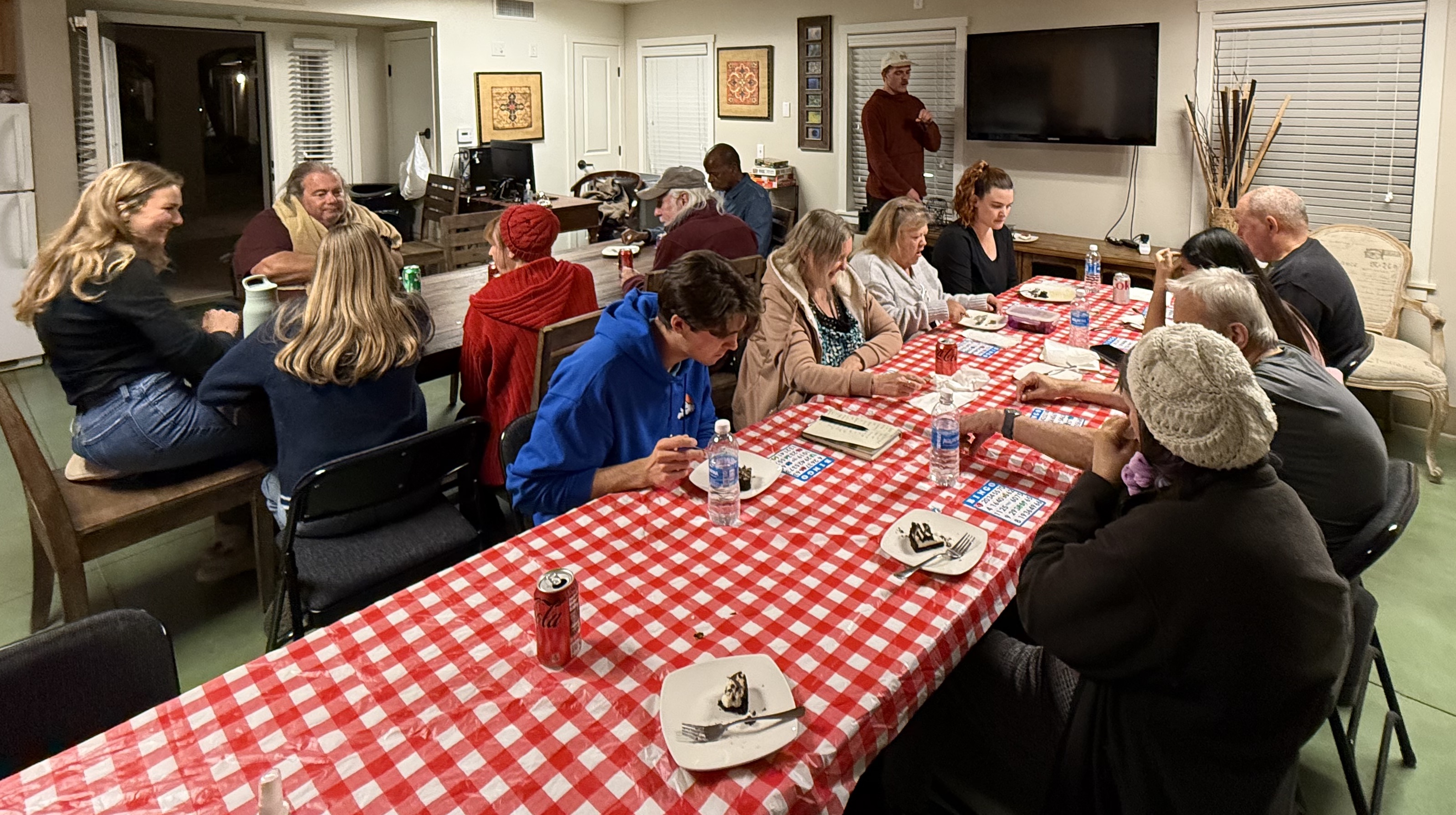
I sat down for a dinner last night with a group of people, most of whom used to be homeless. I should say that this isn’t unusual for me. A group of volunteers and I do this almost every other week. We’re one happy family at this point. Sharing a meal with this lot feels like having Thanksgiving a couple of times a month, except perhaps with more entertaining table guests.
Typically we outsiders to the place arrive around 15 minutes early. The deal is that we bring the food. Last week — a sweltering week — it was an assortment of serve-yourself salads: an orzo salad with heirloom tomatoes and kalamata olives, a spinach salad with fresh peaches and goat cheese crumbles, another green salad that resembled a Cobb salad but with a different name that I can’t remember.
Before we arrive, there’s usually a couple of our hosts who have already been setting up the dining tables and chairs. When I told one of them that I had brought the orzo salad and that it was pre-dressed with a homemade balsamic vinaigrette, she remarked that she didn’t like balsamic. I shouldn’t have been as offended as I was. She doesn’t like a lot of things. I told her I’d leave the other pasta salad un-dressed, then. Later on I found her eating the orzo salad. And pleased with it, I might add.
The other guy who usually helps set up had a long career as a travel guide. He took people all over Western Europe, and his best friends still live on the shores of Lake Como. He works at a store that sells wares from around the globe now, an hourly nod to his former life. One guy who comes to dinners is a talented painter. He once brought three of his pieces, immaculately framed, and propped them up to the side of the room for our viewing pleasure. Another member of the group had a career as a civil engineer, and another lived several years on a commune in Hawaii. At these dinners, I have never met two people who are exactly the same. Go figure.
That’s worth saying though, because we don’t treat people who are unhoused this way. To look for a description in the abstract of someone experiencing homelessness is something like spinning the Wheel of Fortune (or misfortune) with basically four choices: lazy, desperate, addicted, mentally ill. I’d like to buy a vowel. When these are the sole descriptors we have to choose from, it dictates the way we interact with people. We either write them off and conceptualize them as a problem, in the same way potholes on Cabrillo Boulevard are a problem, or we try to save them.
I spent years of life feeling immense pressure whenever I was around someone who was evidently homeless, like I had to single-handedly pull them out of their situation or else I wasn’t doing them any good. Do I buy them food? Sign them into a treatment center? Help them find a job? And because I knew I couldn’t do most of those things, I avoided them. There are case managers for that, I reasoned. Leave that stuff to the professionals.
We do a couple things by succumbing to either one of these positions, though: (1) we relegate all care of these individuals to people who are typically overworked and underpaid (i.e., “homeless services nonprofits”), and (2) we deprive ourselves of being human together.
I don’t know of a better way to put this. There is so much more to an unhoused person than the current state of their housing, or even, the current state of their mind. And, there is so much more to us than seeing a whole population as merely a problem to be solved.
I’ve gotten in the practice, these days, of asking people who appear to be living outside things like what their favorite movie is. Or what the neighborhood they grew up in was like. Or what their favorite spot in town is. And then I listen; the answers are fascinating.
I’m still a recovering “saviorist,” but I don’t feel so much pressure to change someone’s life anymore. None of us should feel that. And I think that has made room for me and the person across from me to be more of who we are, pathology-free. When you can be who are, you can learn to love yourself again. When you love yourself, making positive changes for yourself simply becomes an extension of that love.
I’m interested to see, in other words, what happens when our unhoused population become our unhoused neighbors. What happens when we know them by name? When we know them as painters and engineers and musicians and, yes, balsamic-haters? What might that do for all of us?
Do me a favor. Take two minutes to chat with the person on the bench this week. Ask them about the best concert they’ve ever been to. I’d love to hear the response you get.
The group has about eight programs to connect people — dinners, art, writing groups, and more. To learn more about getting involved, email dj.johnson at kingdomcauses.org.

