

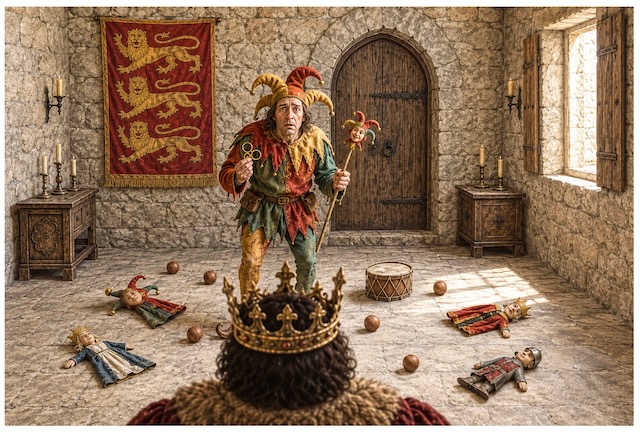
Excavations of Castell Gwyn (the White Castle) in Monmouth, Wales, recently unearthed the diary of Drws Modrwy — the Welsh Court Jester of England’s King John. John briefly lived in the White Castle for two separate terms. It was during his second term that Drws Modrwy acted as his Court Jester and wrote the diary.
To understand Modrwy’s diary, know that John was a contemptuous man who had a contentious reign. He attempted to expand his power as king from 1199 to 1216, fought constantly with European leaders, insulted Pope Innocent III, and continually denied being an “admirer” of young girls (even though he married a 12-year old). In 1215, English Barons tried to stop John’s abuse of kingly power by forcing him to put his seal on the Magna Carta. John arrogantly refused to admit his defeat, and, instead, reputably said that he’d created “the biggest and most beautiful document in history.”
Obviously, Modrwy’s diary is rare — few writings from the 13th century have survived and none express uncensored opinions about a King who could have you killed at any time for insulting him. So Modrwy was very brave — or foolish — to write down his criticisms of the king.
Perhaps in fear of being discovered while writing his entries, Modrwy sometimes wrote phrases instead of complete sentences. His diary’s pages are damaged but the legible entries have been translated from his Middle English into our modern English in the following transcription. His descriptions of jests he told the king are highlighted in italics.
The Diary of Drws Modrwy, a 13th Century Court Jester
All is for his amusement. What interests him for the moment. He doesn’t care about other people. He makes up the world to his liking. If you don’t agree with him, he deems you an idiot and has you persecuted.
Today I told him, “You are the greatest liar the world has ever known” and he got very mad. But then I said, “Nobody in the whole world can lie prone like you — all the women say so.” He laughed. I must make him laugh. If he doesn’t laugh, he may have me killed. He loves revenge more than any man I have ever met.
He fears intruders are taking his imaginary world from him so he orders that they be collected and jailed. Without his pride he is nothing. He knows it. He fears it.
He is a man who thinks he is a god. Opposition cannot stop him. Respect for others does not stop him. His moral code says he has the right to have his way. He craves the affirmation of others, even from those he despises, and those who [The remainder of the entry is missing.]
“Your military prowess is shoddy, you act upon a whim instead of a plan — you attack then withdraw, you threaten to attack then do nothing. No one believes you, no one can trust what you say — and that … that is brilliant strategy! Your negotiating skills are beyond imaginable. Your opponents never know what you are going to do. You will win every battle if you continue to fight like this. Or at least you can say you won.” He very much liked this jest.
He will have you burned alive unless you are loyal to him above all else. Such threats only serve to limit his understanding of what is real.
He sees only what happens in front of him. He has no vision for anything larger. He has made the kingdom weak. He acts the fool because he does not understand what a king should be and thus makes fools of us all.
[Several pages after that entry are too damaged to read.]
“You care about no one else. the hungry, the poor, the sick, all you care about is what happens to you. But by caring about yourself you care about everybody because you ARE the kingdom. Your dictum ‘Why provide for others? Let others provide for you!’ shall be enshrined on all your monuments!” He did not laugh.
He seeks wealth to prove to all that he is worthy. As if the value of a human soul has a price. But his folly is that a human soul has no value if it does not express respect and love and humility.
He believes no one nor any court can command him. If something is said or done that contradicts him he calls it a lie a lie a lie. But it is you, dear King, who lie lie lie. You create it all. As god once did. Because you believe you are a god. The greatest god. What a jest.
[There are no more entries.]
Dicky Pearce, the last Court Jester in England, met his end during a satiric performance for the Earl of Suffolk at Berkeley Castle, Gloucestershire, in either 1725 or 1728 — the time and manner of his death are in question. Some say he fell off a balcony. Some say he was pushed. Dicky Pearce was silenced for whatever truth he was trying to tell. But Drws Modrwy still speaks his truth from the grave.
Note: The J in DJT stands for John.

