
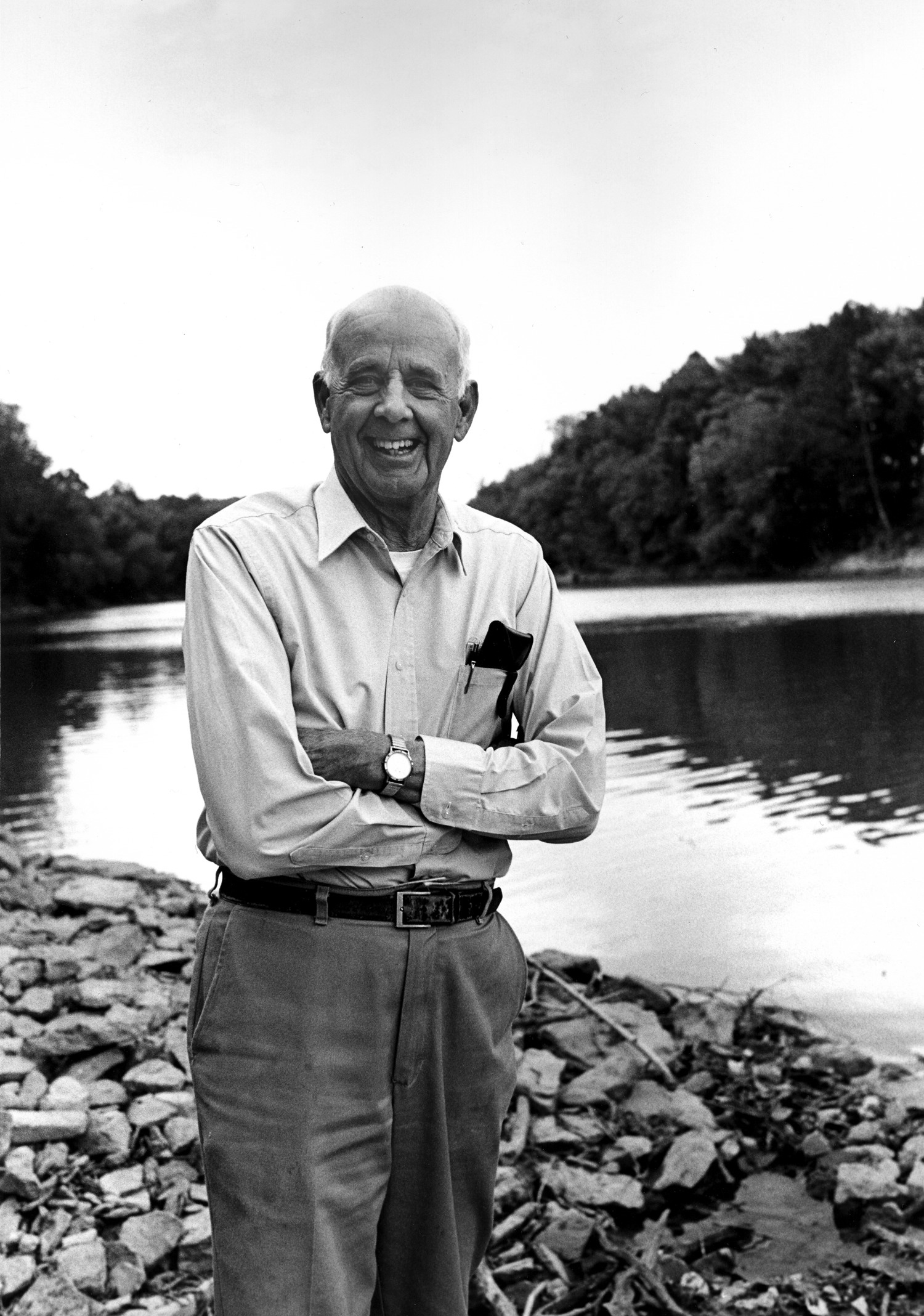
Over the course of a lifetime, if you are really lucky, there might be one or two people whose words or presence permanently alter your path. Wendell Berry was one of them for me.
I first met Wendell through his 1977 book, The Unsettling of America: Culture and Agriculture. I had only been farming for a few years, but that book helped put my work into a broader social, ecological, and cultural context. Through it I began to understand how a society, once rooted in the land, could, in such a short time, become so disconnected from it.
Berry’s writing was a salve, it was redemptive, and it ignited a fire in me to continue doing work that while deeply rewarding was all-consuming and not always well-paid.
Agriculture at that time was still viewed as a form of drudgery, not always respected as a profession. Early in my career, I remember a carload of teenagers screaming “dirt farmer” at me as they sped by the field where I worked. Fifty years later, I am amazed to see the opposite: eaters who desperately want a deeper connection with their food but hold a somewhat romantic view of those of us who produce it and what it takes to do so.
Berry’s writing reinforced my belief that reclaiming our roots in agriculture was not some return to the past but an investment in our collective future.
In the early 1970s, there were a small number of us who were pioneering a new agrarian movement. We viewed our work as a form of public service — for the land and for a society that needed to eat but no longer had any relationship with how their food came to them.
Berry warned of the impacts that would occur when farmers are replaced with chemicals and machines, and he predicted one of the greatest unacknowledged national emergencies: that the 2 percent of us growing the food for the rest are aging out and not being replaced. This incredible imbalance, I believe, is at the heart of every problem in our food system.
Wendell and his lifelong partner, Tanya, came to visit me when I was running Fairview Gardens farm in Goleta. Wes Jackson, who founded the Land Institute, had told him about this little farm surrounded by development, the amazing amount of food it was producing, and the numbers of new farmers it was training.
I picked up Wendell and Tanya at the airport in an old Toyota pickup truck, embarrassed when I realized how difficult it was for him to pretzel his tall, lanky frame into that tiny cab. During the next few days, we talked, explored the region, and shared some wonderful meals. Wendell spoke to enthusiastic audiences at the university and at the farm.
Over the years, as my own books found their way into the world, I had the opportunity to appear with Wendell at various venues around the country. He was one of the rare individuals who, in spite of his notoriety, remained humble and grounded. He would begin an answer to an audience question with “Well, I don’t know,” always baffled that people wanted to imbue him with some power he did not want to own.
At an event in Louisville, Kentucky, a well-known political figure with a vastly different worldview showed up to pick a fight. Witnessing these two men in public dialogue was like a master class in diplomacy; their debate became infused with a willingness to really listen to each other and an acceptance of differences with respect.
Wendell and I sat together on the stage at that event and took turns presenting. After reading an excerpt from my forthcoming book I left the podium and sat back down. He leaned in close, the audience watching, and whispered the kind of praise every writer dreams of hearing from such a literary giant. That acknowledgement carried me through numerous periods of self-doubt, and the ups and downs that I suspect every writer experiences.
In 2003, I received a call from the Brown Forman company, one of the largest producers of spirits and wine, asking if I would come speak at a sustainability conference. I was a little hesitant to participate in a conference sponsored by the company that makes Jack Daniel’s. Sensing my hesitation, the caller told me that “your friend Wendell Berry” would be involved. My tone instantly changed. I told her I would get back to her and called Wendell to get some background.
“Michael,” he said, in his beautiful Kentucky drawl, “these are good people, good people.” Then he added, “If you come, we’ll share a glass of organic bourbon that has been in the barrels aging.” What he didn’t reveal was that bourbon was to be marketed as “Old Wendell” in his honor.
After that conference, I visited with Wendell and Tanya at their farm along the Kentucky River, their home for more than six decades, and was introduced to the people and the place that have informed so much of his writing. I could see that the natural and human communities in which Wendell spent much of his life were not just subjects to be written about, they were who he was. I could also see the power of simply “staying put,” an underlying theme in much of Berry’s writing, and how essential that is in really knowing a place, knowing how to care for it, and in truly becoming part of it.
Wendell Berry did not hesitate to call out the outrages he saw in the world, and he was pointed in his critiques. But he was not, as some of his critics suggested, stuck in some mythic golden past. He could see how civic responsibility and rural values were being replaced with personal greed and consumption, and he implored us all to protect what little was left of the natural world and to devote ourselves to a deeper relationship to the places and people where we lived. He could see how powerless we could feel in the face of the broader global dilemma, but he knew firsthand that we have enormous power close to home.
The day before Wendell died, without any knowledge of his condition or age, my son Aaron asked me if I had been in touch with him. It had been years since I had communicated with Wendell and Tanya, so I thanked Aaron for the reminder and decided to write them a letter. The next day, I received word that Wendell had died.
There is an irony in writing about Wendell Berry on his passing. He probably would not have wanted attention focused on him in death, just as he avoided it in life. But there must be a public honoring of such a life, one lived so well, and an acknowledgement of the more than half a century of inspiration he provided to so many of us through his words and his kindness. Obituaries honor the dead, but they are written for the living.
The loved ones we call the dead depart from us and for a while are absent. And then as if called back by our love, they come near us again. They enter our dreams.
We feel they have been near us when we have not thought of them.
They are simply here, simply waiting while we are distracted among our obligations. At last it comes to us: They live now in the permanent world.
We are the absent ones. —Wendell Berry
Michael Ableman is a farmer, founder/director of the Center for Urban Agriculture at Fairview Gardens, and author of numerous books and essays.

