

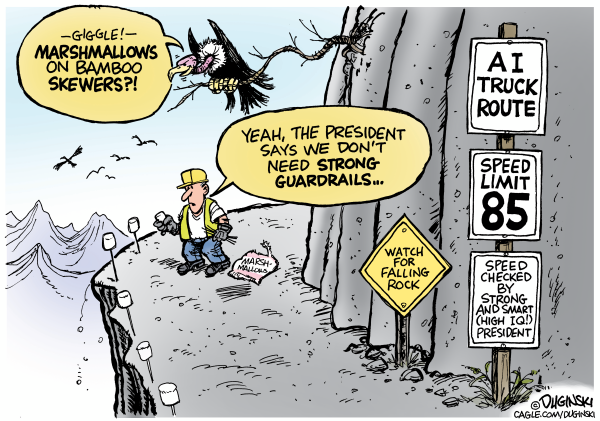
President Trump recently mocked communities who oppose AI data centers as “backward,” claiming, “If we kill the Golden Goose, you will only have yourselves to blame.” Earlier this summer he called widespread opposition to Artificial Intelligence data centers a “mistake,” citing benefits to local communities. A recent Gallup poll shows that 71% of Americans disagree.
Federal agencies and domestic law enforcement now describe the growing AI data center resistance as “anti-tech extremism,” according to a May 2026 Wired report, in keeping with Trump’s National Security Presidential Memo-7, which directs the Department of Justice to target anyone who appears to harbor “anti-capitalism” views. Many observers see this as yet another indicator of the regime’s slide toward fascism.
Are 71 percent of Americans anti-tech extremists?
Seven in 10 Americans, including residents of deep red states and rural communities, oppose data center construction, according to the Gallup poll released earlier this year. Another poll showed that the majority of voters believe the costs of AI outweigh any benefits. Concerns include rising utility bills, plummeting property values, and a general distrust of AI.
Significantly, among those opposing data centers, the majority expressed environmental concerns. Half cite excessive resource use, with 18 percent specifically mentioning water and energy usage and 16 percent worrying about pollution, including sleep-disrupting noise from data centers’ incessant hum. Others worry about loss of farmland, wildlands, and wildlife.
The Trump Administration’s growing disconnect with popular sentiment is a potential opportunity for environmentalists and Democrats who have long sought a big-tent issue to bridge political divides. Public concern surrounding AI may be the biggest unifying issue we’ve seen in generations.
The public is right to worry. Data center energy consumption is unprecedented, creating heat islands, warming temperatures, and rising electricity costs, impacts that fall most heavily on low-income communities and people of color. Most data center energy comes from fossil fuels, threatening the likelihood of the U.S. meeting global climate commitments.
Water is another issue. By 2028, U.S. data centers could use 720 billion gallons of water each year just to cool AI servers. Much of that water is lost to evaporation. Residential water costs in communities with data centers are rising, with heaviest impacts on low-income residents. While the industry touts recent improvements in water usage, through “closed-loop cooling” methods, this approach is no silver bullet. These systems cut water use but pose severe environmental risks by demanding much more electricity to power mechanical chillers and by using toxic chemicals like anti-freeze and biocides that can poison local ecosystems during leaks or maintenance flushes.
Data centers also rely on power sources that release significant air pollution, including nitrogen oxides, carbon monoxide, and particulate matter, contributing to asthma and respiratory disorders. While 4 million Americans live within one mile of data centers, communities closest to such facilities are overwhelmingly non-white — a clear-cut pattern of environmental racism.
Wildlife suffers too. Noise and bright lights create “sensory danger zones,” disrupting nocturnal animals and confusing migratory birds and butterflies. Trump’s data center push — which requires clearing land for electricity infrastructure, roads, and buildings — comes after he has already rolled back endangered species habitat protections.
Unlike broad concerns about international conflicts or affordability, data center resistance is often portrayed as hyperlocal. Data Center Watch, run by AI security company 10a Labs, found that from May 2024 to March 2025 local opposition blocked or delayed $64 billion in data center projects. Data Center Watch treats this backlash somewhat dismissively as “the new NIMBY [not in my backyard] flashpoint.”
Yet, while the majority of Americans do not want data centers built near them, polls indicate that opposition is not tied to proximate impact. Only 8 percent of respondents opposing data centers say they know of one or more near where they live. This opposition shows potential to transcend geographic proximity to become a nationwide movement rooted in broader principles and concerns about the future AI technologies represent. The backlash is no elitist NIMBY uprising.
AI resistance is the big-tent issue of our day — and one of the fastest political shifts in recent memory — crossing party lines, rural and urban divides, and generations. So how can the majority of Americans who oppose data centers combat these threats?
Contact groups like Halt the Harm Network or Food and Water Action to learn more and support their work. Share their reports with neighbors and friends. Consult the NAACP’s “Stop Dirty Data” list of proactive measures for fighting AI-driven environmental injustices. Encourage elected officials to support the AI Data Center Moratorium Act, introduced by Senator Bernie Sanders (I-Vt.) and Representative Alexandria Ocasio-Cortez (D-N.Y.), to impose a federal freeze on construction and expansion of large-scale AI data centers.
Trump may think concerns about AI data centers are mistaken and backward. But when 71 percent of Americans agree on something, that’s no mistake. It’s a movement waiting to happen.
Lisa H. Sideris is 2025-2026 Public Voices fellow of The OpEd Project and UC Santa Barbara, where she is professor and vice-chair of the Environmental Studies Program. David N. Pellow is Distinguished Professor and Dehlsen Chair of Environmental Studies at the UCSB, where he teaches courses on environmental justice and climate justice, human-animal conflicts, sustainability, and social change movements.

