

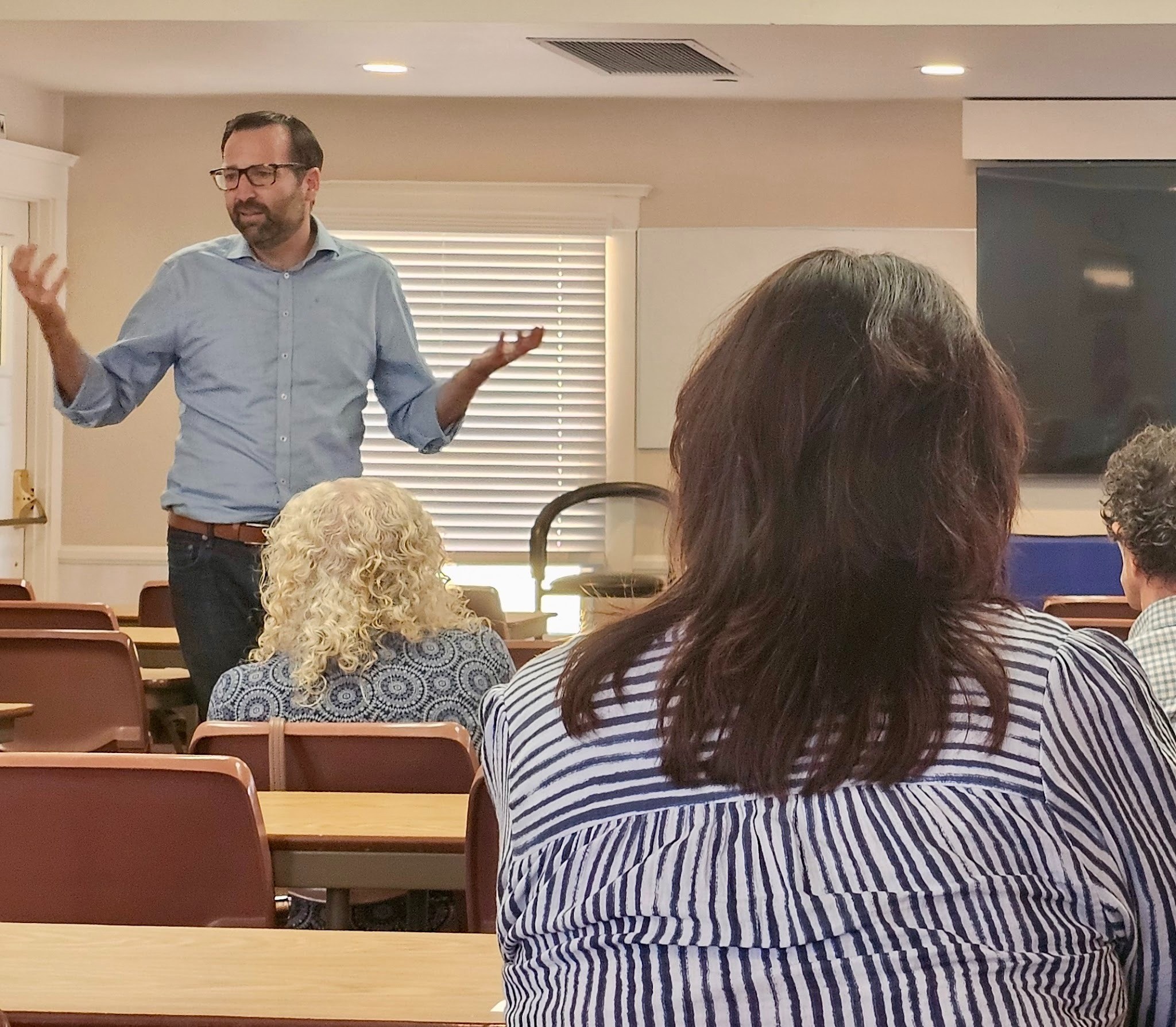
Ben Allen is running for California State Insurance Commissioner, represents communities directly impacted by wildfire and was in Santa Barbara discussing wildfire risk, home insurance, and what Santa Barbara homeowners can expect from prevention work.
By Kathleen Rogers
For locals in Santa Barbara and across the state, knowing about wildfire preparation and what you can do to harden your home is important for both our personal homes, our neighbors, and our costs. Many of us live with memories of packing for evacuation or tragically losing a home. Even if a home is not in a historically “high fire” area, home insurance costs have risen and become more urgent as many local homeowners, including myself, have been dropped by their long-time insurance providers, even with no claims and when not in a traditional high risk area.
I have been paying close attention and helping homeowners become more ‘fire wise’ and harden their homes for safety purposes for several years. I also want to know: what improvements would an insurer recognize as beneficial to coverage? Will they lower the cost of coverage? Should consumers expect a similar policy to be available at renewal?
State Sen. Ben Allen, a candidate for California insurance commissioner, discussed those concerns with members of the Santa Barbara Association of Realtors on September 30. The California Association of Realtors has endorsed Allen. He began with the pressures facing insurers and homeowners, the growing reliance on the FAIR Plan, and the need to reduce wildfire losses across whole communities.
At a Santa Barbara town hall last year, current Insurance Commissioner Ricardo Lara discussed California’s move to allow forward-looking wildfire catastrophe models in insurance rate requests. That reform was intended to help bring insurers back into the market; this conversation a year and a half later focused in part on how to understand those models and receive credit for reducing risk.
Will Firewise work lead to better home insurance coverage?
One of the questions I raised was what homeowners can expect if they organize a Firewise community. Residents may commit substantial time and money to maintaining defensible space and improving their homes. They need to know whether that work will lead specifically to a clear insurance benefit.
Allen said insurers should be involved in identifying the community safety measures that would make them more willing to offer coverage. He described a development in San Diego County where coordinated construction and maintenance standards have, he said, helped residents obtain insurance at lower premiums than a neighboring community. He wants more direct work among insurers, fire experts, local governments, and residents to establish standards that can be put into practice elsewhere.
California already recognizes qualifying Firewise USA participation and individual home improvements for insurance discounts. But a discount is not a promise that a company will offer or renew a policy. For neighborhoods already doing or considering this work, that distinction matters.
Can homeowners understand their risk assessments?
I also asked about the new catastrophe models and assessments that may use aerial images, property data, artificial intelligence, and other technology. Forward-looking models can help account for changing conditions. Homeowners still need to know what a model says about their property, whether the information is accurate, and how completed safety work changes the result. I raised the question from personal experience, having ended up on the FAIR Plan without a clear understanding of why my home was assessed as it was.
Allen emphasized transparency and the ability to correct errors. He pointed to SB 1301, the bill he authored that was signed into law in September. Beginning January 1, 2028, it will require insurers to give more detailed reasons for residential property insurance nonrenewals, including information about a wildfire risk classification when that is a reason for the decision. It also establishes a way for homeowners to dispute inaccurate or incomplete information.
That addresses an immediate need when coverage is at stake. A further question is how clearly insurers can explain the assumptions behind their models and recognize documented improvements at both the property and neighborhood level.
What if the reason for nonrenewal can be fixed?
Another SBAOR attendee described an HOA’s struggle to find replacement insurance after receiving short notice of cancellation. Allen said homeowners need both time and useful information when an insurer decides against renewal.
Under SB 1301, the general notice of nonrenewal will be at least 90 days. If the insurer identifies a condition the policyholder can remedy, the law calls for at least 120 days’ notice, an explanation of the needed change, and time to complete it. These provisions begin in 2028.
Do buyers know what their policies will pay after a loss?
Allen is a current state senator from Santa Monica and has been helping many constituents who are still dealing with the Palisades fire.
The discussion turned to what happens after a loss.
Ask yourself and your insurance agent if you have replacement cost coverage, or actual cash value? Do you know the difference?
Those terms can be easy to overlook when choosing a policy, although they may lead to very different payments after a disaster.
This is how I think of it, your insurance expert will be more detailed. If you need a new roof, and your roof is 25 years old: do you need insurance to cover what it will cost you TODAY to put on a new roof, or, do you need insurance to pay you the actual cash value of the old, 30 year roof?
Allen said he favors a simpler, standardized summary of major coverage choices and their effect on premiums. He also discussed a proposed public scorecard showing how insurers handle claims after disasters. These are ideas he would pursue as commissioner, not tools currently available to buyers.
What can we do to “harden” our homes and neighborhoods, and how can we get help with the costs?
I have shared a home fire safety checklist with friends, family, and clients and highlighted the Santa Barbara County Fire Safe Council’s resources for home preparation and neighborhood organization. The checklist offers a place to start a conversation about maintenance, defensible space, and improvements to discuss with qualified fire safety professionals.
How can residents get help to do the safety work in the first place?
Beyond how much insurance savings carriers might offer after these are done, what about the many homeowners who could use financial incentives and assistance to increase fire resilience?
- Removing existing plants and creating a 5 foot plant free ‘zone 0’ defensible space.
- Installing new ember resistant ⅛ vents over all home basement and attic openings
- Trimming trees away from the roof, cleaning gutters and installing auto gas shut-offs
- Upgrading to noncombustible roofs (including tile, asphalt, shingle, slate.)
- Meeting with neighbors and building an official FireWise community.
Two possibilities for discussion at both the State and Federal level are pairing eligible down payment assistance with financing for initial fire hardening, and/or offering a predictable rebate, voucher, or tax credit for verified property and neighborhood work.
These are ideas for discussion, not benefits currently promised to homeowners.
I am working on this personally and helping neighbors, friends and clients learn more. And I’m always interested in learning more and getting more resources. To me, this type of home hardening investment will have bigger payoffs, sort of like going to a primary care doctor before things get worse, vs going to the emergency room with a major issue.
Fire preparation and insurance decisions are easier to address before a renewal notice arrives or a purchase is underway.
If you own a home, are considering buying, or preparing to sell, I recommend you pay attention to the State Insurance Commissioner election, our local Santa Barbara elections and national midterms. If you would like to discuss with additional local experts for your home, call your real estate or insurance agent, or reach out to me directly for confidential conversation. I love to help think through questions, learn more, and share connections to local expert resources.
Kathleen Rogers is a Santa Barbara real estate advisor with eXp Luxury who helps her clients with healthy, high performance homes. She is a Rotarian, a director of the Santa Barbara Association of Realtors, a Chamber Ambassador and a trail runner. She attended the meeting with Senator Ben Allen along with others and writes independently; the views here are her own, not those of SBAOR or a candidate’s campaign. DRE #02044953. Reach Kathleen at 805-284-3900 or Kathleen.Rogers@exprealty.com
###
REALTORS®: Share your industry info in “REAL ESTATE SCOOP.” Email sarah@independent.com for details.
Related Posts


You must be logged in to post a comment.