

Almost 30 years ago, along with two colleagues from the County Auditor-Controller’s Office, I helped team-teach an evening course in government accounting through UCSB Extension. The Government Finance Officers Blue Book was our text.
The primary reasons we held the class were to formally teach junior accounting staff in regional government offices that utilize the County Treasury and to increase the pool of qualified candidates for our office. It worked. Our technical interactions with other finance offices improved, and several graduates of the course subsequently led quite successful careers at the county and other governments. I am still proud to have been a part of that initiative.
Most of the students who enrolled in the course were new accounting/economics graduates from either Cal Poly or UCSB. One student didn’t fit the mold. He was a middle-aged doctor. An OB-GYN, known as Dr. Dan. He had recently been elected to the Santa Barbara City Council, and he wanted to learn the language of his new line of work. I remember he was an excellent student.
At the time, I thought how refreshing it was to see an individual, then entrusted with hundreds of millions of taxpayer dollars, endeavoring to learn the unique details of government finance. I didn’t live in the city at the time — if I did, I would have voted for him.
So why bring all of that up now?
The most recent discussions about the city’s current financial predicament reminded me of that course and Dr. Dan. So much of the recent discussion and debate centers on fundamental misunderstandings. Some of the things I have heard make little sense. I have not heard mention of significant steps that it will take to correct our course and replenish our reserves.
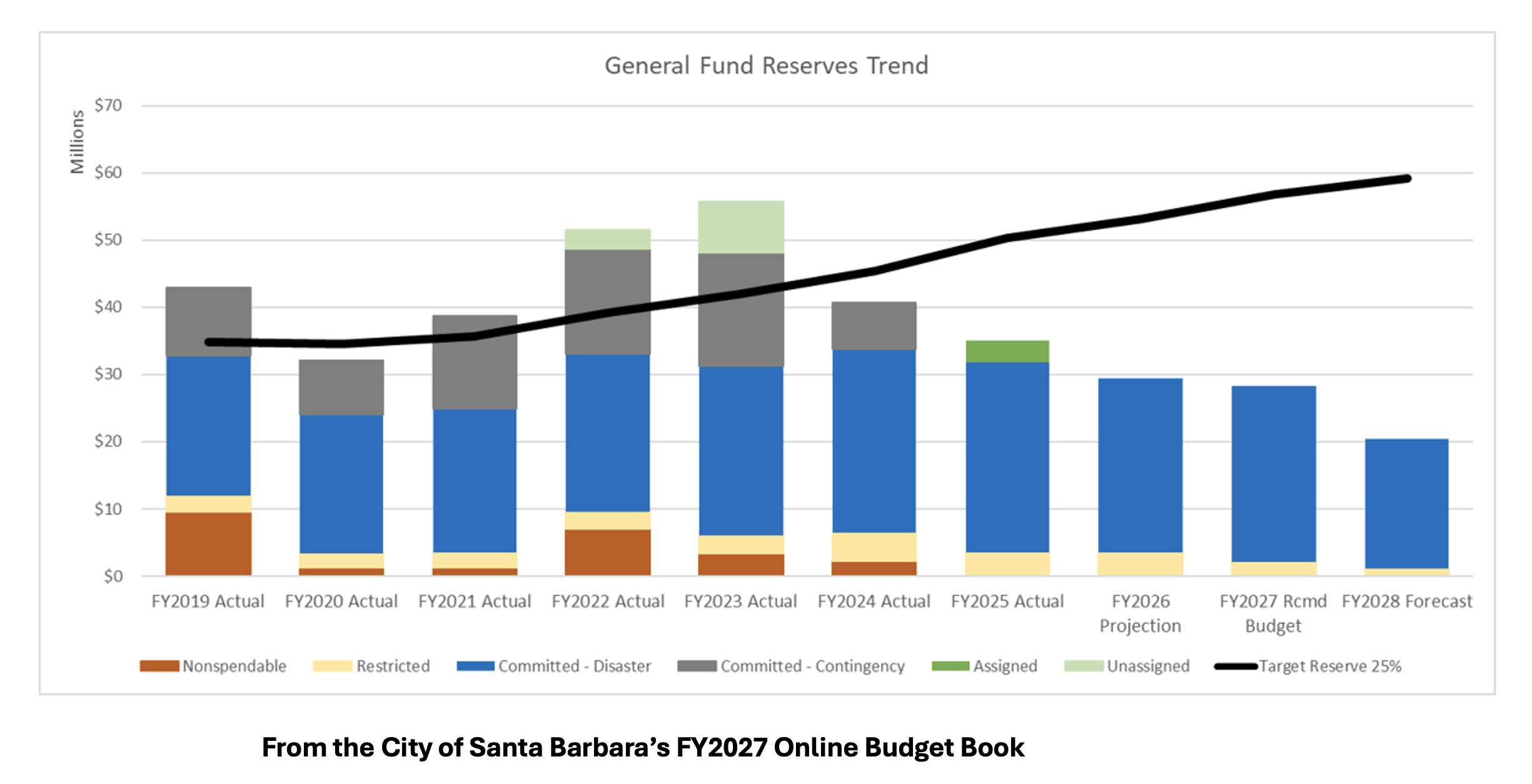
The city’s general fund reserve policy states that we should set aside an amount equal to 15 percent of expenditures for disasters and another 10 percent for contingencies (nonemergency but urgent opportunities or needs). Separately, the city also maintains reserves in other funds such as Water, Wastewater, and Airport.
At the end of fiscal year 2023, the city ended with general fund reserves over $42 million, which met our policy. The city also had an additional $8 million in unassigned fund balance. At the end of fiscal year 2026, we ended the year with reserves of only $28 million, about half our stated policy, and no additional unassigned fund balance. We went from $50 million in the bank to $28 million.
In just three years, three years without a recession or other financial calamity and with a sales tax increase, we spent $22 million more than we made. And if you consider that we should have added to our reserves during those relatively good economic times, we probably spent closer to $25 million more than we should have. By the end of the current fiscal year we will have overspent by $30 million. That’s a lot. Wonder why.
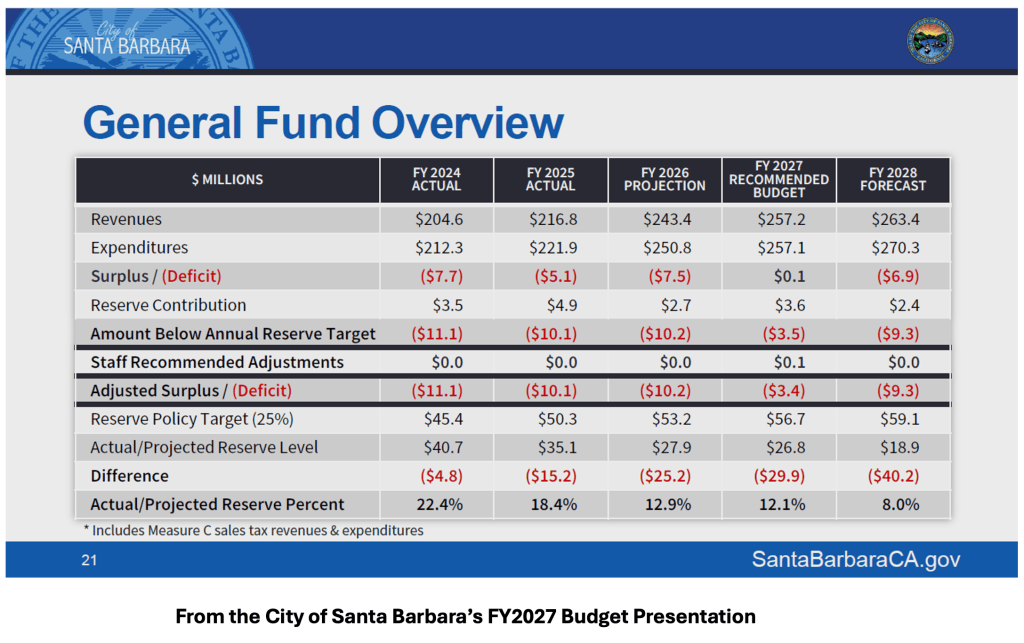
I’ve seen explanations that include inflation, employee benefit increases, and other pretty predictable factors. Some on the council have cited inaccurate financial reports as one of the reasons, and I agree there have been plenty of those. It is easy to find city financial reports on the web today that do not agree with each other. Budget presentations that don’t tie to prior years’ audited financials. General fund reports that sometimes include Measure C funds and others that don’t. All of that is troubling, but not a reason to overspend by $30 million.
Other times we hear that it is additional priorities that got us into trouble — and you must agree there as well. But spending a million or so of reserves for a State Street Master Plan doesn’t really explain it. And transferring $5 million from reserves to the local housing trust fund doesn’t fully explain it either.
Looking forward, we spent countless hours creating a complex rent control ordinance with the hopes of later funding a sizable bureaucracy to monitor 15,000 rentals and their corresponding rental agreements. That’ll be expensive. All these things add up.
Remember during this period, the voters of the city approved Measure I, a sales tax increase, to shore up city finances and provide funds for a limited number of new initiatives. It was here, I think, where we really took our eye off the ball. It seems, after a tax increase that generates about $15 million in new revenue annually, we still have the roughly same deficit. That hurts.
Accompanying all of this is a misunderstanding that seems prevalent — it is how reserves are accumulated and saved. Some of that is driven by the way they are reported and presented.
Reserves are a subdivision of net assets or fund balance (spendable and not restricted) left over in the general fund at year-end. Increasing reserves is not remotely like an expenditure, though numerous reports seem to link them together. They are in fact the opposite. Budgeting to add to reserves is an intention not to spend. It requires not only budgeting an operating surplus but actually achieving it.
Put simply, you don’t spend or use funds during the year to increase reserves. You cannot earmark funds during the year and assign those funds mid-year to reserves.
Putting money aside in the general fund is not like depositing money into your 401(k) or your personal savings account. It’s not. That money stays in the general fund and will be used if needed no matter what the intention or plan.
The pickle we’re in today is that we need to achieve a general fund surplus of $4 million or $5 million every year and that should build our reserves back over the next decade or so. That’s a tall order.
It’s an uncertain world out there. We need to be prepared to handle what comes next with an adequate reserve balance. We need leaders like Dr. Dan who make sure they understand the implications of what they do before they act.


You must be logged in to post a comment.