

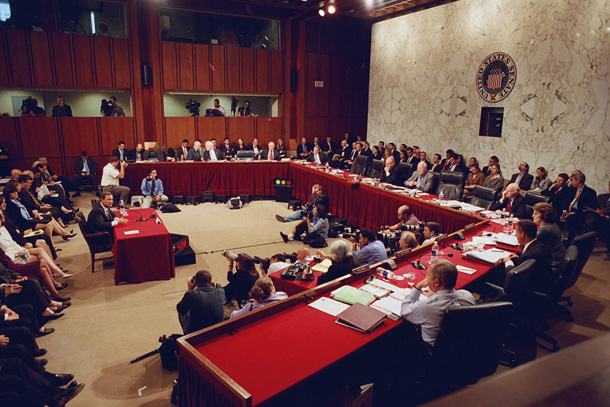
The practice of Supreme Court nominees declining to say how they would rule on issues that might come before the court is known as the Ginsburg standard. At her 1993 SCOTUS confirmation hearing, Justice Ruth Bader Ginsburg said she would give “no hints, no forecasts, no previews.” Nominees since then have often cited it when being asked probing confirmation questions by senators from the other political party. In the past, of course, the hottest probing question topic was about overturning Roe v. Wade. In the future it could be about the 2010 Citizens United v. Federal Elections Commission case that allows unlimited wealthy political donations.
A nationwide Santa Barbara standard could improve on the Ginsburg standard by elevating judges and justices to an even more nonpartisan posture. Specifically, and simply, several Santa Barbara Superior Court judges have (1) re-registered to vote and (2) done so without stating a political party preference. Basically, the judges, for the voting record, rid themselves of political party affiliation. This could be the Santa Barbara standard.
Imagine if all new judges statewide and eventually nationwide did this same thing. Then, of course, over the years, the day would come and then persist that SCOTUS nominees could both say and prove they acted neutral by citing the Santa Barbara standard. The nominees would have long since stopped publicly being identified as declared partisan voters everywhere but Alabama, where declaring party affiliation is not an option. Such a consistent approach to nonpartisanship could only help the public image of the nation’s courts.
This proposed standard will no doubt be criticized as naive, unrealistic, and unattainable by bona fide political experts. The primary reason for that is obvious — belonging to the party in power can be good for a judge’s career. Making partisan appointments and nominees can on its face be good for encouraging partisan outcomes.
Presidents overwhelmingly pick judges from their own party. One summary of political scientists Lee Epstein and Jeffrey Segal’s data says that 3,082 judicial appointments were made from 1870-2005, and 92.5 percent were from the appointing president’s party.
The most nonpartisan governor on this topic was Arnold Schwarzenegger. His office reported 285 Republicans, 234 Democrats, and 50 who declined to state a party. That’s about 50 percent Republican, so he was far more bipartisan than most presidents and fellow governors. Note well there are judges dotted throughout the state who do decline to state a party.
Obviously, same-party appointments do not mean all judges or any judge in particular rules along party lines. In fact, analysts have found Trump losing district court cases at similar rates before liberal and conservative judges, around 84 percent and 82 percent. Other studies find party affiliation of the appointing president does predict outcomes in some case types, so the evidence is mixed.
This essay is not meant to be definitive on the statistics. But everyone knows what’s going on. The lower the rank of the judge, the easier it is for the judge to freely eschew the trappings of party affiliation. The higher you go on the judge food chain, being more partisan can be seen as a feather in one’s cap.
As noted above the current president loses often in the trial courts, but data shows the administration wins often at the Supreme Court. So, the higher you go the easier it is for the public to ascribe partisan motivations to courts.
For these reasons, after getting elected as a Santa Barbara County Superior Court judge, I did in fact re-register to vote using the “declined to state” option. I think it is a simple but powerful allegiance to nonpartisanship each time I learn from one of my colleagues that they have done the same.
Perhaps I am just a dreamer. Or maybe, just maybe, as the next SCOTUS confirmation hearings are conducted, a senator might ask the nominee the hard question. The hard question will be about the Santa Barbara standard. The question would go something like this: “Honorable nominee, who has worked for years in the nonpartisan field of judging, would you be willing to re-register to vote without declaring party affiliation before you are confirmed?” May God bless America and may God bless her judges.
James F. Rigali is a judge of the Santa Barbara County Superior Court.

