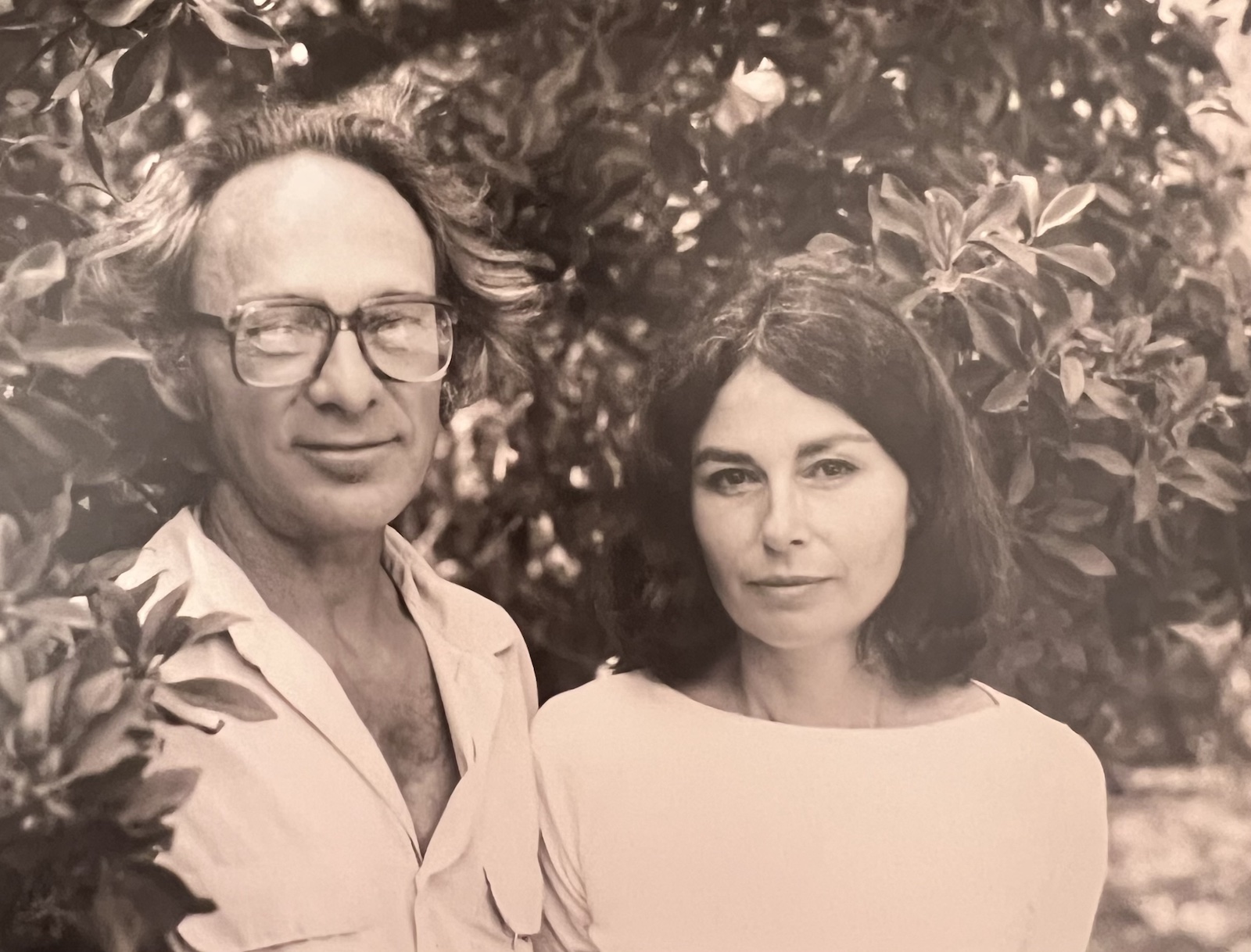
It’s funny to remember that Max was a public figure. He never called attention to himself, but he was to me and many Santa Barbarans a recognizable character.
“Who’s that guy — is he a writer?” a local asked me as Max and I waved to each other from across State Street. “He must be.”
“Why?” I smiled.
“Because every time I see him, he’s writing — or even reading a book!”
As quiet as he was and as guarded as I was, I don’t think any man ever knew me as well as Max did. As an undergraduate I was his student at UCSB’s College of Creative Studies, where he taught literature and writing courses for more than 30 years. He introduced and revealed Chaucer and Sophocles to me and to hundreds of other students. In his Narrative Prose course, which he allowed me to attend after I graduated, he encouraged my writing of fiction. For about 40 years, Max read anything I wrote and always gave me straight assessments and precisely directed advice.
In my early twenties, we became friends. He and his wife, Elaine, often hosted casual but elaborately prepared dinners (cooked solely by her) at their house, or they’d invite me and others to meet them at restaurants, their favorite for a couple of decades being the Rose Café on the Mesa. But their house was my favorite venue. They made me and their other friends feel at home. I was more at home at their home at 1802 Olive Avenue than I’ve ever felt anywhere but home. I loved Max and Elaine. They saw me stumble through graduate school and romances and break-ups and finally were practically the foster godparents of the relationship between me and the woman I married. I was, by the way, working at the Independent then, where one of my duties (and pleasures) was editing in 1991-92 Max’s biweekly column, A Writer’s Notebook.
He had routines of writing in coffee shops downtown and at UCSB and at the downtown library. He read widely in fiction and biography. His unargumentative assessments of authors and books were careful, candid, and brilliant. His own fiction he revised and revised, sometimes crossing out page after page. He was attempting not fine writing (though it always was) but to try to see deeper and clearer into the images and moments that his imagination showed him. He sometimes jettisoned what seemed gold to me — I was reading his work almost as frequently as he read mine. While he was selecting stories, essays, and diaries for Keeping Warm (2004), he told me he was throwing out almost all of his rejected manuscripts, but I objected and, thank goodness, he saved me some.
My wife and I moved to New York City, but we visited Max and Elaine nearly every year and spent parts of two of my sabbaticals at UCSB, mainly because Max and Elaine were still living here. My wife and I named our first child after Max. About a dozen years ago, Max was diagnosed with Parkinson’s (though his daughter Anna believes it may have been a misdiagnosis for Lewy Body Dementia), but he continued reading insatiably. During the pandemic, I wrote to him nearly every day and for two years after, we spoke once or twice a week on the phone while I composed his biography. (He named me his literary executor in 1996.) In the midst of writing that biography, I read his unpublished manuscripts; among them was a handwritten novel about Ralph Camarillo, the cowboy who taught the adolescent Max how to train horses and compete professionally in rodeos. Max had written it after his diagnosis. Ralph is about both Max’s struggle to remember and thereby, through his visions of memories, create fiction. It seems to me an extraordinary work (excerpts of which the Independent published last year).
For years, if I was downtown between 10 and 3, and it wasn’t one of his teaching days, I anticipated that if I wandered the few blocks from Victoria Court to Carrillo and glanced in at the coffee shops or went into the library that I might see Max, and, if he invited me, which he usually did, I would sit down and talk. I opened up to him as I opened up to almost no one else, and as he intently listened to my ridiculous problems, if I was lucky, he’d laugh. He let us, his many friends, lean on him. I don’t know what we gave him in return, but I do know we adored this generous, kindly, modest man, who also just happened to be a marvelous writer.