
Could Oak Trees Help Block Fires?
Botanic Garden Studying Their Potential as
Native, Living Fuel Breaks
By Callie Fausey | July 17, 2025
Read more of our Fire Resiliency feature here.
Firefighters may have an unlikely ally: trees.
Anecdotal evidence has long shown that oak trees can act as a line of defense against spreading blazes. Now, the Santa Barbara Botanic Garden is trying to prove that native oaks can be used for fuel breaks, or defensible space, right in our backyard.
Typically, fuel breaks entail stripping land of all vegetation to stop flames in their tracks. It’s a popular fire mitigation technique used across the state, including in Los Padres National Forest and throughout Santa Barbara County.
But while fuel breaks are considered essential for fire preparedness, clear-cutting is a controversial method. It does have its benefits — it’s simple and relatively cheap — but environmentalists often cringe at the thought of completely removing native vegetation, which can harm biodiversity, destabilize slopes, and counterproductively offer up real estate to invasive species that often burn more readily.
The Botanic Garden is positing that fuel breaks do not need to be so, well, bald. Instead, it argues, oak trees — many of which retain moisture throughout the year — can provide a natural barrier. Not only are oaks less flammable, but they also provide habitat, block ember-spreading winds, stabilize slopes, add nutrients to the soil, and excel in resprouting after fires.
“When you start a fire, you start with fine, dry fuels — fine grasses that ignite easily,” explained Dr. Denise Knapp, the garden’s director of conservation and research. “Oaks are the opposite.”

Knapp said that oaks are their own microclimate, maintaining moisture in their bark and leaves and providing shade underneath their canopies that starves weeds. “Scientists and firefighters have long observed that oaks are not as easily ignitable — they’re not like those fine, dry fuels,” she noted.
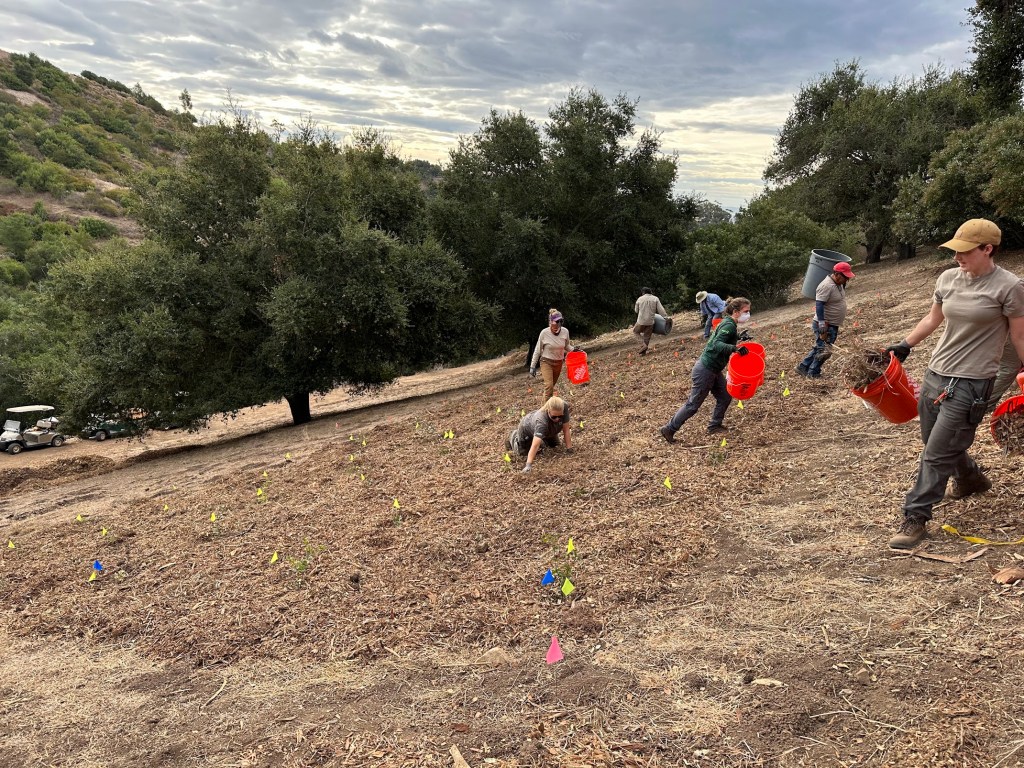
With funding from the Santa Barbara Regional Wildfire Mitigation Program, Botanic Garden staff and volunteers planted 216 coast live oak saplings on a hot, sunny, and steep slope on the eastern side of the garden in 2022. Since then, they’ve been monitoring their growth and studying whether a shaded oak grove could be an effective, and replicable, fuel break.
Scientists collect temperature, humidity, soil moisture, and wind data — important variables for wildfire — from the oak grove and compare it to other areas in the garden. They’re also tracking survival and growth rates, including irrigation volume and seedling age.
“We planted in three different plots, and [survival rates] depended on which plot — as high as 60 percent and as low as 26 percent, largely due to gopher predation,” Knapp said. “We replanted with gopher cages.”
The goal is for the trees to grow up and provide a living wildfire buffer for the Garden and the surrounding community, she explained. The garden is considered part of the urban-wildland interface — where wild areas meet urban communities — which are at higher risk of igniting and harming nearby residents.
“Everyone wants to protect their homes from fires, but we also want to take care of the environment,” she explained. “Oaks are rock stars for providing habitat for all types of things, from bugs to birds.”
One drawback, however, is that oaks are slow-growing, and require some maintenance. Growth rates depend on how “happy” the trees are, and what you consider fully grown, Knapp said. But on average, it can take about 20 years for them to establish their own micro-environment.
“But they’re workhorses,” she said. “They’re worth the wait.”
The oak fuel break experiment is just one of the ways the garden is researching how we can live with fire, including post-fire research and developing a list of fire-wise native plants. People are encouraged to visit the garden to learn more about these initiatives and can even watch the young oak trees grow up along the garden’s new Tipton Trail.





You must be logged in to post a comment.