

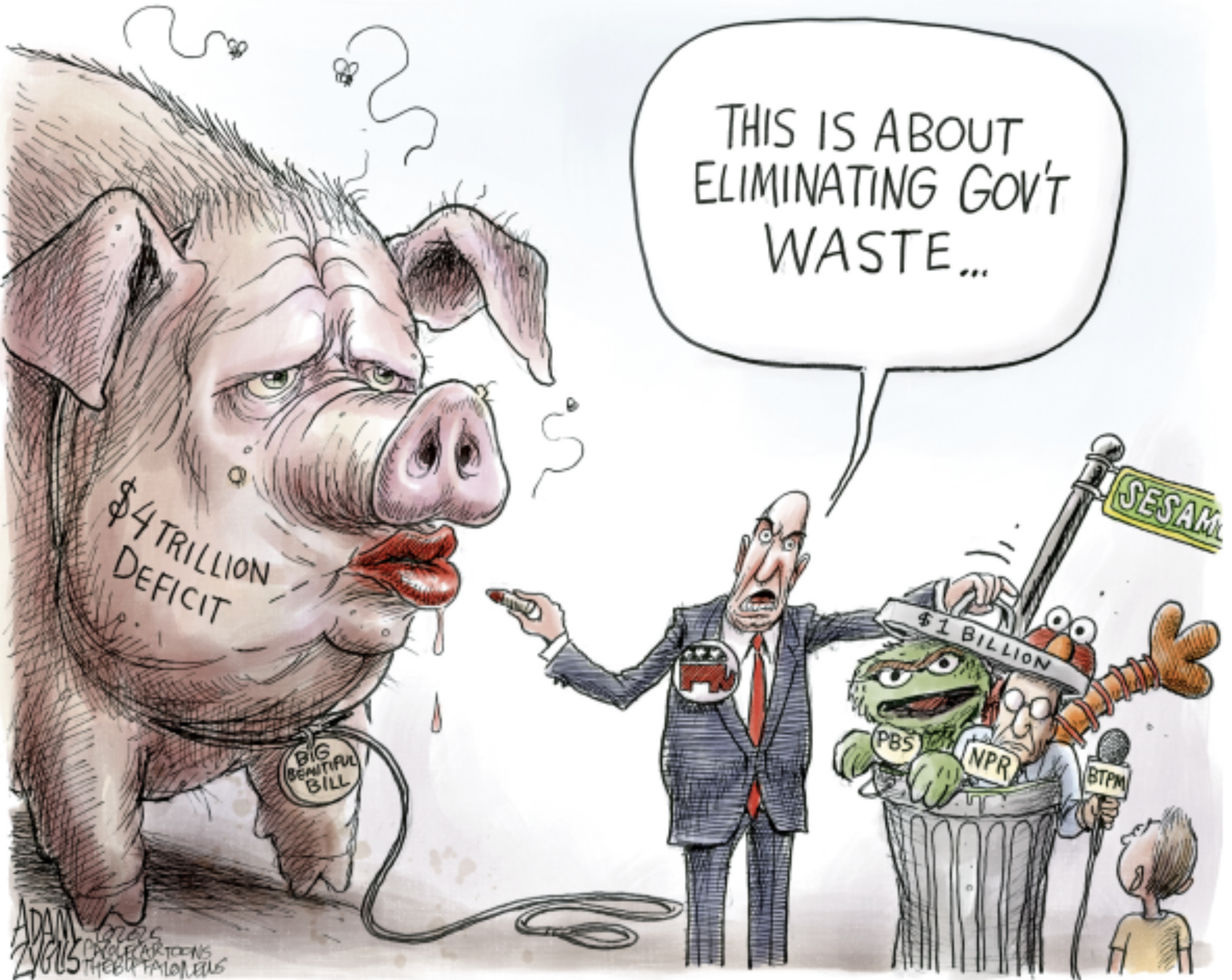
Fear is no longer just as an emotion — like the very real catastrophic flash floods that have claimed more than 100 lives in Texas, thus far — it’s become a political strategy, a cultural weapon, and a corrosive force reshaping the American soul. It spreads like a fever, distorting reason, choking compassion, and settling deep into the places where truth and trust once lived: our government, our classrooms, and the broadcasts that once aimed to inform, not inflame.
We see the symptoms plainly.
In June, Congress slashed funding for NPR and PBS — institutions that don’t shout, don’t rage, don’t follow trends. They inform. They educate. They connect. The rescissions bill cut more than a billion dollars from the Corporation for Public Broadcasting, placing hundreds of rural stations at risk.
At the Department of Education, a slow dismantling is underway — not because the institution failed, but because it succeeded in enforcing civil rights, aiding students, and upholding equal access to learning.
This isn’t merely about bureaucracies and budget lines. It’s about a mindset: a mindset America has seen before.
In the 1950s, it was communists. Today, it’s books. Teachers. Journalists. Public servants. Back then, Senator Joseph R. McCarthy used suspicion as a weapon. Lives were destroyed. Loyalty questioned by rumor. And when Edward R. Murrow finally confronted the madness, he reminded us: “We must not confuse dissent with disloyalty.”
That warning echoes louder than ever.
On March 20, Donald Trump signed an Executive Order directing the Secretary of Education to begin closing the department altogether. The language was bureaucratic. The intent was clear: eliminate the federal commitment to equal opportunity in education. Strip away oversight. Return control to states — many of which are already rewriting curriculums, banning books, and threatening educators.
We’ve seen what fear looks like when given legal authority.
In 1942, it wore the mask of national security. Franklin Roosevelt — over the objections of his wife, Eleanor — signed Executive Order 9066. More than 100,000 Japanese Americans were forcibly relocated. No trial. No evidence. Only ancestry.
Fear did that. Not justice. Fear.
Once again, the fever is back.
What happens when Ken Burns is labeled “divisive” for telling the truth about slavery, the Civil War, or Vietnam? What happens when a teacher, like John Scopes in 1925, is punished for teaching science instead of scripture?
Before a jury, Clarence Darrow said it best: “Ignorance and fanaticism is ever busy and needs feeding.” In his closing argument, he thundered: “Scopes isn’t on trial; civilization is on trial. The right to think is very much on trial.”
That trial never ended.
It’s up to us to make the case — for knowledge, for decency, for truth. And yes, it takes more than slogans. It takes civic courage.
Support public institutions that reflect our better values. Subscribe to your PBS station. Speak up for your local library. Write to your representatives and ask — plainly and persistently — to fight for a country that’s smarter, kinder, and more just — and to fight against those who would make it smaller, meaner, and less informed.
Stand with teachers, with librarians, with students. When a book is banned, read it. When a history lesson is censored, teach it. When a public servant is threatened for doing their job, defend them.
Vote. Not just in presidential elections, but for the school board down the street and the city council around the corner. That’s where this battle is being fought.
We confront fear not by shouting louder, but by standing taller. With reason. With decency. With courage.
Fear thrives in the shadows. Democracy doesn’t.
And if we want to heal the fever, we must do what’s hardest and most necessary: Get uncomfortable. Because truth demands it.
And the right to think—still, always—is on trial.
Jim Lichtman has written and spoken on ethics for more than 30 years. His latest book, “Trust and Confidence: Inside the Battle Between the Secret Service and Ken Starr,” won the 2023 American Writing Award for U.S. History. He publishes weekly commentaries at ItsEthicsStupid.com.

